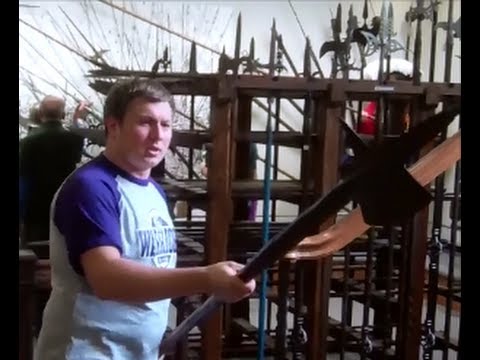
The Length of the Pollaxe and Halberd
0
Standard Halberd-Pollaxe·themantheycallPibb
Just some of my findings on the pollaxe and halberd with some neat handling of the real thing. Video on haft shape - htt…
Translation: standard halberd-pollaxe
The Standard Halberd-Pollaxe subfamily covers the fundamental techniques of European hafted polearm combat as described in the historical fight books: guards (posta), strikes with both the axe head and the butt spike (queue), thrusts, half-staffing grip changes, and the hooking and tripping techniques that exploit the weapon's complex head geometry. [1] Standard technique emphasises the versatility of the pollaxe — the weapon can strike with the axe edge, the hammer face, the top spike, and the butt spike, each requiring different grip positions and body mechanics. [1],[2] The half-staff grip (hands spread apart near the middle of the shaft) allows the fighter to use both ends of the weapon rapidly, creating a constantly shifting offensive threat. [2],[3]
Standard pollaxe technique is reconstructed primarily from the detailed instructions in Fiore dei Liberi's Fior di Battaglia and Le Jeu de la Hache, two of the most important historical sources for European polearm combat. [1] HEMA practitioners and scholars continue to refine the interpretation of these medieval texts through practice and competition. [2],[3]
The standard halberd/pollaxe is a versatile polearm capable of cutting, thrusting, hooking, and bludgeoning. [1]
Halberd and pollaxe fighting was a key component of medieval armoured combat, documented in numerous Fechtbücher. [1]
Halberd/pollaxe combat is competed at HEMA events featuring polearm divisions. [1]
No images yet for this technique.
Sign in to suggest an image.
Just some of my findings on the pollaxe and halberd with some neat handling of the real thing. Video on haft shape - htt…
No instructional courses yet for this technique.
Sign in to suggest a course.
Risk of injury to the person this technique is applied to
Spears, halberds, and naginata; maximum reach with lethal cutting/thrusting capability
Skill level needed to execute this technique reliably
Whether this technique is allowed under major competition rule sets
The Art of Combat (Joachim Meyer, 1570)
Alias sources — [1] Fiore dei Liberi's Fior di Battaglia (1409) [2] The Medieval Art of Swordsmanship (Tobler, 2010) [3] The Medieval Art of Swordsmanship (Tobler, 2010)
Effectiveness sources — [1] The Martial Arts of Renaissance Europe (Anglo, 2000)
Standard katakana transliteration of Western martial arts terminology (外来語) — used in Japanese MMA, boxing, and BJJ communities
Alias sources — [1] Fiore dei Liberi's Fior di Battaglia (1409) [2] The Medieval Art of Swordsmanship (Tobler, 2010) [3] The Medieval Art of Swordsmanship (Tobler, 2010)
Effectiveness sources — [1] The Martial Arts of Renaissance Europe (Anglo, 2000)
wrist snap speed, sliding grip coordination, hip rotation
long reach and strong wrists for staff manipulation
forearms, wrist rotators, core rotators, shoulders
Every move, in any martial art, shares a few universal traits. Mix and match below to pinpoint the right tool — or compare equivalents across styles.
According to historical manuals and museum examples, a pollaxe used in historical martial arts should be approximately six to seven feet long, depending on the user's height, to match what is documented in the surviving manuals and historical artifacts.
A shorter pollaxe restricts the range of techniques you can execute; for example, choking techniques that are possible with a longer weapon become unavailable, significantly limiting your technical repertoire.
The Standard Halberd-Pollaxe subfamily covers the fundamental techniques of European hafted polearm combat as described in the historical fight books: guards (posta), strikes with both the axe head and the butt spike (queue), thrusts, half-staffing grip changes, and the hooking and tripping techniques that exploit the weapon's complex head geometry. Standard technique emphasises the versatility of the pollaxe — the weapon can strike with the axe edge, the hammer face, the top spike, and the butt spike, each requiring different grip positions and body mechanics.
Standard pollaxe technique is reconstructed primarily from the detailed instructions in Fiore dei Liberi's Fior di Battaglia and Le Jeu de la Hache, two of the most important historical sources for European polearm combat. HEMA practitioners and scholars continue to refine the interpretation of these medieval texts through practice and competition.
Traditional martial arts: legal — Practiced in traditional kata/forms and weapon-specific competition under var…; IWUF: legal — Legal in wushu taolu if applicable; HEMA: legal — Legal in applicable historical weapon categories
Danger rating 9/10. Extreme — spears, halberds, and naginata; maximum reach with lethal cutting/thrusting capability
The standard setup chain: Grip and Stance → Chamber → Strike → Recovery.
Standard counters include: Beat Parry — deflect the blade with a sharp lateral beat before it reaches target / Displacement — move the body off the line while threatening with the point / Counter-Thrust — extend into the attacker's line during their advance.
Common variants: Overhead strike (bringing the staff down from above in a vertical arc); Lateral strike (horizontal sweep targeting the ribs or head); Thrust (straight thrust with the end of the staff); Butt-end strike (striking with the rear end of the staff at close range).
Halberd/pollaxe combat is competed at HEMA events featuring polearm divisions.
Top errors to watch for: Using only the axe blade — the hammer, spikes, hooks, and queue are all primary tools; limiting to the blade wastes t… / Not using the half-staff grip — the standard grip allows the most versatile weapon manipulation / Fighting at the wrong distance — pollaxe operates at a medium range, closer than spear but further than dagger / Ignoring thrusts — the top spike thrust is the most effective technique against armour; don't rely on cuts.
The Standard Halberd-Pollaxe is also known as Sutandādo Harubādo / Pōruakkusu, Pollaxe Combat, Azza Technique, Halberd Fighting.