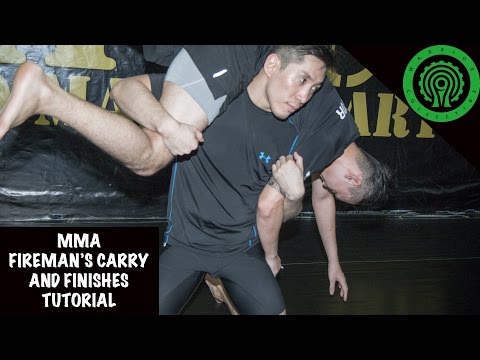
MMA Fireman's Carry and Finishes Tutorial
0
Standard Fireman Carry Technique·Stuart Tomlinson·Added by Admin
Royston Wee, UFC Vet, Pro MMA fighter and coach at Impact Mixed Martial Arts in Singapore is here filmed by the Warrior …
Translation: standard fireman's carry technique
Standard Fireman's Carry Technique is the textbook execution in which the wrestler secures a collar tie and wrist control, drops to both knees while threading the arm between the opponent's legs to grip the far thigh, pulls the controlled arm across the shoulders, and explosively stands and rotates to send the opponent over the shoulders and onto the mat. [1],[2] The throw requires coordinated timing between the level change, arm threading, and rotational finish. [2],[3]
The fireman's carry is one of the highest-percentage throws in freestyle wrestling, combining a deep level change with a rotational finish that reliably exposes the opponent's back. [1] Its effectiveness stems from the low entry angle, which makes it difficult for the opponent to sprawl effectively, and the strong shoulder contact that controls the opponent throughout the throw. [2]
The fireman's carry is one of the most commonly scored throws in freestyle wrestling at UWW World Championships and Olympic Games, particularly in the lighter weight categories where speed and agility enable the deep level-change entry. [1]
No images yet for this technique.
Sign in to suggest an image.
Royston Wee, UFC Vet, Pro MMA fighter and coach at Impact Mixed Martial Arts in Singapore is here filmed by the Warrior …
No instructional courses yet for this technique.
Sign in to suggest a course.
Risk of injury to the person this technique is applied to
Kata-Guruma; shoulder carry to throw; moderate landing impact
Skill level needed to execute this technique reliably
Whether this technique is allowed under major competition rule sets
Japanese amateur wrestling terminology
Japanese amateur wrestling terminology
Standard katakana transliteration of Western martial arts terminology (外来語) — used in Japanese MMA, boxing, and BJJ communities
Standard katakana transliteration used in Japanese wrestling (レスリング)
explosive turning speed, arm pulling power, deep level change
shorter stature for getting under the opponent, strong back
deltoids, trapezius, quadriceps, core
Stuart Tomlinson emphasizes bringing your leg to their arm and ensuring their arm is across their body, then squeezing and pulling their head down to maintain control during the entry.
If they don't turn, you can transition to a triangle by locking their arm tight across their face, then squeezing and pushing up while pulling their head down to finish the submission.
Standard Fireman's Carry Technique is the textbook execution in which the wrestler secures a collar tie and wrist control, drops to both knees while threading the arm between the opponent's legs to grip the far thigh, pulls the controlled arm across the shoulders, and explosively stands and rotates to send the opponent over the shoulders and onto the mat. The throw requires coordinated timing between the level change, arm threading, and rotational finish.
This fundamental fireman's carry technique has been taught in wrestling rooms worldwide as one of the first throws a beginner learns, owing to its relatively simple mechanics and high success rate.
IJF: banned — Banned since 2010 leg grab prohibition — direct hansoku-make; IBJJF: legal — Legal at all belt levels; UWW: legal — Legal in both freestyle and Greco-Roman; Unified MMA: legal — Legal throwing technique; ADCC: legal — Legal; FIAS Sport Sambo: legal — Legal; FIAS Combat Sambo: legal — Legal
Danger rating 5/10. High — Kata-Guruma; shoulder carry to throw; moderate landing impact
The standard setup chain: Grip Setup (Kumi-kata) → Off-Balance (Kuzushi) → Entry (Tsukuri) → Execution (Kake).
Standard counters include: Lower Centre of Gravity — bend knees and drop hips to make the throw harder to execute / Grip Break — deny the thrower their preferred gripping configuration / Stiff-Arm — maintain distance with straight arms to prevent the entry.
Common variants: Morote seoi nage (two-handed shoulder throw with both hands gripping); Ippon seoi nage (one-arm shoulder throw loading the arm over the shoulder); Drop seoi nage (dropping to the knees for a lower entry point); Korean-style shoulder throw (modified entry with deeper level change).
The fireman's carry is one of the most commonly scored throws in freestyle wrestling at UWW World Championships and Olympic Games, particularly in the lighter weight categories where speed and agility enable the deep level-change entry.
Top errors to watch for: Knee landing outside the opponent's base instead of between their feet — off-centre entry fails / Not threading the arm deep enough — your shoulder must make contact with their hip / Pulling the arm before the opponent is loaded — the sequence is: enter, load, then pull / Staying in the loaded position too long — the opponent grabs your waist and blocks the roll.
The Standard Fireman Carry Technique is also known as Faiyāmanzu Kyarī, Classical Fireman's Carry, Standard Shoulder Carry Throw, Basic Fireman's Carry.