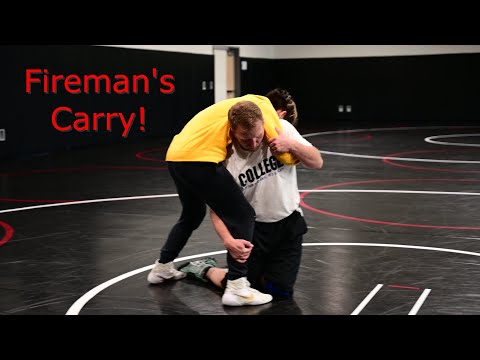
Fireman's Carry!
0
Modified Fireman Carry·Andrew Pickett (North Salem Grappler)
This video covers the basics of the fireman's carry. We believe this is important to learn because it gives wrestlers a…
Translation: modified fireman's carry
Modified Fireman's Carry encompasses variations of the standard fireman's carry throw that alter the entry, grip, or finishing mechanics to adapt to different competitive rulesets or tactical situations. [1],[2] Common modifications include entering from a single-leg position, executing without dropping to the knees, or finishing with a lateral roll rather than a shoulder wheel. [2],[3] In modern freestyle wrestling and MMA, modified entries are especially important due to rule changes and the need to avoid exposing the back during the throw. [3]
The modified fireman's carry adapts the technique for situations where the standard entry is defended, using alternative grips or body positions. [1]
Modified fireman's carry techniques developed in competitive wrestling to address defensive improvements. [1]
Modified fireman's carry variants are used in freestyle competition. [1]
No images yet for this technique.
Sign in to suggest an image.
This video covers the basics of the fireman's carry. We believe this is important to learn because it gives wrestlers a…
No instructional courses yet for this technique.
Sign in to suggest a course.
Risk of injury to the person this technique is applied to
Kata-Guruma; shoulder carry to throw; moderate landing impact
Skill level needed to execute this technique reliably
Whether this technique is allowed under major competition rule sets
Japanese amateur wrestling terminology
Japanese amateur wrestling terminology
Mixed Japanese-Western terminology — combines traditional Japanese terms with katakana loanwords
Standard katakana transliteration used in Japanese wrestling (レスリング)
explosive turning speed, arm pulling power, deep level change
shorter stature for getting under the opponent, strong back
deltoids, trapezius, quadriceps, core
Every move, in any martial art, shares a few universal traits. Mix and match below to pinpoint the right tool — or compare equivalents across styles.
From inside tie, pull your finger right on the bicep and reach around to create a nice solid grip for the technique.
Andrew Pickett's favorite setup involves using the poles to get your opponent to step as you fall in, which creates the opportunity to execute the technique.
Pop your opponent's hip and use hip pressure the same way as before; if they sprawl out, push their hip off to complete the technique.
Yes—fake like you're shooting a single leg, and when your opponent pulls their leg back, you can shoot the fireman's carry to the other side.
Modified Fireman's Carry encompasses variations of the standard fireman's carry throw that alter the entry, grip, or finishing mechanics to adapt to different competitive rulesets or tactical situations. Common modifications include entering from a single-leg position, executing without dropping to the knees, or finishing with a lateral roll rather than a shoulder wheel.
Modified fireman's carry techniques evolved as wrestlers adapted the classical shoulder wheel to changing competitive rules, particularly the 2010 judo ban on below-the-waist grabs, which forced judoka to develop no-leg-grab variations.
IJF: banned — Banned since 2010 leg grab prohibition — direct hansoku-make; IBJJF: legal — Legal at all belt levels; UWW: legal — Legal in both freestyle and Greco-Roman; Unified MMA: legal — Legal throwing technique; ADCC: legal — Legal; FIAS Sport Sambo: legal — Legal; FIAS Combat Sambo: legal — Legal
Danger rating 5/10. High — Kata-Guruma; shoulder carry to throw; moderate landing impact
The standard setup chain: Grip Setup (Kumi-kata) → Off-Balance (Kuzushi) → Entry (Tsukuri) → Execution (Kake).
Standard counters include: Lower Centre of Gravity — bend knees and drop hips to make the throw harder to execute / Grip Break — deny the thrower their preferred gripping configuration / Stiff-Arm — maintain distance with straight arms to prevent the entry.
Common variants: Morote seoi nage (two-handed shoulder throw with both hands gripping); Ippon seoi nage (one-arm shoulder throw loading the arm over the shoulder); Drop seoi nage (dropping to the knees for a lower entry point); Korean-style shoulder throw (modified entry with deeper level change).
Modified fireman's carry variants are used in freestyle competition.
Top errors to watch for: Losing the arm control during the modified entry — without gi grips, the arm is harder to secure / Not adapting the level change for the specific modification — each variant requires a different depth / Over-modifying and losing the core mechanics — the load-and-roll must be preserved regardless of entry variation / Not drilling the specific grip alternatives for no-gi (wrist control, two-on-one, overhook).
The Modified Fireman Carry is also known as Henkei Faiyāmanzu Kyarī, Modified Fireman's, Kneeling Fireman's Carry, Short Fireman's Carry.