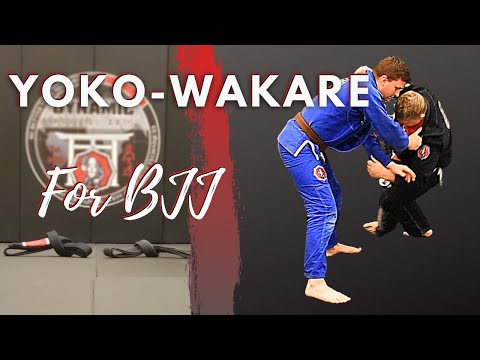
X-Sleeve Yoko-wakare | Takedowns for Jiu-jitsu
0
Standard Yoko Wakare·Takedowns For Jiu-jitsu·Added by Admin
#JudoForJiujitsu #yokowakare In this video, we demonstrate and discuss a cross sleeve grip variation of Yoko-wakare (si…
Translation: side separation
Standard Yoko Wakare is the textbook side separation throw in which tori grips uke conventionally, steps to one side, and drops their body laterally to the mat while pulling uke strongly in the same direction, causing uke to be thrown over tori's dropping body. [1],[2] The throw relies on the contrast between tori's sudden descent and the maintained upward pull on uke's upper body. [2],[3]
Yoko wakare (side separation) is effective as a sacrifice throw that exploits the opponent's forward momentum by dropping to the side and pulling them over. [1]
Yoko wakare is classified in the Kodokan system as a yoko-sutemi-waza technique. [1]
Yoko wakare is occasionally seen in IJF competition. [1]
No images yet for this technique.
Sign in to suggest an image.
#JudoForJiujitsu #yokowakare In this video, we demonstrate and discuss a cross sleeve grip variation of Yoko-wakare (si…
No instructional courses yet for this technique.
Sign in to suggest a course.
Risk of injury to the person this technique is applied to
Yoko-Sutemi-Waza; lateral falling sacrifice; shoulder/rib impact risk
Skill level needed to execute this technique reliably
Whether this technique is allowed under major competition rule sets
Kodokan Judo — Official Nage-waza Classification
Traditional Judo throwing technique terminology (Kodokan Institute)
Official Kodokan ground technique classification system
Standard Japanese martial arts terminology (kanji/hiragana)
Established Japanese martial arts naming convention — native Japanese term (和語/漢語)
Traditional Judo throwing technique terminology (Kodokan Institute)
commitment, timing, body weight manipulation, falling skill
heavier build (body weight drives the throw), good ukemi
core rotators, hip flexors, abdominals
Pull your opponent to create a reaction and get them to step forward. Depending on which foot they step with, you'll have different sweep opportunities available, or if they stay squared up, you can transition to techniques like sumigayishi or other variations.
If your opponent stalls and stays squared up with you instead of stepping, you have multiple follow-up options available beyond the initial sweep, including transitions to other techniques.
Keep a sleeve grip to avoid losing the arm, grab your own wrist, lay down underneath your opponent, and push their arm between their own legs to force a forward roll, then come up to take the back or finish with a kimura.
Standard Yoko Wakare is the textbook side separation throw in which tori grips uke conventionally, steps to one side, and drops their body laterally to the mat while pulling uke strongly in the same direction, causing uke to be thrown over tori's dropping body. The throw relies on the contrast between tori's sudden descent and the maintained upward pull on uke's upper body.
The standard yoko wakare is included in the Kodokan's official throw listing and has been taught as part of the yoko sutemi waza curriculum since the early formalisation of judo.
IJF: legal — Legal throwing technique; IBJJF: legal — Legal at all belt levels; UWW: legal — Legal in both freestyle and Greco-Roman; Unified MMA: legal — Legal throwing technique; ADCC: legal — Legal; FIAS Sport Sambo: legal — Legal; FIAS Combat Sambo: legal — Legal
Danger rating 6/10. High — Yoko-Sutemi-Waza; lateral falling sacrifice; shoulder/rib impact risk
The standard setup chain: Grip Setup (Kumi-kata) → Off-Balance (Kuzushi) → Entry (Tsukuri) → Execution (Kake).
Standard counters include: Lower Centre of Gravity — bend knees and drop hips to make the throw harder to execute / Grip Break — deny the thrower their preferred gripping configuration / Stiff-Arm — maintain distance with straight arms to prevent the entry.
Common variants: Rear sacrifice (falling backward while pulling the opponent over); Side sacrifice (falling to the side to project the opponent laterally); Rolling sacrifice (combining a roll with the sacrifice throw for rotation); Counter sacrifice (using the opponent's forward pressure as the driving force).
Yoko wakare is occasionally seen in IJF competition.
Top errors to watch for: Not establishing a genuine standing throw entry first — uke must be defending something / Falling to the side without extending your body — you ball up and uke steps over you / Releasing the pull when you hit the ground — the pull must continue through uke's fall / Turning in too shallowly — a shallow entry means your body doesn't cross uke's base.
The Standard Yoko Wakare is also known as Yoko Wakare, Classical Side Separation, Standard Lateral Separation Throw.