Soto-Makikomi
0
Soto Makikomi·American Judo
Soto-makikomi is often associated with big, fat guys but it can be used effectively by smaller players, especially if th…
Translation: outer wraparound
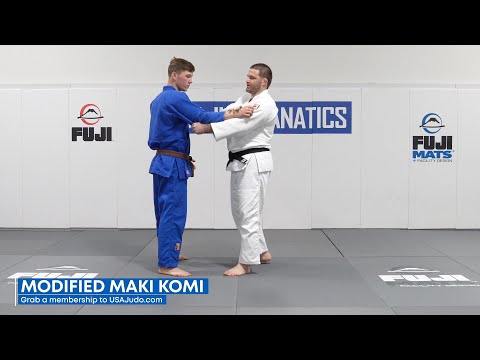
Soto Makikomi is an outer winding throw in which tori wraps their arm over and around uke's arm and upper body from the outside, then drops and rolls laterally to bring uke crashing to the mat. [1],[2] The 'soto' (outer) designation indicates that the wrapping action occurs from the outside of uke's body, distinguishing it from uchi makikomi. [2],[3] Soto makikomi is highly effective from an over-the-shoulder grip and is often used in competition when tori has achieved a dominant gripping position on one side. [3]
Soto makikomi (outer winding throw) winds the opponent around the attacker's body from the outside, using a rolling sacrifice to bring them down. [1]
Soto makikomi is part of the Kodokan judo yoko-sutemi-waza syllabus. [1]
Soto makikomi is scored in IJF competition. [1]
No images yet for this technique.
Sign in to suggest an image.
Soto-makikomi is often associated with big, fat guys but it can be used effectively by smaller players, especially if th…
Mark Gilston, 4th degree judo black belt, discusses and demonstrates various applications of Soto Makikomi (the outer wr…
No instructional courses yet for this technique.
Sign in to suggest a course.
Risk of injury to the person this technique is applied to
Rolling sacrifice adds rotational momentum; uncontrolled landing risk
Skill level needed to execute this technique reliably
Whether this technique is allowed under major competition rule sets
Kodokan Judo — Official Nage-waza Classification
Traditional Judo throwing technique terminology (Kodokan Institute)
Official Kodokan ground technique classification system
Standard Japanese martial arts terminology (kanji/hiragana)
Established Japanese martial arts naming convention — native Japanese term (和語/漢語)
Traditional Judo throwing technique terminology (Kodokan Institute)
explosive turning speed, arm pulling power, deep level change
shorter stature for getting under the opponent, strong back
deltoids, trapezius, quadriceps, core
Every move, in any martial art, shares a few universal traits. Mix and match below to pinpoint the right tool — or compare equivalents across styles.
Get low and get under your opponent so that when they come down, they cannot scramble back to their back before you gain control. Seiryoku Zenyo emphasizes that this positioning prevents them from recovering to a defensive posture.
Keep your arm high and leading—your hand should touch your chin with your armpit up by their shoulder. American Judo stresses that you pull past this position to lock it in tight, then bring your hip through to finish.
Reach over for their hand, pull it, and slide it down—there is a wrist lock available here if your school allows it. Seiryoku Zenyo notes you can also keep the lock tight enough to control them without relying on strength.
Simply move your leg out of their way. Seiryoku Zenyo notes this creates a nice pin position, and in Judo you can transition to Ura Gitani (the rear hold) from here.
Soto Makikomi is an outer winding throw in which tori wraps their arm over and around uke's arm and upper body from the outside, then drops and rolls laterally to bring uke crashing to the mat. The 'soto' (outer) designation indicates that the wrapping action occurs from the outside of uke's body, distinguishing it from uchi makikomi.
Soto makikomi developed as a power variant within Kodokan judo's makikomi family, gaining popularity in international competition where gripping battles often created ideal entry positions for the outer wrap.
IJF: legal — Legal throwing technique; IBJJF: legal — Legal at all belt levels; UWW: legal — Legal in both freestyle and Greco-Roman; Unified MMA: legal — Legal throwing technique; ADCC: legal — Legal; FIAS Sport Sambo: legal — Legal; FIAS Combat Sambo: legal — Legal
Danger rating 6/10. High — rolling sacrifice adds rotational momentum; uncontrolled landing risk
The standard setup chain: Grip Setup (Kumi-kata) → Off-Balance (Kuzushi) → Entry (Tsukuri) → Execution (Kake).
Standard counters include: Lower Centre of Gravity — bend knees and drop hips to make the throw harder to execute / Grip Break — deny the thrower their preferred gripping configuration / Stiff-Arm — maintain distance with straight arms to prevent the entry.
Common variants: Morote seoi nage (two-handed shoulder throw with both hands gripping); Ippon seoi nage (one-arm shoulder throw loading the arm over the shoulder); Drop seoi nage (dropping to the knees for a lower entry point); Korean-style shoulder throw (modified entry with deeper level change).
Soto makikomi is scored in IJF competition.
Top errors to watch for: Overhooking too loosely — the arm wrap must be tight enough that uke cannot pull free / Falling forward without rotating — you need to roll, not just drop / Not maintaining chest-to-chest contact — space allows uke to pull away / Rolling too slowly — the power comes from explosive forward commitment.
The Soto Makikomi is also known as Outer Winding Throw, Outside Wrap-Around, Soto Makikomi, Outer Rolling Throw.