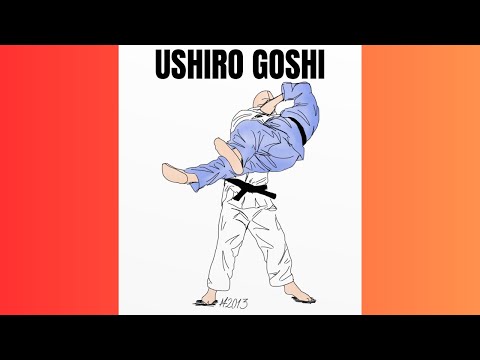
TÉCNICA USHIRO GOSHI
0
Ushiro Goshi·JUDÔ ONTEM E HOJE
O canal Judô ontem e hoje, mostrará técnicas, filosofia da arte, atualizações de técnicas, grandes mestres, contra- ataq…
Translation: rear hip throw
Ushiro Goshi (rear hip throw) is a koshi-waza technique primarily used as a counter-throw, in which the defender blocks the opponent's hip throw attempt, lifts them from behind by wrapping the arms around the waist, and wheels them over the hip in the reverse direction. [1] The technique exploits the moment when an attacker turns in for a hip throw — by blocking the turn, securing a grip around the waist from behind, and using the hip as a fulcrum, the defender can lift and reverse the opponent's own throwing attempt. [1],[2] Ushiro-goshi requires significant strength to lift the opponent and sufficient hip placement to create the wheeling action. [2],[3]
Ushiro goshi is part of the Kodokan judo koshi-waza syllabus, specifically developed as a counter to forward hip throws. [1]
Ushiro goshi is scored in IJF competition as a counter throw. [1]
No images yet for this technique.
Sign in to suggest an image.
O canal Judô ontem e hoje, mostrará técnicas, filosofia da arte, atualizações de técnicas, grandes mestres, contra- ataq…
No instructional courses yet for this technique.
Sign in to suggest a course.
Risk of injury to the person this technique is applied to
Koshi-Guruma uses hip as wheel axis; high rotational force
Skill level needed to execute this technique reliably
Whether this technique is allowed under major competition rule sets
Kodokan Judo — Official Nage-waza Classification
Traditional Judo throwing technique terminology (Kodokan Institute)
Official Kodokan ground technique classification system
Standard Japanese martial arts terminology (kanji/hiragana)
Established Japanese martial arts naming convention — native Japanese term (和語/漢語)
Traditional Judo throwing technique terminology (Kodokan Institute)
hip rotation speed, core strength, lower back stability
strong hips and core, good flexibility for turning entry
hip rotators, core, quadriceps, latissimus dorsi
Every move, in any martial art, shares a few universal traits. Mix and match below to pinpoint the right tool — or compare equivalents across styles.
Ushiro Goshi (rear hip throw) is a koshi-waza technique primarily used as a counter-throw, in which the defender blocks the opponent's hip throw attempt, lifts them from behind by wrapping the arms around the waist, and wheels them over the hip in the reverse direction. The technique exploits the moment when an attacker turns in for a hip throw — by blocking the turn, securing a grip around the waist from behind, and using the hip as a fulcrum, the defender can lift and reverse the opponent's own throwing attempt.
Ushiro goshi was included in the Kodokan gokyo as a koshi-waza technique, valued as one of judo's most effective counter-throws against hip-throw attacks. The technique demonstrates the judo principle of using the opponent's committed attack against them by redirecting the energy.
IJF: legal — Legal throwing technique; IBJJF: legal — Legal at all belt levels; UWW: legal — Legal in both freestyle and Greco-Roman; Unified MMA: legal — Legal throwing technique; ADCC: legal — Legal; FIAS Sport Sambo: legal — Legal; FIAS Combat Sambo: legal — Legal
Danger rating 6/10. High — Koshi-Guruma uses hip as wheel axis; high rotational force
The standard setup chain: Grip Setup (Kumi-kata) → Off-Balance (Kuzushi) → Entry (Tsukuri) → Execution (Kake).
Standard counters include: Lower Centre of Gravity — bend knees and drop hips to make the throw harder to execute / Block the Hip — post hand on the thrower's hip to prevent loading / Step Around — circle away from the throw direction to avoid being loaded / Grip Break — deny the thrower their preferred gripping configuration.
Common variants: Standard hip throw (full turn-in with hip below the opponent's centre of gravity); No-gi hip throw (adapted without gi grips, using overhook and collar tie); Drop hip throw (dropping to one knee to lower the fulcrum point); Combination hip throw (chaining from a failed foot technique or hand technique).
Ushiro goshi is scored in IJF competition as a counter throw.
Top errors to watch for: Trying to lift uke straight up without hip contact — your hip must block theirs first / Arching backward too aggressively — this risks landing uke on their head (dangerous) / Not securing the waist wrap before attempting to lift — uke can slip out / Attempting ushiro goshi when uke has already completed their entry — too late to counter.
The Ushiro Goshi is also known as Rear Hip Throw, Back Hip Throw, Ushiro Goshi, Reverse Hip.