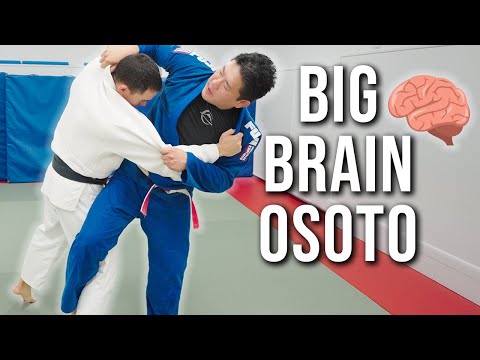
Osoto Gari's Most Important Detail
0
Standard O Soto Gari Trip·Shintaro Higashi·Added by Admin
Osoto gari is a thinker's move. Use this new knowledge to out maneuver your opponents. Check out the Instructionals belo…
Translation: standard major outer reap
The Standard O Soto Gari Trip executes the fundamental major outer reap where the attacker steps beside the opponent, drives their weight backward over the targeted heel with upper body control, and sweeps the loaded leg backward with the full length of the reaping leg. [1] The attacker's reaping leg contacts the back of the opponent's thigh or calf and drives through in a powerful backward sweep while the hands push the opponent's shoulders backward and down. [1],[2] The opponent falls backward over the swept leg, often with significant force due to the long lever arm. [2] The technique requires commitment — the attacker must drive their body weight into the reap while maintaining balance on the supporting leg. [2],[3]
O soto gari is one of the most powerful takedowns in judo because it combines upper-body driving force with a full-length leg reap, generating significant impact force on landing. [1] The technique is effective against opponents who lean backward or shift weight to the rear foot. [1] Its directness and power make it one of the highest ippon-scoring techniques in judo competition. [2] In MMA, the o soto gari trip has been adapted as a clinch-range takedown by fighters with judo backgrounds. [3]
O soto gari is classified in the Kodokan Gokyo no Waza, Dai Ikkyo (first group), and has been a fundamental judo technique since 1882. [1] Masahiko Kimura (7th dan), considered one of the greatest judoka of all time, was known for a devastating o soto gari. [2] The technique is taught in every judo programme worldwide and has been adopted into sambo, wrestling, and MMA. [1]
O soto gari is consistently among the top five most scored techniques at the judo World Championships and Olympic Games. [1] Teddy Riner (France), three-time Olympic gold medallist and 10-time World Champion, has used o soto gari as one of his signature techniques in the heavyweight division. [2] Ronda Rousey adapted o soto gari for her MMA career, using it effectively in UFC competition. [3]
No images yet for this technique.
Sign in to suggest an image.
Osoto gari is a thinker's move. Use this new knowledge to out maneuver your opponents. Check out the Instructionals belo…
No instructional courses yet for this technique.
Sign in to suggest a course.
Risk of injury to the person this technique is applied to
O-Soto-Gari style; backward fall with head impact risk
Skill level needed to execute this technique reliably
Whether this technique is allowed under major competition rule sets
Kodokan Judo — Official Nage-waza Classification
Traditional Judo throwing/takedown terminology (Kodokan Institute)
Official Kodokan ground technique classification system
Standard Japanese martial arts terminology (kanji/hiragana)
Established Japanese martial arts naming convention — native Japanese term (和語/漢語)
Traditional Judo throwing/takedown terminology (Kodokan Institute)
timing, balance, upper body control for push-pull
good coordination and sense of opponent's weight distribution
core stabilisers, hip adductors/abductors, calves
Head control with the lapel hand is the most overlooked detail in o soto gari. Shintaro Higashi emphasizes that while the leg and sleeve hand are important, controlling your opponent's head with the collar hand is the top priority that most people neglect.
If your opponent can turn their head away from you, the technique becomes very difficult to complete. Shintaro Higashi explains that you need the collar hand controlling the head throughout the throw so your opponent cannot escape by lifting their head up and over.
If you're having trouble with o soto gari, focus on what your collar hand is doing and how you're controlling your opponent's head. Shintaro Higashi recommends reviewing video of your technique in slow motion to ensure you're maintaining that head control throughout the throw.
The Standard O Soto Gari Trip executes the fundamental major outer reap where the attacker steps beside the opponent, drives their weight backward over the targeted heel with upper body control, and sweeps the loaded leg backward with the full length of the reaping leg. The attacker's reaping leg contacts the back of the opponent's thigh or calf and drives through in a powerful backward sweep while the hands push the opponent's shoulders backward and down.
Standard o soto gari has been one of judo's most practised and scored techniques since the art's founding, appearing in competition at every level from beginner to Olympic finals. The technique's power and directness have made it a favourite across all grappling disciplines.
IJF: legal — Legal (ashi-waza) — trips executed without grabbing opponent's legs are permi…; IBJJF: legal — Legal at all belt levels, scored as takedown (2 points); UWW: restricted — Legal in freestyle, restricted in Greco-Roman (leg-to-leg contact prohibited); Unified MMA: legal — Legal takedown technique; ADCC: legal — Legal, scored 2-4 points in second half of match; FIAS Sport Sambo: legal — Legal — all takedowns permitted; FIAS Combat Sambo: legal — Legal; NCAA Folkstyle: legal — Legal, scored as takedown (2 points)
Danger rating 5/10. High — O-Soto-Gari style; backward fall with head impact risk
The standard setup chain: Establish Grip → Off-Balance (Kuzushi) → Execute the Reap/Sweep.
Standard counters include: Sprawl — drop hips back and drive weight down to stuff the takedown attempt / Lift the Targeted Leg — raise the foot being attacked to avoid the reap or sweep / Step Over — lift the targeted leg over the sweeping limb to evade / Counter-Throw — use opponent's committed weight shift to execute a counter technique.
Common variants: Standard trip (blocking or sweeping the support leg while driving the up…); Combination trip (chaining an inside trip with an outside trip when the opp…); Counter trip (using the trip as a counter when the opponent attacks); Clinch trip (executing the trip from a tight clinch position).
O soto gari is consistently among the top five most scored techniques at the judo World Championships and Olympic Games. Teddy Riner (France), three-time Olympic gold medallist and 10-time World Champion, has used o soto gari as one of his signature techniques in the heavyweight division.
Top errors to watch for: Approaching with the wrong foot — your lead foot must step beside theirs to create the correct angle / Sweeping with just the foot instead of the full leg — hip-to-ankle contact generates maximum force / Not driving the chest forward during the sweep, so the opponent lands on top of you / Sweeping the leg that isn't bearing weight — useless against a light foot.
The Standard O Soto Gari Trip is also known as O Soto Gari, Standard Major Outer Reap, O Soto Gari Takedown, Power Outside Trip.