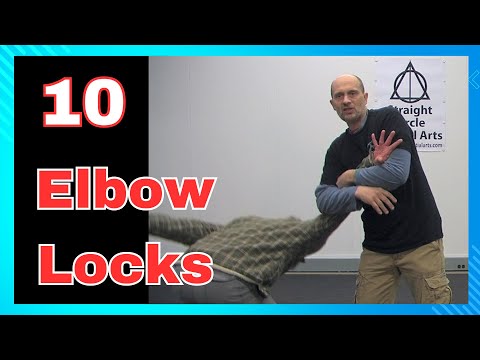
10 Elbow Locks Every Martial Artist Must Know.
0
From Clinch·Straight Circle Martial Arts·Added by Admin
Learn 10 must know elbow locks. Please check out my newest channel. The Karate Man. https://www.youtube.com/@TheKarate…
Translation: from clinch
The Z-lock from clinch is applied during a standing clinch by trapping the opponent's wrist and bending it into a Z-shaped configuration where the forearm, wrist, and hand form angular zigzag segments. [1],[2] The Z-shape is created by applying both flexion and radial or ulnar deviation simultaneously, stressing the wrist ligaments from multiple angles at once. [1] The clinch provides the body-to-body contact needed to trap the arm and apply the compound wrist manipulation before the opponent can retract. [1],[2]
The Z-lock is found in traditional jujutsu and chin na systems that emphasize compound wrist manipulations attacking multiple planes of motion simultaneously. [1],[2] The name refers to the zigzag shape of the wrist when the lock is properly applied. [1] In modern grappling, the Z-lock from clinch is a specialized technique used by practitioners with training in traditional wrist manipulation arts who integrate these methods into their standing game. [1],[2]
Clinch submissions exploit the close-range tie-up to attack with standing guillotines, arm-in chokes, and neck cranks. [1]
Clinch submissions derive from judo standing submissions and catch wrestling. [1]
Standing guillotine chokes from the clinch are among the most common submissions in MMA competition. [1]
No images yet for this technique.
Sign in to suggest an image.
Learn 10 must know elbow locks. Please check out my newest channel. The Karate Man. https://www.youtube.com/@TheKarate…
No instructional courses yet for this technique.
Sign in to suggest a course.
Risk of injury to the person this technique is applied to
Wrist lock variant targeting carpal and radioulnar joints through forced deviation or torsion
Skill level needed to execute this technique reliably
Whether this technique is allowed under major competition rule sets
Japanese BJJ community standard katakana transliteration
Japanese BJJ community standard katakana transliteration
Standard katakana transliteration of Western martial arts terminology (外来語) — used in Japanese MMA, boxing, and BJJ communities
Japanese terminology sourced from Japanese BJJ community standard katakana transliteration
fine motor control, grip sensitivity, quick hand transitions
dexterous hands with strong fingers
forearm flexors and extensors, intrinsic hand muscles
According to Straight Circle Martial Arts, you need to stretch your opponent so their elbow comes completely straight. If the elbow is bent, the lock won't be effective—all the joints must be fully extended to make them weak.
Straight Circle Martial Arts emphasizes that your hip must go in the same direction as your hand. If your hand goes forward while your hip goes a different direction, it won't generate proper pressure.
Straight Circle Martial Arts teaches that you should envision the finish like a punching motion—expanding into the lock rather than just pushing. One hand comes up while the other comes down, and you may apply pressure in two directions (down and then to the side) rather than a simple push.
Straight Circle Martial Arts explains that you should use your neck as one point of support and your arm as a second point of support to lever your opponent down, rather than just pulling. This leverage approach is more effective than relying on arm strength alone.
The Z-lock from clinch is applied during a standing clinch by trapping the opponent's wrist and bending it into a Z-shaped configuration where the forearm, wrist, and hand form angular zigzag segments. The Z-shape is created by applying both flexion and radial or ulnar deviation simultaneously, stressing the wrist ligaments from multiple angles at once.
The Z-lock is found in traditional jujutsu and chin na systems that emphasize compound wrist manipulations attacking multiple planes of motion simultaneously. The name refers to the zigzag shape of the wrist when the lock is properly applied.
IBJJF: legal — Legal at all belt levels; IJF: banned — Only elbow joint locks (kansetsu-waza) permitted in judo — all other joint lo…; ADCC: legal — Legal — all submissions legal in ADCC; Unified MMA: legal — Legal submission technique; FIAS Sport Sambo: legal — Legal; FIAS Combat Sambo: legal — Legal
Danger rating 5/10. Wrist lock variant targeting carpal and radioulnar joints through forced deviation or torsion
The standard setup chain: Establish Position → Create the Threat → Secure the Hold → Finish.
Standard counters include: Early Recognition — identify the submission attempt early and begin defence immediately / Posture and Base — maintain strong posture and base to prevent submission setups / Grip Fight — deny the attacker their preferred gripping configuration.
Common variants: Standard wrist lock (kote gaeshi) (two-handed rotational lock on the wrist); Gooseneck wrist lock (flexion lock bending the wrist down toward the forearm); Standing wrist lock (applied during grip fighting or a standing exchange); Ground wrist lock (catching the opponent's posted hand from mount, side cont…).
Standing guillotine chokes from the clinch are among the most common submissions in MMA competition.
Top errors to watch for: Using pain compliance from clinch without a takedown or transition plan — the pain should create openings for the nex… / Leaning your weight into the opponent without maintaining base — you become vulnerable to counter-throws and trips / Applying trachea pressure in training — throat strikes and pressure are dangerous and should only be simulated lightl… / Using clinch pain compliance as stalling — referees may break the clinch if no technique follows the control.
The From Clinch is also known as Kurinchi kara, Clinch Z-Lock, Standing Z Wrist Lock.