Two Fundamental Takedowns from the Clinch
0
From Clinch·roymarsh jiujitsu
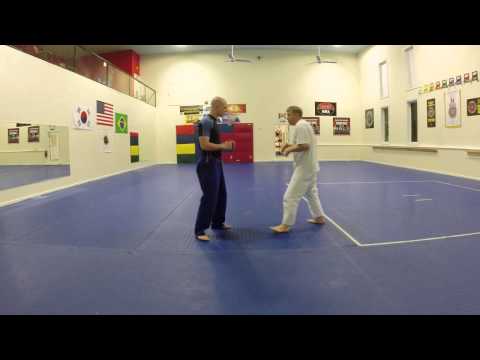
These are two fundamental self defense takedowns from the Clinch
Translation: from clinch
The chin-down wrist lock from clinch is applied during a standing clinch by gripping the opponent's hand and pressing the wrist into flexion while simultaneously driving the bent wrist downward toward the opponent's own chin or chest. [1],[2] The clinch provides the close range needed to trap and manipulate the wrist while preventing the opponent from pulling away. [1] The downward driving force combined with the flexion creates compound stress on the wrist joint's ligaments and tendons, producing intense pain that can force a submission. [1],[2]
Chin-down wrist manipulations from clinch range are documented in traditional jujutsu and aikido as standing joint-control techniques for self-defense. [1],[2] The technique appears in the kote family of wrist locks across multiple Japanese martial arts lineages. [1] In law enforcement training, clinch-range wrist locks are taught as pain-compliant control methods for standing subjects, making this a widely distributed technique across combative traditions. [1],[2]
Clinch submissions exploit the close-range tie-up to attack with standing guillotines, arm-in chokes, and neck cranks. [1]
Clinch submissions derive from judo standing submissions and catch wrestling. [1]
Standing guillotine chokes from the clinch are among the most common submissions in MMA competition. [1]
No images yet for this technique.
Sign in to suggest an image.
These are two fundamental self defense takedowns from the Clinch
No instructional courses yet for this technique.
Sign in to suggest a course.
Risk of injury to the person this technique is applied to
Wrist lock variant targeting carpal and radioulnar joints through forced deviation or torsion
Skill level needed to execute this technique reliably
Whether this technique is allowed under major competition rule sets
Japanese BJJ community standard katakana transliteration
Japanese BJJ community standard katakana transliteration
Standard katakana transliteration of Western martial arts terminology (外来語) — used in Japanese MMA, boxing, and BJJ communities
Japanese terminology sourced from Japanese BJJ community standard katakana transliteration
fine motor control, grip sensitivity, quick hand transitions
dexterous hands with strong fingers
forearm flexors and extensors, intrinsic hand muscles
According to Roy Marsh, you need a complete line of contact from your shoulder down to your hip rather than just points of contact with your hands. A single point of contact is easy for your opponent to break, but a solid body connection glues their hips to you and prevents them from creating space or lifting their leg to knee you.
Roy Marsh emphasizes that once you achieve the clinch, the most important thing is to maintain it—similar to maintaining the mount position in jiu-jitsu. It doesn't matter how good your clinch entries are if your opponent can immediately break out of it.
Roy Marsh recommends positioning yourself three-quarters to the side rather than directly in front or too far to the side. Being slightly in front helps you protect your face, while being too far to the side makes defense harder and doesn't set you up as well for the fundamental takedowns.
Roy Marsh stresses picking the leg up directly in front of the knee rather than from the side or at the knee itself. Lifting from the side allows them to escape, and grabbing at the knee is too heavy and sets you up to be thrown since they can bend their leg.
The chin-down wrist lock from clinch is applied during a standing clinch by gripping the opponent's hand and pressing the wrist into flexion while simultaneously driving the bent wrist downward toward the opponent's own chin or chest. The clinch provides the close range needed to trap and manipulate the wrist while preventing the opponent from pulling away.
Chin-down wrist manipulations from clinch range are documented in traditional jujutsu and aikido as standing joint-control techniques for self-defense. The technique appears in the kote family of wrist locks across multiple Japanese martial arts lineages.
IBJJF: legal — Legal at all belt levels; IJF: banned — Only elbow joint locks (kansetsu-waza) permitted in judo — all other joint lo…; ADCC: legal — Legal — all submissions legal in ADCC; Unified MMA: legal — Legal submission technique; FIAS Sport Sambo: legal — Legal; FIAS Combat Sambo: legal — Legal
Danger rating 5/10. Wrist lock variant targeting carpal and radioulnar joints through forced deviation or torsion
The standard setup chain: Establish Position → Create the Threat → Secure the Hold → Finish.
Standard counters include: Early Recognition — identify the submission attempt early and begin defence immediately / Posture and Base — maintain strong posture and base to prevent submission setups / Grip Fight — deny the attacker their preferred gripping configuration.
Common variants: Standard wrist lock (kote gaeshi) (two-handed rotational lock on the wrist); Gooseneck wrist lock (flexion lock bending the wrist down toward the forearm); Standing wrist lock (applied during grip fighting or a standing exchange); Ground wrist lock (catching the opponent's posted hand from mount, side cont…).
Standing guillotine chokes from the clinch are among the most common submissions in MMA competition.
Top errors to watch for: Using pain compliance from clinch without a takedown or transition plan — the pain should create openings for the nex… / Leaning your weight into the opponent without maintaining base — you become vulnerable to counter-throws and trips / Applying trachea pressure in training — throat strikes and pressure are dangerous and should only be simulated lightl… / Using clinch pain compliance as stalling — referees may break the clinch if no technique follows the control.
The From Clinch is also known as Kurinchi kara, Clinch Chin-Down Wrist Lock, Standing Chin-Down Lock.