From Guard

SubFamily

ガードから(Gādo kara)

Transliteration

Translation: from guard

Overview

Kneebars from guard are applied when the bottom player catches the opponent's leg during passing attempts and transitions to a kneebar position, controlling the thigh and applying hip pressure to hyperextend the knee. [1],[2] Common entries include catching the leg during stack passes, knee-slice passes, and backstep passes. [3]

Also known as
Guard Position Lock[1]Bottom Guard Submission[2]

History & Origin

Guard-based kneebars developed as part of the modern leg lock revolution in BJJ, where bottom players learned to attack the legs during guard passing exchanges. [1],[2],[3]

Effectiveness

Guard submissions exploit the bottom position's hip mobility and leg control to attack with triangles, armlocks, and chokes. [1]

Lineage

Guard-based submissions are a defining feature of BJJ, refined from judo's ne-waza and greatly expanded by Brazilian practitioners. [1]

Competition Record

Guard submissions are the most common finishing position in BJJ competition at all levels. [1]

Images

No images yet for this technique.

Sign in to suggest an image.

Biomechanical Mechanism

Primary ActionHyperextension of the elbow joint — the hips drive upward against the posterior humerus while controlling the wrist
Joints InvolvedElbow (extension beyond normal ROM), wrist (stabilized), shoulder (isolated and controlled)
Force VectorPosterior-to-anterior force on the upper arm with fixed distal anchor at the wrist creates a lever arm across the elbow
Leverage PrincipleHips act as the fulcrum — the longer the lever (full arm extension), the less force needed to hyperextend

Position & Entry

From top half guardStep over the opponent's leg, fall back while hugging the leg, extend the hips to hyperextend the knee
From ashi garamiTransition from heel hook position to kneebar by controlling the leg and extending against the knee
From mount or side control (spin)Spin to the opponent's legs, isolate one leg, fall back into kneebar position

Variants

Standard kneebarhip extension against the front of the knee from belly-down position
Rolling kneebarentering from a scramble or guard pass with a roll
Reverse kneebarapplied from the opposite side for a different entry angle
Calf-crush to kneebartransitioning from calf slicer when the opponent straightens the leg

Videos

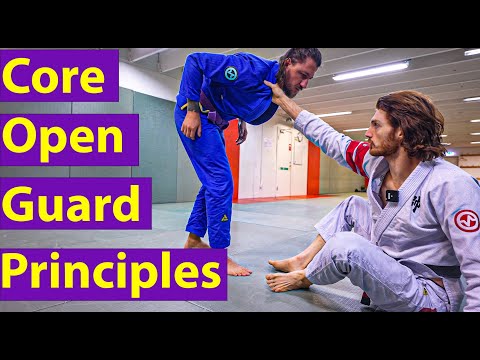
Most Important Guard Principles

0
From Guard·JonThomasBJJ

This video I go through 6 of the most important principles for developing an open guard. Open guard can be very complic

1 video

Learn This Technique

No instructional courses yet for this technique.

Sign in to suggest a course.

Ratings

Danger Rating

Risk of injury to the person this technique is applied to

6
High6/10

Joint locks from guard require control but carry significant injury risk

Difficulty

Skill level needed to execute this technique reliably

Intermediate
Competition Legality

Whether this technique is allowed under major competition rule sets

Legal
IBJJF — Legal at all belt levels
IBJJF Rules Book v6.0, June 2024PDF
ADCC — Legal — all submissions legal in ADCC
ADCC Rules Update, April 2025PDF
Unified MMA — Legal submission technique
Unified Rules of MMA, August 2025PDF
FIAS Sport Sambo — Legal
FIAS International Sambo Competition RulesPDF
FIAS Combat Sambo — Legal
FIAS Combat Sambo RulesPDF

Training Notes

Pain compliance from guard uses the bottom player's legs and arms to create pressure on the opponent's face, neck, and ribs — discouraging posture and creating openings for submissions and sweeps (Danaher, New Wave Jiu Jitsu, 2020)
The cross-face from guard pulls the opponent's head across their centre line using forearm pressure on the jaw — breaking their posture and opening choke and armbar opportunities
Rib compression from closed guard squeezes the opponent's torso with the legs — creating discomfort that forces them to address the squeeze rather than their passing game
The chin strap from guard pulls the opponent's chin to their chest — creating cervical flexion discomfort while setting up chokes and armbars
Guard-based pressure is a tool for controlling posture: the opponent cannot pass guard effectively when their head, ribs, and breathing are compromised
Elbow pressure from guard drives the point of the elbow into the opponent's thigh or ribs during guard recovery — creating space through pain
Bottom-player pressure is often underestimated: effective guard players use continuous low-level pressure to frustrate and exhaust the top player

Common Mistakes

!Relying on guard pressure instead of technique — pressure enhances guard work but doesn't replace sweeps, submissions, and retention
!Squeezing with the legs at full power constantly — constant maximum squeeze exhausts your legs; pulse the pressure for effect
!Using the cross-face without setting up a follow-up — the cross-face creates head movement; exploit it with a choke or transition
!Applying rib pressure without foot position — the feet must be hooked and positioned correctly for the leg squeeze to be effective
!Using pain compliance as a substitute for escaping bad positions — if you're in someone's guard, the goal is to pass, not to inflict pain
!Not combining pressure with submissions — guard pressure should flow directly into submission attempts
!Training guard pressure at maximum intensity — in practice, demonstrate the technique; partners don't benefit from being hurt

Related Techniques

Counter Techniques

Setup Chain

1Establish Positionachieve the controlling position needed for this submission
2Create the Threatbegin the submission setup to force a defensive reaction
3Secure the Holdlock the submission grip with proper body mechanics
4Finishapply increasing pressure until the opponent taps or the joint/choke takes effect

Sources & References

Primary Source

JBJJF competition rules; Yahoo知恵袋; Japanese BJJ community

Japanese Q&A community — BJJ technique name verification

Official Japanese BJJ federation — competition rules and terminology

3OtherJapanese Combat Sports Katakana Convention

Standard katakana transliteration of Western martial arts terminology (外来語) — used in Japanese MMA, boxing, and BJJ communities

4CitationJBJJF competition rules; Yahoo知恵袋; Japanese BJJ community

Japanese terminology sourced from JBJJF competition rules; Yahoo知恵袋; Japanese BJJ community

Community

Athletics

Requires

hip bridge power (same mechanic as armbar), leg control

Favours

strong hip extension, long legs for controlling the opponent

Key muscles

glutes, hip extensors, adductors, quadriceps

Frequently Asked Questions

How should I defend my guard without relying on grips?

You should develop the ability to defend your guard through proper blocking, framing, and good mechanics of retention even when you have no grips. Once you can trust your guard defense without grips, you'll be able to apply grips more effectively when you develop specific guard techniques.

Why shouldn't I put both shoulder blades flat on the mat when defending guard?

Having both shoulder blades on the mat gives you only two points of contact, which makes it hard to spin and move. Keeping at least one shoulder blade lifted makes you much more mobile and allows you to create space more easily.

What does 'alignment' mean in guard, and why does it matter?

Alignment means keeping your feet pointed at your opponent. Proper alignment is crucial because if your feet are pointed the wrong way, you're already in a compromised position that's harder to defend from.

How do I track my opponent's movements while defending guard?

When your opponent's hands are in the air, use their thighs or hips to track their movement. If they grab your pants, control their biceps instead of pushing their legs—this way your feet and their biceps will track together as they move.

How does the From Guard work?

Kneebars from guard are applied when the bottom player catches the opponent's leg during passing attempts and transitions to a kneebar position, controlling the thigh and applying hip pressure to hyperextend the knee. Common entries include catching the leg during stack passes, knee-slice passes, and backstep passes.

Where does the From Guard come from?

Guard-based kneebars developed as part of the modern leg lock revolution in BJJ, where bottom players learned to attack the legs during guard passing exchanges.

Is the From Guard legal in competition?

IBJJF: legal — Legal at all belt levels; IJF: banned — Only elbow joint locks (kansetsu-waza) permitted in judo — all other joint lo…; ADCC: legal — Legal — all submissions legal in ADCC; Unified MMA: legal — Legal submission technique; FIAS Sport Sambo: legal — Legal; FIAS Combat Sambo: legal — Legal

How dangerous is the From Guard?

Danger rating 6/10. High — joint locks from guard require control but carry significant injury risk

How do I set up the From Guard?

The standard setup chain: Establish Position → Create the Threat → Secure the Hold → Finish.

How do I defend against the From Guard?

Standard counters include: Early Recognition — identify the submission attempt early and begin defence immediately / Posture and Base — maintain strong posture and base to prevent submission setups / Grip Fight — deny the attacker their preferred gripping configuration.

What are the variants of the From Guard?

Common variants: Standard kneebar (hip extension against the front of the knee from belly-do…); Rolling kneebar (entering from a scramble or guard pass with a roll); Reverse kneebar (applied from the opposite side for a different entry angle); Calf-crush to kneebar (transitioning from calf slicer when the opponent straight…).

How effective is the From Guard in competition?

Guard submissions are the most common finishing position in BJJ competition at all levels.

What are common mistakes when doing the From Guard?

Top errors to watch for: Relying on guard pressure instead of technique — pressure enhances guard work but doesn't replace sweeps, submissions… / Squeezing with the legs at full power constantly — constant maximum squeeze exhausts your legs; pulse the pressure fo… / Using the cross-face without setting up a follow-up — the cross-face creates head movement; exploit it with a choke o… / Applying rib pressure without foot position — the feet must be hooked and positioned correctly for the leg squeeze to….

What are other names for the From Guard?

The From Guard is also known as Gādo kara, Guard Position Lock, Bottom Guard Submission.