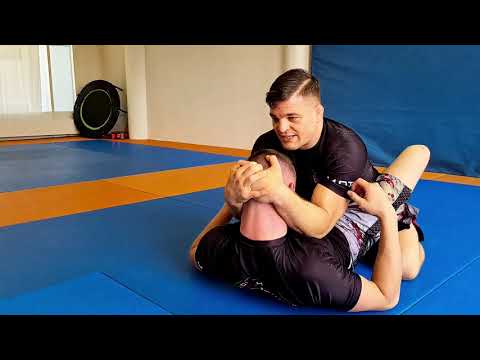
Can Opener - Illegal BJJ Submission Neck Crank from Top Guard advanced Grappling for MMA - CanOpener
0
Stack-Through Can Opener·Peter Mettler Martial Arts
Translation: Can Opener (katakana loanword)
The stack-through can opener combines the traditional can opener neck crank with a stacking guard pass, driving the opponent's knees toward their face while cranking the neck in flexion. [1] From closed guard top position, the attacker clasps the hands behind the opponent's head, pulls it forward and upward, then drives the body forward to stack the opponent onto their shoulders. [1],[2] The stacking motion amplifies the cervical flexion by using the attacker's body weight to compress the opponent's spine from both ends simultaneously — the hands pull the head forward while the torso stacks the legs backward. [2] This dual compression makes the stack-through variant significantly more painful and dangerous than the standard can opener. [2],[3]
The stack-through can opener combination developed in MMA and early BJJ competition where aggressive guard opening methods were common. [1] As guard passing strategy evolved, the stack-through variant became both a guard opener and a neck crank threat that forced the bottom player to release the guard. [2],[3]
Effective guard opener that pressures the cervical spine through stacking and cranking; historically one of the most reliable ways to force open closed guard [1]
An ancient grappling technique present in catch wrestling and judo. The can opener was widely used in early MMA and remains a fundamental tool in wrestling-based grappling [1]
Banned in many IBJJF divisions (illegal neck crank) but legal and commonly used in MMA and some no-gi events. Historically effective at all levels of MMA competition [1]
No images yet for this technique.
Sign in to suggest an image.
No instructional courses yet for this technique.
Sign in to suggest a course.
Risk of injury to the person this technique is applied to
Flexion cranks force the chin toward the chest; compresses anterior cervical structures
Skill level needed to execute this technique reliably
Whether this technique is allowed under major competition rule sets
JBJJF competition rules; Japanese BJJ community
Official Japanese BJJ federation — competition rules and terminology
Standard katakana transliteration of Western martial arts terminology (外来語) — used in Japanese MMA, boxing, and BJJ communities
Japanese terminology sourced from JBJJF competition rules; Japanese BJJ community
grip or squeeze strength, positional control
strong upper body for sustained compression
forearms, biceps, pectorals, core stabilisers
According to Peter Mettler, the can opener was outlawed in BJJ specifically because it is so effective and dangerous—it targets the neck and is a submission that can be applied from top guard, a position where submissions are otherwise limited.
All you need is head control; from there you grab the back of the opponent's head fairly high, lift slightly, and drive your elbow in to apply the crank, as Peter Mettler demonstrates.
Use your knees to control your opponent's hips by pulling them toward your hips and keeping your knees tight; this prevents them from pushing your head off or escaping the crank, even if they try to push against your face with their hands.
The stack-through can opener combines the traditional can opener neck crank with a stacking guard pass, driving the opponent's knees toward their face while cranking the neck in flexion. From closed guard top position, the attacker clasps the hands behind the opponent's head, pulls it forward and upward, then drives the body forward to stack the opponent onto their shoulders.
The stack-through can opener combination developed in MMA and early BJJ competition where aggressive guard opening methods were common. As guard passing strategy evolved, the stack-through variant became both a guard opener and a neck crank threat that forced the bottom player to release the guard.
IBJJF: legal — Legal at all belt levels, gi and no-gi — chokes are the safest submission cat…; IJF: legal — Legal (shime-waza) — strangulation techniques are one of three permitted subm…; ADCC: legal — Legal; Unified MMA: legal — Legal — choke submissions are among the most common finishes in MMA; FIAS Sport Sambo: banned — All chokes prohibited in Sport Sambo; FIAS Combat Sambo: legal — Legal
Danger rating 8/10. Flexion cranks force the chin toward the chest; compresses anterior cervical structures
The standard setup chain: Control Position → Isolate the Arm → Lock the Figure-Four → Apply Rotation.
Standard counters include: Straighten the Arm — extend the arm to break the figure-four grip angle / Roll Toward — roll in the direction of the lock to relieve rotational pressure / Grip the Belt/Shorts — anchor the hand to prevent the arm from being isolated.
Common variants: Standard grip variation (primary hand configuration for maximum choking pressure); Gi variation (uses the lapel or collar as an anchor for additional fric…); No-gi variation (adapted grip and positioning for submission grappling wit…); Transition finish (applied during a positional change to catch the opponent …).
Banned in many IBJJF divisions (illegal neck crank) but legal and commonly used in MMA and some no-gi events.
Top errors to watch for: Stacking without the head grip — the can opener component requires hands behind the head; stacking alone doesn't crea… / Applying the can opener without standing — the stack requires standing in the guard; the seated can opener lacks the … / Using excessive cervical force — the stack adds the opponent's body weight to the cervical stress; the can opener doe… / Not passing immediately when the guard opens — the stack-through creates a brief window; pass instantly rather than c….
The Stack-Through Can Opener is also known as Kyan Ōpunā, Stack Can Opener, Pass-Through Can Opener.