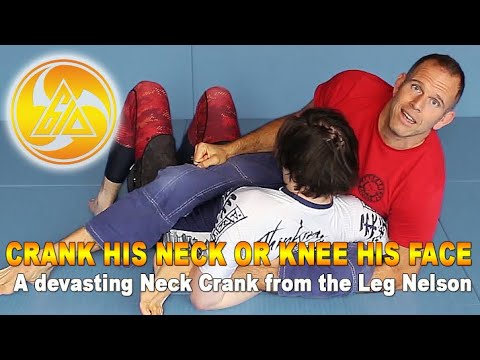
Crank his neck or knee his face - A devasting Neck Crank from the Leg Nelson
0
Face Crank From Rear Mount·EffortlessJiuJitsu
In this video BJJ Blackbelt Björn Friedrich shows a very effective combination of Leg Nelson and a powerful Neck Crank. …
Translation: Face Crank (katakana loanword)
The face crank from rear mount is applied from standard back control by placing a hand or forearm across the opponent's face — typically under the nose or on the chin — and pulling the head backward while the hooks or body triangle anchor the body in place. [1],[2] The opposing forces of the anchored torso and the cranked head create cervical hyperextension. [1] This technique is commonly used as a setup to force the opponent to expose their neck for a rear naked choke, though it can produce a submission through spinal pain alone. [1],[2]
Face cranks from rear mount have been used throughout grappling history as both a submission and a technique to open the neck for chokes. [1],[2] In early MMA, face cranks from the back were commonly employed before rulesets were refined, and they remain legal in most professional grappling competitions. [1] The technique is sometimes called a 'can opener from the back' due to its similarity to the cervical flexion mechanic applied from behind rather than in front. [1],[2]
A secondary attack from rear mount when the rear naked choke is defended; the face crank pressures the jaw and cervical spine, often forcing the opponent to open their neck defense [1]
Used in catch wrestling, MMA, and no-gi grappling as a complement to rear naked choke attacks. The face crank from back control is considered a fundamental 'can opener' for choke defense [1]
Common in MMA when rear naked choke is defended; occasionally produces finishes at regional and national no-gi events [1]
No images yet for this technique.
Sign in to suggest an image.
In this video BJJ Blackbelt Björn Friedrich shows a very effective combination of Leg Nelson and a powerful Neck Crank. …
No instructional courses yet for this technique.
Sign in to suggest a course.
Risk of injury to the person this technique is applied to
Extension cranks force the head backward; risk of vertebral disc and ligament damage
Skill level needed to execute this technique reliably
Whether this technique is allowed under major competition rule sets
Japanese MMA/BJJ standard terminology
Japanese MMA/BJJ standard terminology
Standard katakana transliteration of Western martial arts terminology (外来語) — used in Japanese MMA, boxing, and BJJ communities
Japanese terminology sourced from Japanese MMA/BJJ standard terminology
hip flexibility, long legs relative to torso
longer limbs for easier figure-four lock around head and arm
hip adductors, hamstrings, quadriceps
Every move, in any martial art, shares a few universal traits. Mix and match below to pinpoint the right tool — or compare equivalents across styles.
According to EffortlessJiuJitsu, you should be very careful with full power application since cranking someone's neck with maximum force can cause serious injury requiring surgery. The technique uses perfect body mechanics—similar to a deadlift motion—which generates tremendous force against a fragile target, so controlled practice is essential.
EffortlessJiuJitsu emphasizes that the crank doesn't rely on arm strength or squeezing, but rather on body mechanics using one of the strongest motions the human body can produce—the deadlift-like opening motion—applied against the spine, the most fragile target of the body.
EffortlessJiuJitsu explains that once both arms are trapped, the opponent has no escape route, so you can proceed with the crank or transition to strikes, then return to crank again to finish.
The face crank from rear mount is applied from standard back control by placing a hand or forearm across the opponent's face — typically under the nose or on the chin — and pulling the head backward while the hooks or body triangle anchor the body in place. The opposing forces of the anchored torso and the cranked head create cervical hyperextension.
Face cranks from rear mount have been used throughout grappling history as both a submission and a technique to open the neck for chokes. In early MMA, face cranks from the back were commonly employed before rulesets were refined, and they remain legal in most professional grappling competitions.
IBJJF: legal — Legal at all belt levels, gi and no-gi — chokes are the safest submission cat…; IJF: legal — Legal (shime-waza) — strangulation techniques are one of three permitted subm…; ADCC: legal — Legal; Unified MMA: legal — Legal — choke submissions are among the most common finishes in MMA; FIAS Sport Sambo: banned — All chokes prohibited in Sport Sambo; FIAS Combat Sambo: legal — Legal
Danger rating 9/10. Extension cranks force the head backward; risk of vertebral disc and ligament damage
The standard setup chain: Achieve Controlling Position → Isolate the Neck → Set the Grip → Apply Pressure.
Standard counters include: Tuck Chin — protect the neck by lowering the chin to prevent the choke from sinking / Two-on-One Grip Fight — use both hands to strip the choking grip before it locks / Turn Into — rotate toward the choking arm to relieve carotid pressure / Posture Up — straighten the spine and create distance to break the choking angle.
Common variants: Short choke (palm-to-palm grip) (compact grip for tight spaces when the chin is partially …); Gable grip RNC (interlocked fingers behind the head for maximum squeeze p…); Body triangle RNC (adds body triangle control for stronger hip management du…); One-arm RNC (single arm under the chin when the second arm cannot reac…).
Common in MMA when rear naked choke is defended; occasionally produces finishes at regional and national no-gi events
Top errors to watch for: Relying on the face crank as the primary submission — it's a transition tool for opening the RNC; few opponents tap t… / Pressing into the eyes — target the jaw, forehead, or cheekbone; eye contact is dangerous and illegal / Losing back hooks while applying facial pressure — maintain hooks throughout; the face crank is secondary to back con… / Applying the face crank without immediately following with the RNC — as soon as the chin lifts, the choking arm must ….
The Face Crank From Rear Mount is also known as Feisu Kuranku, Rear Mount Face Crank, Face Lock from Back.