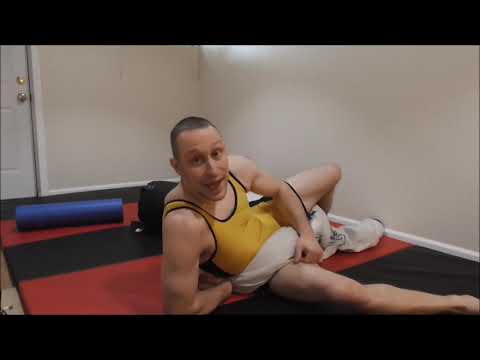
04 Crusafix shoulder lock and straight headscissor
0
Standard Headscissors Strangle·Gay Wrestling classes
This is a sneaky little submission off of the darce defense. The important details are maintaining control til you get …
Translation: Head Scissors (katakana loanword)
The standard headscissors strangle from guard is the fundamental leg-based head squeeze where the attacker traps the opponent's head between the thighs from a bottom guard position and squeezes. [1] The attacker captures the opponent's head as it dips forward during a guard pass attempt, closes the legs around the skull and neck, and contracts the adductor muscles to compress both sides of the neck simultaneously. [1],[2] The standard variant uses a straight leg squeeze without a figure-four lock, relying purely on adductor strength and thigh circumference to generate compression. [2] While simpler than the figure-four version, the standard headscissors can still produce unconsciousness through carotid compression when sufficient force is applied. [2],[3]
Effective when the legs can lock around the neck with proper angle; the squeeze compresses the carotid arteries bilaterally. Requires strong adductors and precise positioning [1]
One of the oldest submission techniques in grappling history, depicted in ancient Greek pankration art. Present in catch wrestling, judo (do-jime family), sambo, and BJJ [1]
Rare standalone finish at elite BJJ and ADCC events but occasionally seen in MMA, catch wrestling, and sambo competition [1]
No images yet for this technique.
Sign in to suggest an image.
This is a sneaky little submission off of the darce defense. The important details are maintaining control til you get …
No instructional courses yet for this technique.
Sign in to suggest a course.
Risk of injury to the person this technique is applied to
Headscissors use the thighs to squeeze the head laterally; risk of neck strain
Skill level needed to execute this technique reliably
Whether this technique is allowed under major competition rule sets
Japanese grappling/BJJ standard terminology; JBJJF competition usage
Official Japanese BJJ federation — competition rules and terminology
Standard katakana transliteration of Western martial arts terminology (外来語) — used in Japanese MMA, boxing, and BJJ communities
Japanese terminology sourced from Japanese grappling/BJJ standard terminology; JBJJF competition usage
grip or squeeze strength, positional control
strong upper body for sustained compression
forearms, biceps, pectorals, core stabilisers
Turn your toe down into the mat to create internal rotation of your hip, which keeps the shoulder pinned down and prevents them from sitting up. According to Gay Wrestling classes, simply placing your leg under the head without this internal rotation won't create enough pressure on the shoulder.
A bent leg gives you lifting power to elevate the opponent's elbow while keeping your other leg down, whereas a straight leg provides no lifting capability. Gay Wrestling classes emphasizes this is a common mistake that reduces the effectiveness of the technique.
Placing your bottom leg on top creates a wall that prevents your opponent from unhooking you and pushing you off, allowing you to straighten out and finish the choke. This positioning makes it much harder for them to escape the submission.
Keep their head facing toward you to take advantage of the taper of your legs; if their head faces straight up, you risk a trachea crush, and if it faces away, they'll be near your calves but you lose optimal pressure angle.
The standard headscissors strangle from guard is the fundamental leg-based head squeeze where the attacker traps the opponent's head between the thighs from a bottom guard position and squeezes. The attacker captures the opponent's head as it dips forward during a guard pass attempt, closes the legs around the skull and neck, and contracts the adductor muscles to compress both sides of the neck simultaneously.
Head scissors are among the oldest grappling techniques, depicted in ancient Greek and Egyptian wrestling art. The guard application was incorporated into BJJ's ground fighting curriculum as both a positional control and a legitimate strangulation attempt.
IBJJF: legal — Legal at all belt levels, gi and no-gi — chokes are the safest submission cat…; IJF: legal — Legal (shime-waza) — strangulation techniques are one of three permitted subm…; ADCC: legal — Legal; Unified MMA: legal — Legal — choke submissions are among the most common finishes in MMA; FIAS Sport Sambo: banned — All chokes prohibited in Sport Sambo; FIAS Combat Sambo: legal — Legal
Danger rating 7/10. Headscissors use the thighs to squeeze the head laterally; risk of neck strain
The standard setup chain: Achieve Controlling Position → Isolate the Neck → Set the Grip → Apply Pressure.
Standard counters include: Tuck Chin — protect the neck by lowering the chin to prevent the choke from sinking / Two-on-One Grip Fight — use both hands to strip the choking grip before it locks / Turn Into — rotate toward the choking arm to relieve carotid pressure / Posture Up — straighten the spine and create distance to break the choking angle.
Common variants: Standard grip variation (primary hand configuration for maximum choking pressure); Gi variation (uses the lapel or collar as an anchor for additional fric…); No-gi variation (adapted grip and positioning for submission grappling wit…); Transition finish (applied during a positional change to catch the opponent …).
Rare standalone finish at elite BJJ and ADCC events but occasionally seen in MMA, catch wrestling, and sambo competition
Top errors to watch for: Squeezing with the knees rather than the thighs — the compression should come from the inner thigh surfaces (adductor… / Not locking the figure-four — the ankle-behind-knee lock is essential; without it, the squeeze is weaker and the oppo… / Placing the legs too low on the neck — the thighs should compress at carotid level (mid-neck); too low catches the sh… / Not extending the hips — hip extension drives the thighs together with structural force; without it, the squeeze reli….
The Standard Headscissors Strangle is also known as Heddo Shizāzu, Classic Head Scissors Strangle, Standard Kubi-basami from Guard.