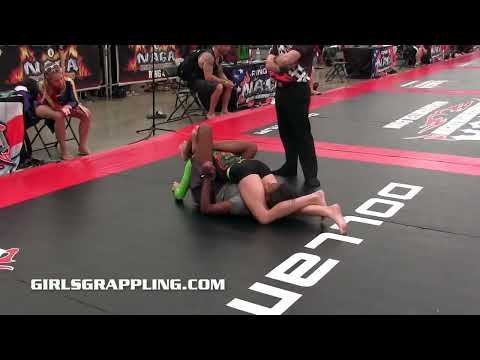
Reverse Headscissors - NAGA Grappling Competition Classic
0
Reverse Headscissors·Judo Queens Only
Translation: Head Scissors (katakana loanword)
The reverse headscissors from guard applies the head squeeze with the attacker's legs oriented in the opposite direction compared to the standard version, typically with the attacker's hips angled or inverted. [1] The reverse orientation changes the compression angle — instead of squeezing the sides of the neck from a front-facing position, the reverse headscissors attacks from an angled or rear-facing direction, which can target different portions of the carotid arteries. [1],[2] This variant often occurs during scrambles when the attacker's guard is partially passed but they manage to recapture the head between the legs from an unconventional angle. [2] The reverse orientation can be disorienting for the trapped opponent, as standard headscissors defence strategies may not apply. [2],[3]
Reverse headscissors positions have been documented in catch wrestling and professional wrestling, where unusual angles of head control were explored for both sport and showmanship. [1] In competition BJJ, the reverse variant emerged as a transition-based attack during guard recovery and scramble situations. [2],[3]
Lower percentage than standard headscissors due to the reversed leg positioning, which reduces squeezing power; can still finish against smaller opponents or those unaware of the threat [1]
A variation of the headscissors found across multiple grappling traditions including catch wrestling, sambo, and traditional jujutsu [1]
Extremely rare as a finish at major competition; occasionally seen in sambo and catch wrestling events [1]
No images yet for this technique.
Sign in to suggest an image.
No instructional courses yet for this technique.
Sign in to suggest a course.
Risk of injury to the person this technique is applied to
Headscissors use the thighs to squeeze the head laterally; risk of neck strain
Skill level needed to execute this technique reliably
Whether this technique is allowed under major competition rule sets
Japanese grappling/BJJ standard terminology; JBJJF competition usage
Official Japanese BJJ federation — competition rules and terminology
Standard katakana transliteration of Western martial arts terminology (外来語) — used in Japanese MMA, boxing, and BJJ communities
Japanese terminology sourced from Japanese grappling/BJJ standard terminology; JBJJF competition usage
grip or squeeze strength, positional control
strong upper body for sustained compression
forearms, biceps, pectorals, core stabilisers
The reverse headscissors from guard applies the head squeeze with the attacker's legs oriented in the opposite direction compared to the standard version, typically with the attacker's hips angled or inverted. The reverse orientation changes the compression angle — instead of squeezing the sides of the neck from a front-facing position, the reverse headscissors attacks from an angled or rear-facing direction, which can target different portions of the carotid arteries.
Reverse headscissors positions have been documented in catch wrestling and professional wrestling, where unusual angles of head control were explored for both sport and showmanship. In competition BJJ, the reverse variant emerged as a transition-based attack during guard recovery and scramble situations.
IBJJF: legal — Legal at all belt levels, gi and no-gi — chokes are the safest submission cat…; IJF: legal — Legal (shime-waza) — strangulation techniques are one of three permitted subm…; ADCC: legal — Legal; Unified MMA: legal — Legal — choke submissions are among the most common finishes in MMA; FIAS Sport Sambo: banned — All chokes prohibited in Sport Sambo; FIAS Combat Sambo: legal — Legal
Danger rating 7/10. Headscissors use the thighs to squeeze the head laterally; risk of neck strain
The standard setup chain: Establish Position → Create the Threat → Secure the Hold → Finish.
Standard counters include: Early Recognition — identify the submission attempt early and begin defence immediately / Posture and Base — maintain strong posture and base to prevent submission setups / Grip Fight — deny the attacker their preferred gripping configuration.
Common variants: Standard grip variation (primary hand configuration for maximum choking pressure); Gi variation (uses the lapel or collar as an anchor for additional fric…); No-gi variation (adapted grip and positioning for submission grappling wit…); Transition finish (applied during a positional change to catch the opponent …).
Extremely rare as a finish at major competition; occasionally seen in sambo and catch wrestling events
Top errors to watch for: Not understanding the body orientation — the reverse specifically means facing the opponent's legs; confusion about d… / Attempting to squeeze from the wrong angle — the thigh-to-carotid alignment differs from the standard; adjust the hip… / Losing the position during the inversion — inverted positions are inherently less stable; maintain tight thigh contac… / Not extending the hips — hip extension drives the thighs together; flat hips reduce compression.
The Reverse Headscissors is also known as Heddo Shizāzu, Reverse Scissor Choke, Inverted Head Scissors.