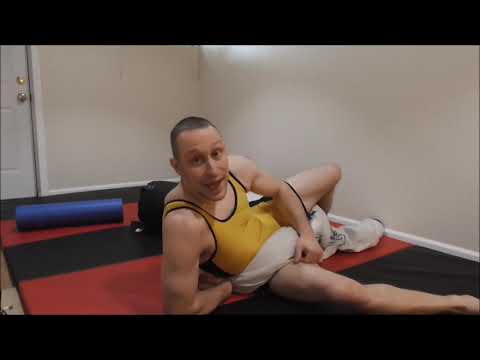
04 Crusafix shoulder lock and straight headscissor
0
Figure-Four Headscissors·Gay Wrestling classes
This is a sneaky little submission off of the darce defense. The important details are maintaining control til you get …
Translation: Triangle Strangle
The figure-four headscissors from guard uses a figure-four leg configuration — one leg bent behind the knee of the other — to lock the head squeeze from a bottom guard position. [1] The attacker traps the opponent's head between the thighs, then hooks one foot behind the opposite knee to form the figure-four, which structurally locks the squeeze and prevents the opponent from simply pulling the head free. [1],[2] The figure-four configuration recruits the powerful hip adductor muscles and adds the mechanical advantage of the interlocking leg structure, significantly increasing compression force. [2] This is the highest-control variant of the guard headscissors because the figure-four lock is extremely difficult to break once established. [2],[3]
The figure-four headscissors uses the legs in a figure-four configuration around the opponent's head to create compression pressure. [1]
Head scissors appear in judo (do-jime family), catch wrestling, and pro wrestling as both control and submission techniques. [1]
Head scissors submissions occasionally appear in MMA and submission grappling. [1]
No images yet for this technique.
Sign in to suggest an image.
This is a sneaky little submission off of the darce defense. The important details are maintaining control til you get …
No instructional courses yet for this technique.
Sign in to suggest a course.
Risk of injury to the person this technique is applied to
Headscissors squeeze the head laterally using the thighs; risk of neck compression
Skill level needed to execute this technique reliably
Whether this technique is allowed under major competition rule sets
Kodokan Judo — Sankaku-jime
Japanese terminology sourced from Kodokan Judo — Sankaku-jime
Official Kodokan ground technique classification system
Standard Japanese martial arts terminology (kanji/hiragana)
Established Japanese martial arts naming convention — native Japanese term (和語/漢語)
Japanese terminology sourced from Kodokan Judo — Sankaku-jime
grip or squeeze strength, positional control
strong upper body for sustained compression
forearms, biceps, pectorals, core stabilisers
Keep your bottom leg on top of your top leg to create a wall that prevents your opponent from unhooking or pushing you off. Maintain a 90-degree bend in your legs rather than keeping them straight, as the bend gives you lifting power and allows you to control your opponent's shoulder and head simultaneously.
Turning your toe down into the mat creates internal rotation of your hip, which keeps your opponent's shoulder pinned to the ground and prevents them from sitting up. Without this internal rotation, you won't have enough pressure on the shoulder even if your leg is positioned correctly.
Position your opponent's head facing towards you to take advantage of the taper of your legs for maximum pressure. If their head faces straight up, they risk a trachea crush, and if they face away, they're close to your calves where you still have good power.
Once you have control with your bottom leg on top and your toe turned into the mat, internally rotate your hips to finish the choke. Keep pressure on your opponent's face and maintain your leg bend throughout the finish.
The figure-four headscissors from guard uses a figure-four leg configuration — one leg bent behind the knee of the other — to lock the head squeeze from a bottom guard position. The attacker traps the opponent's head between the thighs, then hooks one foot behind the opposite knee to form the figure-four, which structurally locks the squeeze and prevents the opponent from simply pulling the head free.
Figure-four leg locks around the head have been used in wrestling traditions worldwide, from sumo to catch wrestling. The guard application was formalised in BJJ and submission grappling as a positional control tool that can produce a strangle or serve as a platform for other attacks.
IBJJF: legal — Legal at all belt levels, gi and no-gi — chokes are the safest submission cat…; IJF: legal — Legal (shime-waza) — strangulation techniques are one of three permitted subm…; ADCC: legal — Legal; Unified MMA: legal — Legal — choke submissions are among the most common finishes in MMA; FIAS Sport Sambo: banned — All chokes prohibited in Sport Sambo; FIAS Combat Sambo: legal — Legal
Danger rating 7/10. Headscissors squeeze the head laterally using the thighs; risk of neck compression
The standard setup chain: Establish Position → Create the Threat → Secure the Hold → Finish.
Standard counters include: Early Recognition — identify the submission attempt early and begin defence immediately / Posture and Base — maintain strong posture and base to prevent submission setups / Grip Fight — deny the attacker their preferred gripping configuration.
Common variants: Standard grip variation (primary hand configuration for maximum choking pressure); Gi variation (uses the lapel or collar as an anchor for additional fric…); No-gi variation (adapted grip and positioning for submission grappling wit…); Transition finish (applied during a positional change to catch the opponent …).
Head scissors submissions occasionally appear in MMA and submission grappling.
Top errors to watch for: Squeezing with the knees instead of the thighs — the compression should come from the inner thighs (adductors) pressi… / Not locking the figure-four properly — one leg's ankle must hook behind the other knee to create the lock; an unlocke… / Trapping the chin inside the legs — the chin should be above the thigh; trapping the chin allows the opponent to turn… / Placing the legs too low on the neck — the thighs should compress at the level of the carotid arteries (mid-neck); to….
The Figure-Four Headscissors is also known as Sankaku-jime, Figure-Four Scissor Choke, Figure-4 Head Scissors.