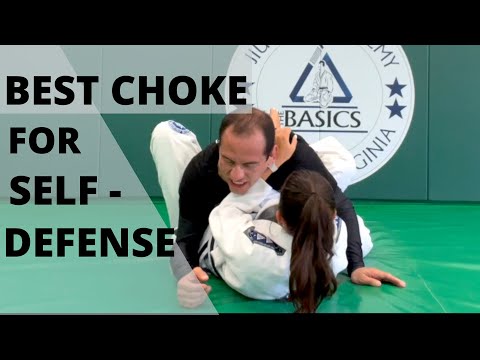
Best choke for self-defense!
0
Self Lapel Rear Choke·Mastery Jiu-Jitsu
In a situation when you are underneath an attacker, he's holding you down and there is no space to push him and get back…
Translation: self-lapel rear strangle
Self lapel rear chokes use the attacker's own gi lapel — pulled out and fed around the opponent's neck — to create a choking loop from back control. [1],[2] Unlike standard lapel feed chokes that use the opponent's collar, self-lapel techniques give the attacker a longer fabric tail that can be threaded in unexpected routes. [1] The own-lapel rear noose choke is the primary technique: the attacker pulls their own lapel free, feeds it under the opponent's chin, catches it with the other hand, and tightens from behind. [1],[3] Self-lapel chokes are difficult to defend because the opponent cannot simply strip the grip from their own collar — the fabric comes from an unfamiliar angle. [1],[4]
Self-lapel choke techniques emerged in Brazilian Jiu-Jitsu as gi players explored creative uses of their own uniform beyond traditional judo collar grips. [1],[2] While judo's shime-waza curriculum focused primarily on gripping the opponent's collar, BJJ practitioners in the 2000s began systematically using their own lapel as an additional weapon from back control. [1],[3] Keenan Cornelius and other modern lapel guard innovators further expanded the self-lapel concept, though rear applications of self-lapel chokes predate the lapel guard era. [1],[4]
The self-lapel rear choke feeds one's own lapel tail around the opponent's neck from behind, creating an improvised strangle. [1]
Self-lapel rear chokes are a modern BJJ innovation for back control attacks. [1]
Self-lapel rear chokes are used at advanced IBJJF competition. [1]
No images yet for this technique.
Sign in to suggest an image.
In a situation when you are underneath an attacker, he's holding you down and there is no space to push him and get back…
No instructional courses yet for this technique.
Sign in to suggest a course.
Risk of injury to the person this technique is applied to
Using one's own lapel from back control creates a self-tightening noose choke
Skill level needed to execute this technique reliably
Whether this technique is allowed under major competition rule sets
Kodokan Judo — Official Katame-waza Classification
Judo eri-jime variant — self-lapel grip
Standard Japanese martial arts terminology (kanji/hiragana)
Established Japanese martial arts naming convention — native Japanese term (和語/漢語)
Judo eri-jime variant — self-lapel grip
grip or squeeze strength, positional control
strong upper body for sustained compression
forearms, biceps, pectorals, core stabilisers
Every move, in any martial art, shares a few universal traits. Mix and match below to pinpoint the right tool — or compare equivalents across styles.
The critical detail is the position of your thumb—if it's too narrow, your elbow won't make it into the proper angle; if it's too low, your wrist won't put pressure on the neck. Insert your second hand as deep as possible, and the power comes from opening your chest rather than lifting your elbows.
This choke is effective when you're on the bottom in confined spaces with no room to escape, such as against a wall or in the back of a car, where it can incapacitate an attacker if applied correctly.
If the attacker is only wearing a t-shirt, gather material from the t-shirt itself to use for the choke rather than relying on a lapel.
First, control your opponent's posture by breaking it with your legs to pull them in close and close the distance, preventing them from striking you or maintaining striking distance.
Self lapel rear chokes use the attacker's own gi lapel — pulled out and fed around the opponent's neck — to create a choking loop from back control. Unlike standard lapel feed chokes that use the opponent's collar, self-lapel techniques give the attacker a longer fabric tail that can be threaded in unexpected routes.
Self-lapel choke techniques emerged in Brazilian Jiu-Jitsu as gi players explored creative uses of their own uniform beyond traditional judo collar grips. While judo's shime-waza curriculum focused primarily on gripping the opponent's collar, BJJ practitioners in the 2000s began systematically using their own lapel as an additional weapon from back control.
IBJJF: legal — Legal at all belt levels, gi and no-gi — chokes are the safest submission cat…; IJF: legal — Legal (shime-waza) — strangulation techniques are one of three permitted subm…; ADCC: restricted — N/A (no-gi competition only — technique requires gi); Unified MMA: restricted — N/A (technique requires gi — not applicable in MMA); FIAS Sport Sambo: banned — All chokes prohibited in Sport Sambo; FIAS Combat Sambo: legal — Legal
Danger rating 8/10. Using one's own lapel from back control creates a self-tightening noose choke
The standard setup chain: Achieve Controlling Position → Isolate the Neck → Set the Grip → Apply Pressure.
Standard counters include: Tuck Chin — protect the neck by lowering the chin to prevent the choke from sinking / Two-on-One Grip Fight — use both hands to strip the choking grip before it locks / Turn Into — rotate toward the choking arm to relieve carotid pressure / Posture Up — straighten the spine and create distance to break the choking angle.
Common variants: Standard grip variation (primary hand configuration for maximum choking pressure); Gi variation (uses the lapel or collar as an anchor for additional fric…); No-gi variation (adapted grip and positioning for submission grappling wit…); Transition finish (applied during a positional change to catch the opponent …).
Self-lapel rear chokes are used at advanced IBJJF competition.
Top errors to watch for: Using a lapel that is too short — ensure enough fabric length to pass behind the neck and be gripped on the other side / Feeding the lapel in front of the neck — the lapel must pass behind the neck, not across the throat (which creates an… / Not maintaining seatbelt control during the feed — one arm must always control the opponent's torso while the other f… / Trying to finish without proper lapel placement — verify the fabric is seated in the crease of the neck before applyi….
The Self Lapel Rear Choke is also known as Ji-eri Ushiro-jime, Own-Lapel Choke, Self-Lapel Strangle.