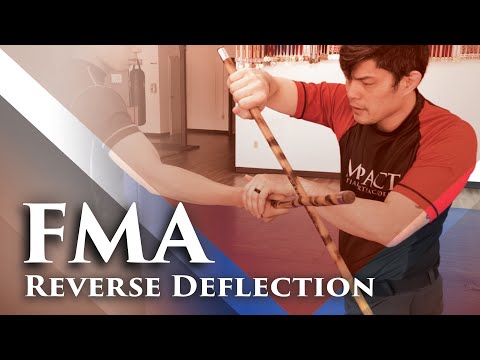
Technique Video: Reverse Cambiata Deflection | Filipino Martial Arts
0
Reverse Front Strike·Impact Martial Arts Academy
In this video, we show the reverse cambiata and a few follow up ideas to train. Train with us in Virginia Beach at Impa…
Translation: reverse front strike
The Reverse Front Strike (Bandae Ap Taerigi) is a Taekwon-Do striking technique where the rear hand delivers a strike to the front of the opponent, using the rotation of the hips and shoulders to generate power from the rear side. [1] Unlike a basic jab or cross, this technique specifically involves a coordinated body rotation from the rear stance position, driving the strike through the target with full body mechanics. [1] It is classified separately from punches (jirugi) in the TKD taxonomy as a striking (taerigi) technique due to the different hand formation and trajectory used. [1]
A versatile striking technique that delivers rear-hand power to a frontal target. [1] The hip rotation generates significantly more force than a jab or front-hand strike. Commonly used as a setup or finishing technique in TKD combinations.
Taekwondo lineage: Japanese Shotokan karate (via Korean students during Japanese occupation 1910–1945) → Korean kwans (Chung Do Kwan, Moo Duk Kwan, Song Muk Kwan, etc.) → unified under General Choi Hong Hi as Taekwon-Do (ITF, 1966) and separately as World Taekwondo (WT/Kukkiwon, 1973). [1]
TKD hand techniques score in both WT and ITF competition, though kicks receive higher point values in WT. In ITF semi-contact, punches are scored equally with kicks to the same target. [1]
No images yet for this technique.
Sign in to suggest an image.
In this video, we show the reverse cambiata and a few follow up ideas to train. Train with us in Virginia Beach at Impa…
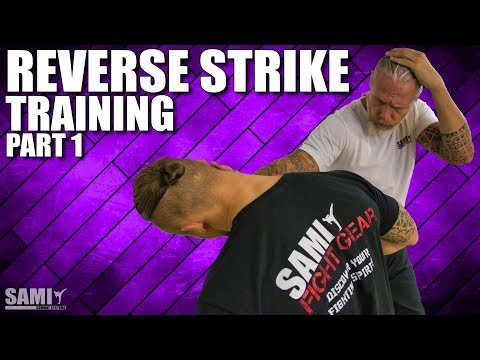
SAMI Combat Systems (SAMICS) – Martial Arts, Selfdefense and Sports Training! Dates and locations can be found on https…
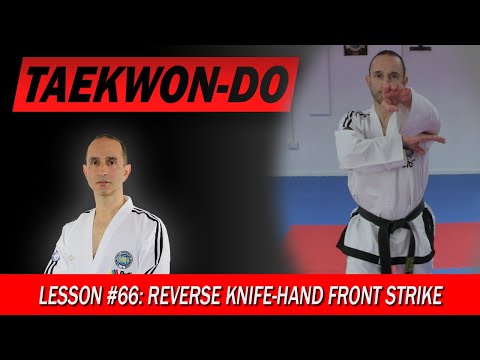
This video shows you how to perform a Reverse Knife-Hand Front Strike (Sonkal Dung Ap Taerigi). I describe the tool used…
The reverse front strike is a versatile striking technique employed across multiple martial arts systems, with instructors presenting distinct but complementary approaches. Donato Nardizzi teaches the reverse knife-hand front strike in Taekwon-Do, emphasizing hand formation with the thumb tucked away and targeting areas such as the temple, jaw, or neck. He stresses the importance of upper body rotation, shoulder drive, and a slight elbow bend before impact to avoid joint injury, noting that reverse execution is more stable than obverse. SAMI Combat Systems presents reverse strikes as returning movements after initial attacks—following uppercuts or hooks with hammer fists or palm strikes—and draws direct parallels to knife-fighting applications, demonstrating how the same mechanics apply across empty-hand and armed contexts. Impact Martial Arts Academy approaches the reverse technique through Filipino martial arts, specifically the reverse kambiata, treating it as a deflection-based entry combining stick work with empty-hand checking and body positioning to establish control before progressing to elbow strikes, punio (fist), or lateral footwork variations depending on distance and power requirements. All three instructors agree on foundational principles: rotational power generation, controlled entry, and strategic hand positioning. They differ primarily in range emphasis—Nardizzi focuses on long-range striking mechanics, SAMI on mid-range boxing combinations, and Impact on close-quarters grappling transitions.
Synthesized from 3 instructors
No instructional courses yet for this technique.
Sign in to suggest a course.
Risk of injury to the person this technique is applied to
Standard hand strike with good body mechanics.
Skill level needed to execute this technique reliably
Whether this technique is allowed under major competition rule sets
Choi, H.H. (1999). Condensed Encyclopedia of Taekwon-Do. International Taekwon-Do Federation.
[1] Choi, Condensed Encyclopedia of Taekwon-Do (1999), Striking Techniques chapter
[1] Choi, Condensed Encyclopedia of Taekwon-Do (1999), Striking Techniques chapter
hip rotation mechanics, shoulder mobility
hip rotators, core obliques, shoulder, triceps
The Reverse Front Strike (Bandae Ap Taerigi) is an ITF Taekwondo striking technique classified separately from punches (jirugi). General Choi's Encyclopedia of Taekwon-Do classifies it as a taerigi (striking) technique due to different hand formation and trajectory than standard punches. (Choi, Encyclopedia of Taekwon-Do)
According to SAMI Combat Systems, the reverse strike is useful when you miss your initial target or as a way to return with the same arm, and it works effectively in combination with techniques like uppercuts and hammer strikes in both empty-hand and knife fighting applications.
Impact Martial Arts Academy teaches three distinct footwork approaches: a deep forward step at 45 degrees for elbow strikes, a half-step for punio strikes to maintain a better power arc, and a lateral step to achieve the full power arc of your foot.
The Reverse Front Strike (Bandae Ap Taerigi) is a Taekwon-Do striking technique where the rear hand delivers a strike to the front of the opponent, using the rotation of the hips and shoulders to generate power from the rear side. Unlike a basic jab or cross, this technique specifically involves a coordinated body rotation from the rear stance position, driving the strike through the target with full body mechanics.
The Reverse Front Strike (Bandae Ap Taerigi) is a fundamental TKD striking technique classified separately from punches (jirugi) due to its different hand formation and trajectory. It is part of the taerigi (striking) family in the TKD technical curriculum.
Unified MMA: Legal: legal — standard striking technique; WKF Karate: Legal: legal — controlled contact required; WT Taekwondo: Legal: legal — kicks are primary scoring technique; WAKO Kickboxing: Legal: legal — full contact permitted; IFMA Muay Thai: Legal: legal — all strikes permitted
Danger rating 4/10. Moderate — standard hand strike with good body mechanics.
The standard setup chain: Jab to occupy guard → reverse front strike to the face → Low kick → opponent drops guard → reverse front strike high → Feint low → reverse front strike to the jaw.
Standard counters include: Parry and counter — deflect the strike and fire back / Slip to the outside — evade and counter-punch / Low kick as the hips rotate — exploit the weight transfer.
Common variants: With fore-fist (standard punching surface); With back-fist (striking with the knuckles of the back of the hand); With knife-hand (open hand strike to the neck or temple); Low reverse front strike (targeting the solar plexus).
TKD hand techniques score in both WT and ITF competition, though kicks receive higher point values in WT. In ITF semi-contact, punches are scored equally with kicks to the same target.
Top errors to watch for: Not rotating the hips — arm-only strikes lack power / Over-rotating past the target — wastes energy and exposes the back / Dropping the guard hand during the strike / Not retracting the striking hand quickly — leaves it exposed.
The Reverse Front Strike is also known as Gyaku Mae Uchi, Bandae Ap Taerigi, Reverse Front Striking, Reverse Punch Strike.