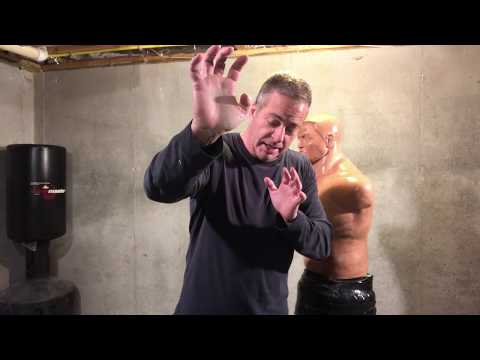
Palm Strike/Flesh Tearing Face Rake
0
Standard Palm Strike·Papa Walsh
devastating palm strike with a flesh a flesh tearing face rake is devastating to an attacker.
Translation: standard palm strike
The standard palm strike is the fundamental open-hand blow delivered with the heel of the palm, with fingers pulled back to expose the dense carpal bones as the impact surface. [1] Fairbairn codified this as one of the most effective blows for close-quarters combat in his 1942 manual, recommending it for strikes to the chin, nose, and jaw. [2] In karate, the equivalent teisho uchi (palm heel strike) was documented by Funakoshi and refined by Nakayama as a versatile close-range weapon. [3] The standard palm strike has persisted across martial arts traditions because it effectively transfers force while protecting the small bones of the hand. [1]
Standard palm strike. [1]
From traditional martial arts. [1]
Used in MMA. [1]
No images yet for this technique.
Sign in to suggest an image.
devastating palm strike with a flesh a flesh tearing face rake is devastating to an attacker.
No instructional courses yet for this technique.
Sign in to suggest a course.
Risk of injury to the person this technique is applied to
Palm strike reduces hand fracture risk; used in self-defense systems
Skill level needed to execute this technique reliably
Whether this technique is allowed under major competition rule sets
The Essence of Okinawan Karate-Do (Shoshin Nagamine, 1976)
Alias sources — [1] Karate-Do Kyohan (Funakoshi, 1935) [2] Kukkiwon Taekwondo Textbook (Kukkiwon, 2006) [3] Dynamic Karate (Nakayama, 1966)
History sources — [1] The Art of Striking (Blauer, 2004) [2] Get Tough! (Fairbairn, 1942) [3] Karate-Do Kyohan (Funakoshi, 1935)
Mixed Japanese-Western terminology — combines traditional Japanese terms with katakana loanwords
Alias sources — [1] Karate-Do Kyohan (Funakoshi, 1935) [2] Kukkiwon Taekwondo Textbook (Kukkiwon, 2006) [3] Dynamic Karate (Nakayama, 1966)
History sources — [1] The Art of Striking (Blauer, 2004) [2] Get Tough! (Fairbairn, 1942) [3] Karate-Do Kyohan (Funakoshi, 1935)
speed, power generation through kinetic chain, striking surface conditioning
athletic build with fast-twitch muscle fibres
varies by strike — hip rotators, shoulders, core
Every move, in any martial art, shares a few universal traits. Mix and match below to pinpoint the right tool — or compare equivalents across styles.
Target the head and vulnerable areas like the temple, eyes, nose, ears, and throat. Papa Walsh emphasizes that the throat is one of the best targets because it's larger than an eye or ear, and even 20% power can be effective.
Practice striking actual objects and train in full-attack scenarios rather than just drilling compliance-based partner drills. Papa Walsh notes that passivity-based training where partners take turns cooperating won't prepare you for real confrontation.
Strike any exposed opening on the body, but prioritize vital areas like the head, throat, eyes, and temples depending on the situation and your physical size relative to your attacker.
The fundamental palm strike driving the heel of the palm forward in a straight line, using hip rotation and arm extension to deliver force without clenching the fist.
The standard palm strike is the fundamental open-hand blow delivered with the heel of the palm, with fingers pulled back to expose the dense carpal bones as the impact surface. Fairbairn codified this as one of the most effective blows for close-quarters combat in his 1942 manual, recommending it for strikes to the chin, nose, and jaw.
Unified MMA: legal — Legal (palm strikes, slaps permitted); WBC/Boxing: banned — Only closed-fist punches permitted; WKF: restricted — Varies by technique — some open-hand strikes legal in kata, generally restric…; Kyokushin: banned — Only closed-fist strikes to body permitted; WT: banned — Prohibited; ITF: restricted — Some knife hand techniques legal; WAKO: banned — Closed fist only; K: banned — 1/GLORY — Closed fist only; IFMA: legal — Legal — palm strikes permitted in Muay Thai
Danger rating 4/10. Moderate — palm strike reduces hand fracture risk; used in self-defense systems
The standard setup chain: Assume Fighting Stance → Generate Power → Execute Strike → Recover to Guard.
Standard counters include: Block — absorb the strike with a protective guard position / Evasion — move the target out of the strike's path / Counter-Attack — time an offensive response during the recovery phase of the strike.
Common variants: Standard variation (primary execution of the strike from the most common stance); Power variation (modified mechanics for maximum force generation); Speed variation (minimised telegraph for a faster, harder-to-read attack); Counter variation (timed to exploit the opponent's offensive commitment).
Used in MMA.
Top errors to watch for: Not locking the wrist — a flexible wrist absorbs the impact instead of transmitting it / Hitting with the base of the fingers instead of the heel of the palm / Pushing instead of striking — the palm strike must have a snap, not a shove / Under-powering the technique because you perceive it as weaker than a punch — it carries comparable force when thrown….
The Standard Palm Strike is also known as Sutandādo Shōtei-uchi, Shotei Uchi, Batangson Chigi, Palm Heel Strike.