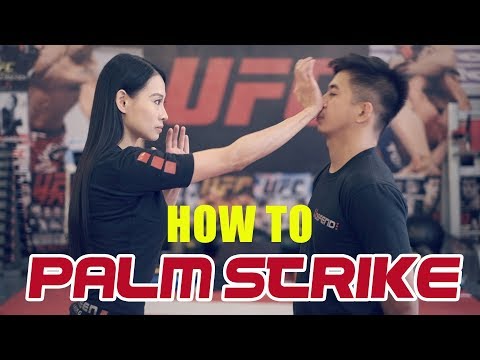
HOW TO PALM STRIKE
0
Palm Strike·Janice Hung
#selfdefense #howtopalmstrike #palmstrike A palm heel strike is an effective technique used in self-defense. This is th…
Translation: palm strike
The palm strike is one of the most universally distributed striking techniques across world martial arts, favoured for its ability to deliver significant force with minimal risk of hand injury. [1] In Chinese martial arts, palm strikes (zhang fa) form the foundation of entire systems such as Baguazhang ('Eight Trigram Palm'). [2] Funakoshi included the palm heel strike (teisho uchi) in Karate-Do Kyohan as a fundamental Okinawan technique. [3] In Western military combatives, Fairbairn and Sykes promoted the palm strike as the preferred empty-hand blow for soldiers, arguing it was more reliable than the closed fist for untrained personnel. [4] Modern self-defence systems including Krav Maga continue to emphasise the palm strike for the same biomechanical safety advantages. [1]
Palm strikes are found in many martial arts including Wing Chun, Krav Maga, and karate. [1]
Palm strikes are used in MMA and self-defence. [1]
No images yet for this technique.
Sign in to suggest an image.
#selfdefense #howtopalmstrike #palmstrike A palm heel strike is an effective technique used in self-defense. This is th…
No instructional courses yet for this technique.
Sign in to suggest a course.
Risk of injury to the person this technique is applied to
Palm strike reduces hand fracture risk; used in self-defense systems
Skill level needed to execute this technique reliably
Whether this technique is allowed under major competition rule sets
The Essence of Okinawan Karate-Do (Shoshin Nagamine, 1976)
Alias sources — [1] Dynamic Karate (Nakayama, 1966) [2] Dynamic Karate (Nakayama, 1966) [3] Dynamic Karate (Nakayama, 1966)
History sources — [1] The Art of Striking (Blauer, 2004) [2] The Martial Arts of Ancient Greece: Modern Fighting Techniques from the Age of Alexander (Dervenis, 2007) [3] Karate-Do Kyohan (Funakoshi, 1935) [4] Get Tough! (Fairbairn, 1942)
Official karate technique names (和語/漢語)
Established Japanese martial arts naming convention — native Japanese term (和語/漢語)
Alias sources — [1] Dynamic Karate (Nakayama, 1966) [2] Dynamic Karate (Nakayama, 1966) [3] Dynamic Karate (Nakayama, 1966)
History sources — [1] The Art of Striking (Blauer, 2004) [2] The Martial Arts of Ancient Greece: Modern Fighting Techniques from the Age of Alexander (Dervenis, 2007) [3] Karate-Do Kyohan (Funakoshi, 1935) [4] Get Tough! (Fairbairn, 1942)
speed, power generation through kinetic chain, striking surface conditioning
athletic build with fast-twitch muscle fibres
varies by strike — hip rotators, shoulders, core
Every move, in any martial art, shares a few universal traits. Mix and match below to pinpoint the right tool — or compare equivalents across styles.
Palm strikes appear in 220 passages across 45 books. The palm heel distributes impact over a broader surface than a fist — lower self-injury risk. Used extensively in Krav Maga, Pencak Silat, and Wing Chun. Bas Rutten famously used palm strikes in Pancrase competition where closed-fist strikes to the head were banned. (45 books in corpus; striking manuals)
A palm heel strike can be as effective as a straight punch, as long as you target vulnerable areas or vital points of the body.
A quick and forceful thrust of the palm heel to the opponent's body can cause significant damage, making it an effective self-defense technique.
A strike delivered with the heel or base of the open palm, driving the hand forward in a thrusting motion to impact the face, chin, or body without risking hand fractures.
The palm strike is one of the most universally distributed striking techniques across world martial arts, favoured for its ability to deliver significant force with minimal risk of hand injury. In Chinese martial arts, palm strikes (zhang fa) form the foundation of entire systems such as Baguazhang ('Eight Trigram Palm').
Unified MMA: legal — Legal (palm strikes, slaps permitted); WBC/Boxing: banned — Only closed-fist punches permitted; WKF: restricted — Varies by technique — some open-hand strikes legal in kata, generally restric…; Kyokushin: banned — Only closed-fist strikes to body permitted; WT: banned — Prohibited; ITF: restricted — Some knife hand techniques legal; WAKO: banned — Closed fist only; K: banned — 1/GLORY — Closed fist only; IFMA: legal — Legal — palm strikes permitted in Muay Thai
Danger rating 4/10. Moderate — palm strike reduces hand fracture risk; used in self-defense systems
The standard setup chain: Assume Fighting Stance → Generate Power → Execute Strike → Recover to Guard.
Standard counters include: Block — absorb the strike with a protective guard position / Evasion — move the target out of the strike's path / Counter-Attack — time an offensive response during the recovery phase of the strike.
Common variants: Standard variation (primary execution of the strike from the most common stance); Power variation (modified mechanics for maximum force generation); Speed variation (minimised telegraph for a faster, harder-to-read attack); Counter variation (timed to exploit the opponent's offensive commitment).
Palm strikes are used in MMA and self-defence.
Top errors to watch for: Hitting with the fingers instead of the heel of the palm — pull the fingers back sharply / Letting the wrist bend on impact — the wrist must be locked with the hand pulled back / Slapping instead of striking — the palm strike must drive through the target linearly / Under-committing because it is an open hand — the palm strike should be thrown with full body mechanics.
The Palm Strike is also known as Shōtei-uchi, Shotei, Teisho, Palm Heel Strike.