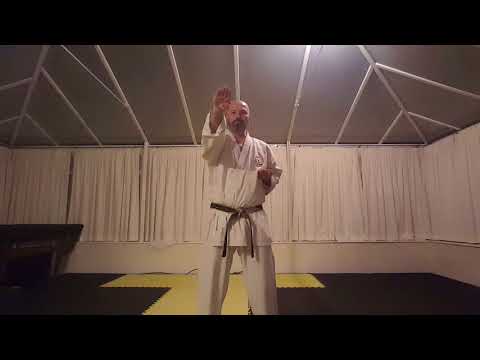
Haito Uchi, Shuto Tsuki & Gyaku Shuto
0
Haito Uchi·Tadashi Ryu Karate Do
Mechanics of how these strikes should be performed
Translation: ridge hand strike (back sword)
Haito Uchi (背刀打ち, 'reverse hand-sword strike') is the ridge hand or inner knife hand strike in karate, delivered with the radial (thumb-side) edge of the open hand. [1] The technique is documented by Funakoshi in Karate-Do Kyohan as the complementary strike to shuto uchi, targeting the temple, jaw, or bridge of the nose. [1] Nakayama classified haito uchi among the intermediate-level open hand techniques in Shotokan karate, noting that it requires careful conditioning of the striking surface to avoid thumb injury. [2] The haito uchi appears in advanced kata such as Sochin and Unsu. [3]
Haito uchi (ridge hand strike) strikes with the inner edge of the hand. [1]
From karate. [1]
Used in karate. [1]
No images yet for this technique.
Sign in to suggest an image.
Mechanics of how these strikes should be performed
No instructional courses yet for this technique.
Sign in to suggest a course.
Risk of injury to the person this technique is applied to
Shuto/karate chop; targets neck, collarbone, temple
Skill level needed to execute this technique reliably
Whether this technique is allowed under major competition rule sets
Karate-Do Kyohan: The Master Text (Gichin Funakoshi, 1935)
Alias sources — [1] Dynamic Karate (Nakayama, 1966) [2] Karate-Do Kyohan (Funakoshi, 1935) [3] Kukkiwon Taekwondo Textbook (Kukkiwon, 2006)
History sources — [1] Karate-Do Kyohan (Funakoshi, 1935) [2] Dynamic Karate (Nakayama, 1966) [3] Best Karate Vol. 3 (Nakayama, 1978)
Official karate technique names (和語/漢語)
Established Japanese martial arts naming convention — native Japanese term (和語/漢語)
Alias sources — [1] Dynamic Karate (Nakayama, 1966) [2] Karate-Do Kyohan (Funakoshi, 1935) [3] Kukkiwon Taekwondo Textbook (Kukkiwon, 2006)
History sources — [1] Karate-Do Kyohan (Funakoshi, 1935) [2] Dynamic Karate (Nakayama, 1966) [3] Best Karate Vol. 3 (Nakayama, 1978)
speed, power generation through kinetic chain, striking surface conditioning
athletic build with fast-twitch muscle fibres
varies by strike — hip rotators, shoulders, core
Every move, in any martial art, shares a few universal traits. Mix and match below to pinpoint the right tool — or compare equivalents across styles.
Both approaches are valid. Tadashi Ryu Karate Do notes there's nothing wrong with winding up first to strike, though the instructor prefers starting square and firing from the hip for more direct power.
Ensure constant movement as you bring the strike across the body—the arm comes up and the elbow rises as well, staying tight to the body rather than moving in a straight line. Once you reach the proper point, then fire the strike. Tadashi Ryu Karate Do emphasizes this prevents telegraphing and maintains proper form.
Target temple height. The ridge of the hand is a valid emphasis point, and there should be a slight angle on the hand as you strike, aiming for the temple area.
No; according to Tadashi Ryu Karate Do, distance comes from your movement as you're on the way out, not from a straight arm extension alone.
A knife hand strike using the inner edge (thumb side) of the open hand, the reverse of shuto uchi, targeting the temple or jaw in an inward chopping motion.
Haito Uchi (背刀打ち, 'reverse hand-sword strike') is the ridge hand or inner knife hand strike in karate, delivered with the radial (thumb-side) edge of the open hand. The technique is documented by Funakoshi in Karate-Do Kyohan as the complementary strike to shuto uchi, targeting the temple, jaw, or bridge of the nose.
Unified MMA: legal — Legal (palm strikes, slaps permitted); WBC/Boxing: banned — Only closed-fist punches permitted; WKF: restricted — Varies by technique — some open-hand strikes legal in kata, generally restric…; Kyokushin: banned — Only closed-fist strikes to body permitted; WT: banned — Prohibited; ITF: restricted — Some knife hand techniques legal; WAKO: banned — Closed fist only; K: banned — 1/GLORY — Closed fist only; IFMA: legal — Legal — palm strikes permitted in Muay Thai
Danger rating 5/10. High — shuto/karate chop; targets neck, collarbone, temple
The standard setup chain: Assume Fighting Stance → Generate Power → Execute Strike → Recover to Guard.
Standard counters include: Block — absorb the strike with a protective guard position / Evasion — move the target out of the strike's path / Counter-Attack — time an offensive response during the recovery phase of the strike.
Common variants: Standard variation (primary execution of the strike from the most common stance); Power variation (modified mechanics for maximum force generation); Speed variation (minimised telegraph for a faster, harder-to-read attack); Counter variation (timed to exploit the opponent's offensive commitment).
Used in karate.
Top errors to watch for: Leaving the thumb extended, which risks severe hyperextension on impact / Hitting with the flat of the palm instead of the inner ridge — the base of the index finger must lead / Swinging too wide and missing — the arc must be controlled and tight / Not committing hip rotation to the circular trajectory.
The Haito Uchi is also known as Haitō-uchi, Ridge Hand Strike, Inside Knife Hand, Sonnal Deung Chigi.