Jujitsu & Karate Atemi Waza • Mawashi to Uraken Shomen Uchi
0
Uraken Shomen Uchi·Jukido Academy
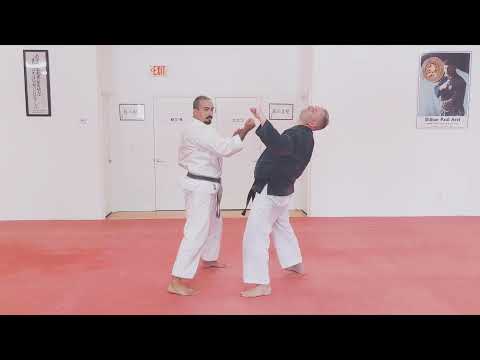
Simple drilling on adapting strikes in real-time to obstacles - here we practice staying loose as long as possible as we…
Translation: Uraken (裏拳) = back-fist (ura = reverse/back, ken = fist), Shomen (正面) = front/forward, Uchi (打ち) = strike — a forward-directed backfist strike using the back of the knuckles to snap into the opponent's face
Uraken Shomen Uchi is a snapping backfist strike delivered to the front (shomen) of the opponent, using the back of the first two knuckles (the dorsal surface of the index and middle finger knuckles) as the striking surface, driven by a rapid wrist snap that produces a fast, cutting impact to the face, nose, or temple. [1] The technique is one of the most distinctive weapons in karate's striking arsenal: while punches drive forward using the front of the knuckles (seiken), the uraken strikes using the BACK of the knuckles, leveraging a whipping wrist snap rather than a thrusting arm extension for power generation. [1],[2] The mechanical execution involves extending the arm toward the target in a horizontal arc, then sharply snapping the wrist to whip the back of the fist into the target — the speed comes from the wrist snap (which occurs over approximately 2-3 inches of travel) rather than the arm extension (which provides direction but not the primary impact force). [1] This wrist-snap mechanism makes the uraken one of the fastest striking techniques in karate — the wrist snap can be executed in under 0.1 seconds, and the back of the knuckles reaches velocities exceeding standard straight punches because the fist is at the end of a two-segment whip (forearm + hand). [1],[2] Oyama demonstrated the Uraken Shomen Uchi as a fundamental Kyokushin technique for targeting the face from angles that straight punches cannot reach — the horizontal arc approaches the face from the side or from above, bypassing the frontal guard. [1] In Kyokushin competition, although punches to the face are prohibited, the uraken is classified as an uchi (strike) rather than a tsuki (thrust/punch), and is LEGAL to the face under Kyokushin rules — making it one of the only hand techniques that can legally target the head in Kyokushin tournament fighting. [1] This regulatory distinction has made the uraken one of the most important competition weapons in Kyokushin karate, with fighters developing sophisticated backfist attacks that exploit the ruleset's unique allowance. [1]
The uraken (backfist) is one of the oldest documented hand weapons in Okinawan karate, appearing in the earliest known kata (Naihanchi/Tekki, Passai/Bassai, Kusanku/Kanku) that predate modern karate styles. [2] The technique reflects the close-quarters combat reality of historical Okinawan te: in tight spaces (market fights, ship corridors, castle hallways), the snapping backfist could reach targets that a full punch could not — the horizontal or downward arc accesses angles unavailable to straight-line punches. [2] Gichin Funakoshi documented multiple uraken variants in Karate-Do Kyohan (1935), establishing them in the modern karate curriculum. [2] Masutatsu Oyama gave the uraken special prominence in Kyokushin karate because of the ruleset he created: by prohibiting punches (tsuki) to the face but permitting strikes (uchi) to the face, Oyama created a tactical environment where the uraken became one of the most important competition weapons — the primary legal hand weapon that could target the head. [1] This regulatory quirk has made Kyokushin fighters among the most skilled backfist practitioners in the world. [1]
In Kyokushin competition, the uraken is the primary legal hand weapon to the head and accounts for a significant percentage of knockdowns and stoppages — fighters who master the wrist-snap backfist have a decisive advantage because their opponents cannot punch back to the face. [1] The technique's speed (the wrist snap is faster than any arm-powered punch) makes it effective even against fighters who are watching for it, because the snap occurs over approximately 2-3 inches in under 0.1 seconds — below the human reaction time. [1] In MMA and other full-contact sports where all hand techniques are legal, the uraken's value is primarily as a surprise technique: the horizontal arc approaches from an angle that the standard frontal guard does not cover. [2] The spinning backfist (a related technique) has produced numerous highlight-reel knockouts in the UFC, demonstrating the technique's fight-ending capability when the rotational momentum of the spin is added to the wrist snap. [3]
The uraken is one of the most important competition weapons in Kyokushin karate — it is the primary legal hand weapon to the head under Kyokushin rules. Numerous Kyokushin World Tournament and All-Japan Tournament knockdowns have been produced by uraken to the temple. In MMA, the spinning backfist has produced memorable knockouts including Shinsho Anzai, Edson Barboza, and others. In WKF karate, the uraken scores as a valid technique to the face with controlled contact.
No images yet for this technique.
Sign in to suggest an image.
Simple drilling on adapting strikes in real-time to obstacles - here we practice staying loose as long as possible as we…
Uraken | Back Fist | Uraken Uchi | Martial Arts Attacks | Self Defence Training | Karate Training | Our Other Most Impo…
Uraken shomen uchi is a back-fist strike executed to the front of the target, commonly taught across karate and integrated martial-arts systems. Jukido Academy emphasizes that the technique functions as a reactive follow-up, typically launched after a feint or initial strike that causes the opponent to react defensively. The instructors stress maintaining a loose elbow during setup to disguise the strike's actual direction and timing, creating a read on the opponent's defensive response before committing to the full technique. Target areas include the nose and temple, with body mechanics prioritizing shoulder rotation and hip engagement to generate power. The instruction highlights deliberate chamber positioning—sometimes starting from head-height—to maximize elasticity and kinetic energy transfer through the entire body. Jukido Academy notes that while the strike may land slightly off-center due to the opponent's repositioning during their defensive reaction, understanding these body dynamics allows the technique to work reliably in practice. The approach emphasizes training with exaggerated, full-range movements to build proper mechanics that translate into effective smaller, faster applications during live engagement.
Synthesized from 1 instructor
No instructional courses yet for this technique.
Sign in to suggest a course.
Risk of injury to the person this technique is applied to
The uraken's whipping speed produces a cutting, concussive impact to the face — the back of the knuckles can cause lacerations (particularly to the eyebrow ridge, where the skin is tight over bone), nasal fractures, and concussive impacts to the temple. In Kyokushin competition, the uraken to the temple has produced numerous knockdowns and stoppages. While less powerful than a straight punch (the wrist snap generates less total force than full arm extension), the concentrated speed of the snap on a small, bony contact surface produces disproportionate damage. [1]
Skill level needed to execute this technique reliably
Whether this technique is allowed under major competition rule sets
This Is Karate (Oyama, 1965)
description: [1] Oyama 1965, [2] Funakoshi 1973
Official karate technique names (和語/漢語)
Established Japanese martial arts naming convention — native Japanese term (和語/漢語)
description: [1] Oyama 1965, [2] Funakoshi 1973
Requires good wrist snap speed (fast-twitch forearm muscles)
Dorsal knuckle conditioning from progressive makiwara training
Good shoulder mobility for the horizontal or diagonal arc
Wrist flexibility for the snap motion
Accessible to all body types — the technique relies on speed rather than power or reach
Uraken shomen uchi (backfist front strike) drives the backfist straight forward to the face — the most direct backfist trajectory. Faster than a standard punch due to the whipping wrist action. (Oyama, This Is Karate; Nakayama, Dynamic Karate)
Focus on the side of your opponent's face even when you're striking from the front, as this helps you understand the proper angle and distance of the technique.
Make sure your entire technique reads in the direction you intend—your shoulders, hips, and strike should all flow together in one cohesive motion rather than moving in conflicting directions.
Uraken Shomen Uchi is a snapping backfist strike delivered to the front (shomen) of the opponent, using the back of the first two knuckles (the dorsal surface of the index and middle finger knuckles) as the striking surface, driven by a rapid wrist snap that produces a fast, cutting impact to the face, nose, or temple. The technique is one of the most distinctive weapons in karate's striking arsenal: while punches drive forward using the front of the knuckles (seiken), the uraken strikes using the BACK of the knuckles, leveraging a whipping wrist snap rather than a thrusting arm extension for power generation.
The uraken (backfist) is one of the oldest documented hand weapons in Okinawan karate, appearing in the earliest known kata (Naihanchi/Tekki, Passai/Bassai, Kusanku/Kanku) that predate modern karate styles. The technique reflects the close-quarters combat reality of historical Okinawan te: in tight spaces (market fights, ship corridors, castle hallways), the snapping backfist could reach targets that a full punch could not — the horizontal or downward arc accesses angles unavailable to straight-line punches.
Unified MMA: legal — Legal (palm strikes, slaps permitted); WBC/Boxing: banned — Only closed-fist punches permitted; WKF: restricted — Varies by technique — some open-hand strikes legal in kata, generally restric…; Kyokushin: banned — Only closed-fist strikes to body permitted; WT: banned — Prohibited; ITF: restricted — Some knife hand techniques legal; WAKO: banned — Closed fist only; K: banned — 1/GLORY — Closed fist only; IFMA: legal — Legal — palm strikes permitted in Muay Thai
Danger rating 6/10. The uraken's whipping speed produces a cutting, concussive impact to the face — the back of the knuckles can cause lacerations (particularly to the eyebrow ridge, where the skin is tight over bone), nasal fractures, and concussive impacts to the temple. In Kyokushin competition, the uraken to the temple has produced numerous knockdowns and stoppages. While less powerful than a straight punch (the wrist snap generates less total force than full arm extension), the concentrated speed of the snap on a small, bony contact surface produces disproportionate damage.
The standard setup chain: From fighting stance: feint Seiken Chudan Tsuki to the body → Opponent drops guard to protect midsection → Extend the arm in a horizontal arc toward the now-exposed temple or face → SNAP the wrist at the end of the arc → Back of knuckles whips into the target → Sharp, fast impact to the temple/nose/eyebrow → Immediate recoil to guard position → In Kyokushin competition: body kick or body punch → opponent covers body → uraken snaps to the exposed temple → the only legal hand weapon to the head in Kyokushin.
Standard counters include: Block with the forearm — raising the forearm to intercept the horizontal arc before the wrist snap contacts / Step back — retreating beyond the arm's reach / Duck — the horizontal uraken passes over a ducking head / Counter-punch — timing a straight punch to arrive during the uraken's arc (the puncher's guard is open during the hor….
Common variants: Uraken Shomen Uchi (front backfist) (straight forward snap to the face, the primary variant); Uraken Sayu Uchi (lateral backfist) (horizontal snap to the side of the head/temple); Uraken Hizo Uchi (body backfist) (snapping to the spleen/liver area of the body); Uraken Oroshi Uchi (downward backfist) (snapping downward from above onto the bridge of the nose …); Spinning Uraken (a 180° or 360° spin followed by the uraken snap, adding r…); Lead hand jab-uraken (using the lead hand to jab, then immediately snapping the…).
The uraken is one of the most important competition weapons in Kyokushin karate — it is the primary legal hand weapon to the head under Kyokushin rules. Numerous Kyokushin World Tournament and All-Japan Tournament knockdowns have been produced by uraken to the temple.
Top errors to watch for: Pushing instead of snapping — the most fundamental error: if the arm pushes forward and the fist contacts with a slow… / Hitting with the wrong surface — the back of the first two knuckles (dorsal metacarpal heads) must contact the target… / Not recoiling — the uraken must snap BACK immediately after contact; leaving the fist extended converts it from a whi… / Telegraphing with the arm extension — the arm should extend minimally (the wrist snap provides the impact); a large, ….
The Uraken Shomen Uchi is also known as Uraken Shomen Uchi, Front Backfist Strike, Forward Backfist, Uraken Uchi, Snapping Backfist.