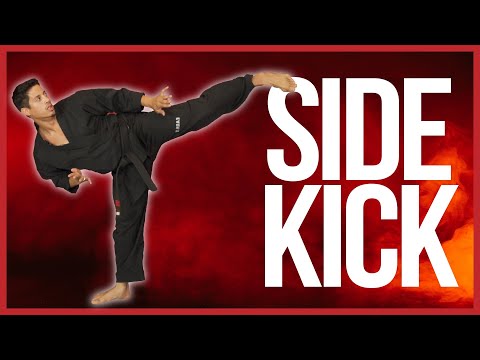
Learn How to Karate Side Kick with World Champion Justin Ortiz
0
Universal Chamber Side Kick·Oss TV
Learn how to execute variations of the Karate Side Kick with World Karate and Point Fighting Champion Justin Ortiz. Lear…
Translation: Universal chamber side kick
The Universal Chamber Side Kick is initiated from a neutral chambered position that can transition into a front, side, or roundhouse kick, disguising the kicker's true intent until the last moment. [1] The knee is raised to a mid-height chamber with the foot tucked — a position common to multiple kick types — before committing to the side kick trajectory. [1] This makes it an excellent feinting tool, as the opponent cannot determine the kick type during the chamber phase. [1]
The Universal Chamber Side Kick offers tactical advantages in specific situations where a standard side kick would be less effective. [1]
Cross-style martial arts kicking tradition. [1]
Commonly used in WT Taekwondo Olympic competition and ITF tournament sparring. Also appears in WKF karate kumite and kickboxing. [1]
No images yet for this technique.
Sign in to suggest an image.
Learn how to execute variations of the Karate Side Kick with World Karate and Point Fighting Champion Justin Ortiz. Lear…
No instructional courses yet for this technique.
Sign in to suggest a course.
Risk of injury to the person this technique is applied to
Side kick variants deliver significant lateral force to the target
Skill level needed to execute this technique reliably
Whether this technique is allowed under major competition rule sets
Essential Book of Martial Arts Kicks (De Bremaeker & Faige, 2010)
[1] De Bremaeker & Faige, Essential Book of Martial Arts Kicks (2010)
Requires good lateral hip flexibility
Strong core for balance
gluteus medius, hip abductors, quadriceps
Documented in De Bremaeker & Faige, Section 2.12. Uses a neutral chamber position shared with front kicks and roundhouse kicks — disguises the kick type until the last moment. (De Bremaeker & Faige, Essential Book of Martial Arts Kicks, 2010)
According to World Champion Justin Ortiz, keep your heel, knee, and hip all in the same plane, making sure everything stays off to the side rather than bringing the heel toward your bottom (which would look like a roundhouse kick). Chamber by bringing your knee straight up, then use your back foot pivot to turn that knee into your stomach.
World Champion Justin Ortiz emphasizes bringing your toes in toward you and pushing your ankle forward, exposing your heel as much as possible so that when you sidekick, your opponent only feels pressure from the heel. This foot positioning is practiced through the 'windshield wiper' drill, where you lift your foot straight up and move it side to side while keeping the heel exposed.
World Champion Justin Ortiz explains that pivoting your back foot gives you two critical advantages: more reach or distance and more power. Keep your pivot foot facing your target as much as possible to maximize these benefits.
According to World Champion Justin Ortiz, tuck your back leg in to create momentum while preventing weight from dragging you down. This tucking motion, combined with the back foot pivot, helps drive the kick more efficiently toward your target.
The Universal Chamber Side Kick is initiated from a neutral chambered position that can transition into a front, side, or roundhouse kick, disguising the kicker's true intent until the last moment. The knee is raised to a mid-height chamber with the foot tucked — a position common to multiple kick types — before committing to the side kick trajectory.
The Universal Chamber Side Kick is a specialised variant of the side kick documented in cross-style kicking methodology. Side kick variations have been developed across karate, taekwondo, and kung fu traditions.
Unified MMA: legal — Legal striking technique; WBC/Boxing: banned — All kicks prohibited in boxing; WKF: legal — Legal, chudan (body) kick scores 2 points, jodan (head) kick scores 3 points; Kyokushin: legal — Legal at full power to body and head; WT: legal — Legal, body kick 2 points, head kick 3 points, spinning body 4 points, spinni…; WAKO: legal — Legal in Full Contact and Low Kick formats; K: legal — 1/GLORY — Legal; IFMA: legal — Legal — kicks are a core Muay Thai technique
Danger rating 6/10. Side kick variants deliver significant lateral force to the target
The standard setup chain: Feint or jab → Chamber → Universal Chamber Side Kick to target → Follow-up technique.
Standard counters include: Step inside the kick range / Catch and sweep / Counter with low roundhouse.
Common variants: High universal chamber side kick (targeting head level); Mid universal chamber side kick (targeting body); Low universal chamber side kick (targeting legs).
Commonly used in WT Taekwondo Olympic competition and ITF tournament sparring. Also appears in WKF karate kumite and kickboxing.
Top errors to watch for: Attempting the universal chamber side kick without sufficient side kick foundation / Poor balance during execution / Insufficient hip rotation.
The Universal Chamber Side Kick is also known as Yunibāsaru Chanbā Saido Kikku, Generic Chamber Side Kick.