How to Hook Kick and Round Kick: Chamber Tip
0
Spin-Forward Hook Back Kick·Ando Mierzwa
►Click here for my Kicking Basics Course! http://www.senseiando.com/kicking-basics-course/ ►Click here to buy Ando a p…
Translation: Spin-forward hook back kick
The Spin-Forward Hook Back Kick combines a forward spin with a back kick that hooks at the end, creating a complex multi-phase attack. [1] The forward spin closes distance, the back kick delivers power, and the hook redirects the strike around the opponent's defence. [1]
Offers specific tactical advantages over the standard back kick in appropriate situations. [1]
Cross-style martial arts kicking tradition; documented in kick compendiums. [1]
Primarily a training, demonstration, and point-fighting technique. Rarely seen in full-contact MMA or kickboxing due to acrobatic risk and telegraphing. Appears occasionally in TKD and point-fighting karate tournaments. [1]
No images yet for this technique.
Sign in to suggest an image.
►Click here for my Kicking Basics Course! http://www.senseiando.com/kicking-basics-course/ ►Click here to buy Ando a p…
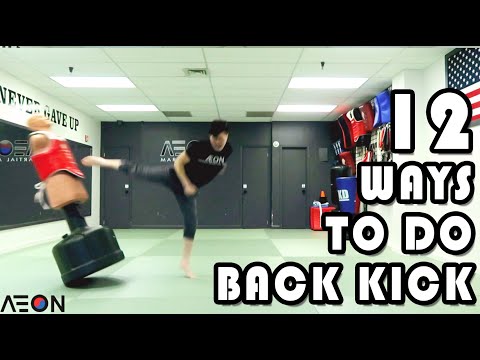
This video is a quick instruction on how to do a back kick in 12 different ways. I have no target holders due to the qua…
The spin-forward hook back kick represents an advanced variation combining rotational momentum with a chambered back kick execution. TN AEON MARTIAL ARTS addresses this technique within their systematic taxonomy of back kick variations, presenting it as the 'Tornado fake spin back kick'—a move requiring prior mastery of the tornado round kick. The execution involves bringing the back knee up while jumping with the front knee as if initiating a tornado round kick, then placing that leg down before throwing the back kick, requiring precise one-two rhythm for proper timing. Ando Mierzwa's foundational chamber work complements this approach: he emphasizes that hook kicks and back kicks share the same fundamental mechanics as front kicks, merely rotated directionally. His 'table' visualization technique—positioning the chambered leg horizontally on an imaginary elevated surface—directly supports the stability needed for a spin-forward approach. Both instructors agree that proper chamber alignment is critical; the back kick must extend from a controlled knee position before execution. Ando notes that on-center targeting with off-center chamber placement allows for efficient trajectory, while TN AEON emphasizes the importance of rhythm in the tornado fake variation. The technique bridges Ando's chamber-focused methodology with TN AEON's combat distance-management approach, requiring both stability and momentum control.
Synthesized from 2 instructors
No instructional courses yet for this technique.
Sign in to suggest a course.
Risk of injury to the person this technique is applied to
Back Kick variant with standard striking power
Skill level needed to execute this technique reliably
Whether this technique is allowed under major competition rule sets
Essential Book of Martial Arts Kicks (De Bremaeker & Faige, 2010)
[1] De Bremaeker & Faige, Essential Book of Martial Arts Kicks (2010)
Requires solid back kick foundation
Good balance and coordination
Documented in De Bremaeker & Faige, Section 4.9. A hybrid that combines a forward spin with a hooking back kick trajectory — the heel arcs around rather than thrusting straight. (De Bremaeker & Faige, Essential Book of Martial Arts Kicks, 2010)
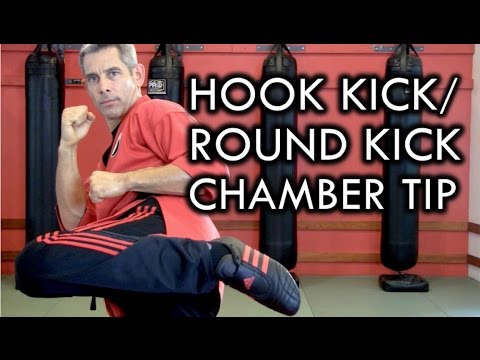
Think of the hook kick as a modified side kick rather than a fancy separate technique. According to Ando Mierzwa, you chamber and stick out your foot like a side kick, but aim it off the center line so it curves around the target.
Ando Mierzwa recommends imagining you're setting your leg on a table at the proper height, or using an actual table to practice—this helps you understand the correct chamber position before executing the kick.
TN AEON MARTIAL ARTS teaches multiple approaches: you can step forward with your back foot to close distance, slide forward by stepping with your front foot and pushing off your back foot, or use a hop step by faking a front leg kick before bringing it back down and throwing the back kick.
According to TN AEON MARTIAL ARTS, first learn the tornado round kick motion by bringing your back knee up and jumping, then put that leg down and throw a back kick. The key is maintaining proper rhythm and timing between the fake and the actual kick.
The Spin-Forward Hook Back Kick combines a forward spin with a back kick that hooks at the end, creating a complex multi-phase attack. The forward spin closes distance, the back kick delivers power, and the hook redirects the strike around the opponent's defence.
The Spin-Forward Hook Back Kick is a specialised variant documented in cross-style kicking methodology. It represents an advanced development of the standard back kick.
Unified MMA: legal — Legal striking technique; WBC/Boxing: banned — All kicks prohibited in boxing; WKF: legal — Legal, chudan (body) kick scores 2 points, jodan (head) kick scores 3 points; Kyokushin: legal — Legal at full power to body and head; WT: legal — Legal, body kick 2 points, head kick 3 points, spinning body 4 points, spinni…; WAKO: legal — Legal in Full Contact and Low Kick formats; K: legal — 1/GLORY — Legal; IFMA: legal — Legal — kicks are a core Muay Thai technique
Danger rating 6/10. Back Kick variant with standard striking power
The standard setup chain: Feint → Spin-Forward Hook Back Kick → Follow-up combination.
Standard counters include: Step inside range / Block and counter / Low kick to support leg.
Common variants: High variant; Mid variant; Low variant.
Primarily a training, demonstration, and point-fighting technique. Rarely seen in full-contact MMA or kickboxing due to acrobatic risk and telegraphing.
Top errors to watch for: Attempting without solid back kick foundation / Poor balance / Insufficient power generation.
The Spin-Forward Hook Back Kick is also known as Supin Fowādo Fukku Bakku Kikku, Forward-Spinning Hook Back Kick.