Raymond Daniels - How to Set up and Land Spin Back Kicks with Power for Kickboxing / MMA
0
Spin-Back Back Kick·Stuart Tomlinson
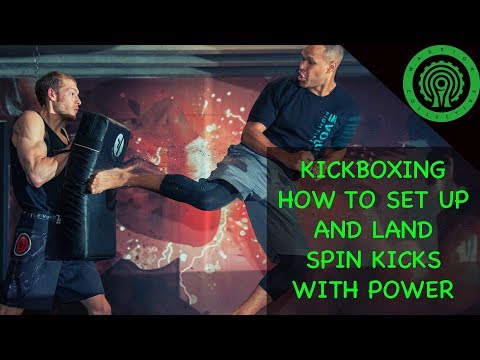
Spinning back kicks are a hugely powerful tool for anyone who can set them up and land them like Raymond Daniels can. Vi…
Translation: spinning back kick
The Spin-Back Back Kick combines a 180-degree spin with a straight back kick, using rotational momentum to increase the power of the heel thrust. [1] The fighter pivots on the lead foot, rotates the body backward while sighting the target over the shoulder, and drives the rear leg straight back as the rotation completes. [1] The spin adds significant power to what is already one of the strongest kicks in martial arts. [1] Unlike the standard back kick which is thrown from a static position, the spin-back version is typically used as an offensive technique to close distance while attacking. [1]
Practiced across Taekwondo, kickboxing, and MMA. Popularized in sport karate and TKD tournament competition from the 1970s onward. [1]
High-risk, high-reward technique seen in MMA, kickboxing, and TKD competition. Multiple notable KOs in UFC and GLORY kickboxing. Less common than standard kicks but spectacular when it lands. [1]
No images yet for this technique.
Sign in to suggest an image.
Spinning back kicks are a hugely powerful tool for anyone who can set them up and land them like Raymond Daniels can. Vi…
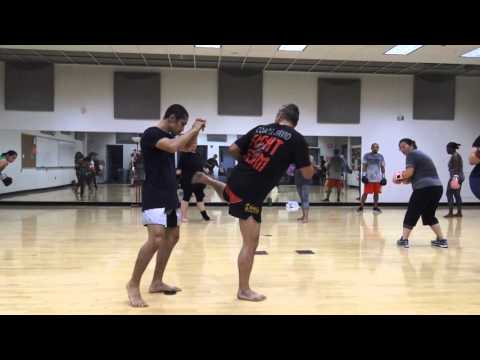
Professional Thai Boxing Ming Freeman teaches the students at West Los Angeles College the basic Spin Back Kick with a s…
The spin-back back kick is executed by stepping toward the opponent while simultaneously looking over the shoulder and rotating the hips to generate power, then driving the leg straight backward in a linear motion similar to a donkey kick. Both BAM Channel and Stuart Tomlinson emphasize the critical importance of the initial step and shoulder check to establish proper distance and alignment before committing to the kick. BAM Channel stresses stepping to the front foot, looking over the shoulder, and firing the kick straight back without allowing the leg to swing around, noting that failure to step properly will cause the kick to arc and miss the target. Tomlinson adds tactical context for combat applications, detailing two primary entry methods: a defensive approach where the fighter stays close and creates space afterward via cross-out footwork, and an offensive approach where stepping forward closes the gap before executing the spin. Tomlinson emphasizes maintaining low posture to generate torque and distinguishes between scenarios where the opponent stands firm versus disengages, requiring different foot placement during the spin. Both instructors agree on the fundamental mechanics of the straight-back trajectory and the necessity of pivoting smoothly back to guard position. Tomlinson provides additional emphasis on distance management and the follow-up cross-out step to safely exit after a high-risk technique, while BAM Channel focuses on repetitive drilling of the isolated movement pattern.
Synthesized from 2 instructors
No instructional courses yet for this technique.
Sign in to suggest a course.
Risk of injury to the person this technique is applied to
Rotational + linear force through heel = devastating. Body shots cause organ damage; numerous fights ended by this kick.
Skill level needed to execute this technique reliably
Whether this technique is allowed under major competition rule sets
De Bremaeker, M. & Faige, R. (2010). Essential Book of Martial Arts Kicks. Tuttle Publishing.
[1] De Bremaeker & Faige, Essential Book of Martial Arts Kicks (2010), Section 4.3, pp. 151-153
[1] De Bremaeker & Faige, Essential Book of Martial Arts Kicks (2010), Section 4.3, pp. 151-153
rotational balance, spatial awareness, hip extension power
core obliques, gluteus maximus, hamstrings, calves
You want to be very close and tight to your target—almost with your shoulder against them—while keeping your back foot positioned to create space for the kick itself. Stuart Tomlinson emphasizes getting close enough to throw the spin back kick from punching range, then using footwork to maintain the correct distance.
After landing the kick, create space for yourself by 'crossing out' rather than staying in place. This is important because the spin back kick is a high-risk, high-reward technique that requires distance for safety and to set up follow-up strikes.
The BAM Channel points out that if you don't properly step before firing the kick, the spin will automatically swing your kick around and you'll miss. Make sure you step first, then fire the kick rather than spinning without the correct footwork.
Stuart Tomlinson recommends stepping into the 'hot zone'—closing the gap with a crossover footwork—to generate more power and force as you transition your stance before executing the spin back kick.
The Spin-Back Back Kick combines a 180-degree spin with a straight back kick, using rotational momentum to increase the power of the heel thrust. The fighter pivots on the lead foot, rotates the body backward while sighting the target over the shoulder, and drives the rear leg straight back as the rotation completes.
Combines the power of the static back kick with rotational momentum from a 180-degree turn. Primarily offensive, unlike the static back kick which is defensive/counter.
Unified MMA: Legal: legal — standard striking technique; WKF Karate: Legal: legal — controlled contact required; WT Taekwondo: Legal: legal — kicks are primary scoring technique; WAKO Kickboxing: Legal: legal — full contact permitted
Danger rating 9/10. Extreme — rotational + linear force through heel = devastating. Body shots cause organ damage; numerous fights ended by this kick.
The standard setup chain: Jab-cross to freeze → spin back kick to body → Front kick feint → opponent drops hands → spin to head → Punch combo finisher → spin back kick to liver.
Standard counters include: Angle off during spin / Push forward to disrupt balance / Low kick counter during wind-up.
Common variants: To the midsection (most common target); To the head (maximum damage); With step-in (closes distance before the spin).
High-risk, high-reward technique seen in MMA, kickboxing, and TKD competition. Multiple notable KOs in UFC and GLORY kickboxing.
Top errors to watch for: Arcing the kick during spin — keep thrust straight / Not sighting target — blind spin / Spinning too wide — stay tight / Over-committing — miss = off-balance.
The Spin-Back Back Kick is also known as Kaiten Ushiro Geri, Spinning Back Kick, Reverse Back Kick, Turn-Back Kick, Spinning Back Thrust Kick.