Back Kick Tutorial - Increase Your Power
0
Short Back Kick·Scott Adkins
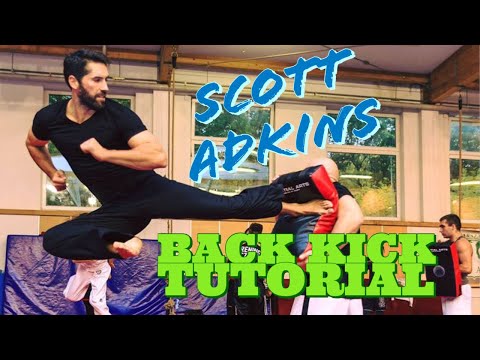
World renowned martial artist Scott Adkins teaches you how to improve the speed and power of the BACK KICK. One of the m…
Translation: Short back kick — a compact back kick with minimal leg extension, optimised for very close range where a full back kick would over-extend
The Short Back Kick is a compact variant of the back kick that uses minimal leg extension to deliver the heel into a target directly behind the practitioner, optimised for very close range situations where a full-extension back kick (ushiro geri kekomi) would over-extend and miss or lose power. [1] The technique resembles a mule's kicking motion — hence the common name 'Mule Kick' — with a short, sharp hip extension that drives the heel straight backward into the opponent's midsection, groin, knee, or shin from distances as close as 12-18 inches. [1] While the standard back kick chambers the knee high and thrusts the leg out to full extension (reaching targets 3-4 feet behind), the Short Back Kick keeps the knee relatively low and the extension minimal — the power comes from a sharp hip extension (gluteal contraction) rather than a full leg thrust, producing a compact, fast kick that operates in the space between clinch range and standard kicking range. [1] De Bremaeker and Faige document the Short Back Kick as the close-range member of the back kick family, filling the tactical gap where the opponent is too close for a standard back kick but positioned behind the practitioner — a common situation in multiple-attacker scenarios, after a missed spinning technique, or when the opponent circles to the practitioner's rear quarter. [1] In MMA, the Short Back Kick has been used effectively against opponents who circle behind the fighter during cage-wall exchanges — the compact kick fires backward without the fighter needing to fully turn around, maintaining their position against the cage while punishing the opponent's circling movement. [2] The technique's simplicity — it is essentially a backward hip thrust with the heel — makes it accessible to beginners while remaining effective at the highest levels. [1]
The Short Back Kick exists in various forms across virtually all kicking martial arts as the natural solution to the close-range rear-threat problem. [1] In karate, short backward kicks appear as applications (bunkai) of certain kata movements. In taekwondo, the abbreviated back kick is taught as a close-range variant of dwi chagi. [1] The 'mule kick' name comes from the visual resemblance to a mule or horse's kicking motion — a short, sharp backward thrust of the hind leg — and has been used colloquially in martial arts and MMA commentary for decades. [2] Krav Maga incorporates the Short Back Kick as a standard response to rear approaches and rear clinching, recognising that self-defence situations rarely provide the space for full-extension back kicks. [1] De Bremaeker and Faige documented the technique as the close-range variant in the back kick family (Section 4.2) in their 2010 compilation. [1]
The Short Back Kick fills a specific tactical gap: situations where the opponent is close behind and there is insufficient distance or time for a full back kick, spinning technique, or turn-and-face response. [1] Its simplicity (backward hip thrust) makes it one of the most reliable techniques under stress — there is no complex chamber, spin, or visual tracking required. [1] In self-defence, the Short Back Kick to the knee or groin is considered one of the most effective first-response techniques to a rear approach because it operates without needing to see the attacker or turn around. [1] In MMA, the compact backward kick has been used against cage-wall circling and in clinch exchanges where the opponent shifts to the fighter's back. [2]
Universal martial arts technique (appears independently in karate, TKD, kung fu, self-defence systems) → documented as the close-range back kick variant by De Bremaeker & Faige (2010). [1]
The Short Back Kick is used in MMA cage exchanges when the opponent circles to the fighter's back. In self-defence scenarios, the backward kick to the knee or groin is a standard first-response technique. The 'mule kick' has been called by UFC commentators during cage-clinch exchanges where fighters fire short backward kicks to the opponent's lead leg.
No images yet for this technique.
Sign in to suggest an image.
World renowned martial artist Scott Adkins teaches you how to improve the speed and power of the BACK KICK. One of the m…
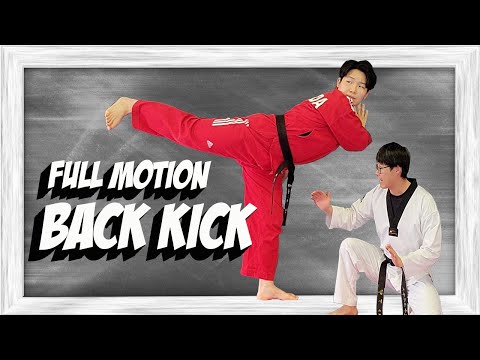
It was very fun and exciting to make a "Full motion Back KICK" tutorial video. I am not the "Best" but I will try hard t…
The back kick is executed from a fighting stance through a three-step sequence: stepping or switching the feet to create a clear line of sight, rotating the body 180 degrees, and driving the heel straight backward toward the target. Both Scott Adkins and Kids Taekwondo Canada emphasize keeping the hips low and facing away from the opponent—not elevated as in a side kick—to maintain a direct, efficient trajectory. Scott Adkins stresses pushing off the floor immediately upon weight transfer to generate power from ground reaction force and hip rotation, avoiding the common error of chambering the knee first, which dissipates momentum. Kids Taekwondo Canada recommends locking the supporting arm against a wall to control shoulder opening and ensuring the kicking leg stays close to the support leg during extension to prevent the knee from flaring outward. Both instructors note that telegraphing is a significant weakness; Adkins recommends disguising the technique through seamless weight switches and feints, while Kids Taekwondo Canada advises pushing hard off the ground just before the kick to maintain surprise. The heel strikes with power concentrated through hip drive and floor force, making it among the most devastating kicks in martial arts.
Synthesized from 2 instructors
No instructional courses yet for this technique.
Sign in to suggest a course.
Risk of injury to the person this technique is applied to
The Short Back Kick's compact range limits its power compared to a full back kick, but the heel's hard surface and the gluteal muscle's raw force produce a genuinely painful and disruptive impact. When targeting the knee (a common application), the backward-directed force hyperextends the joint from behind — one of the knee's most vulnerable loading directions. When targeting the groin, even moderate force is incapacitating. [1]
Skill level needed to execute this technique reliably
Whether this technique is allowed under major competition rule sets
Essential Book of Martial Arts Kicks (De Bremaeker & Faige, 2010)
description: [1] De Bremaeker 2010 pp.148-150
Standard katakana transliteration of Western martial arts terminology (外来語) — used in Japanese MMA, boxing, and BJJ communities
description: [1] De Bremaeker 2010 pp.148-150
Minimal flexibility requirements (no high kick required — the kick operates at knee-to-waist level)
Strong gluteal muscles for the hip extension power source
Good proprioception for targeting behind the body without visual tracking
Balance on the standing leg during the backward thrust
Accessible to ALL body types and fitness levels — this is one of the simplest kicks in martial arts
You want to kick with your heel higher than your toes, and keep your knee down rather than raised up. Scott Adkins emphasizes that raising your knee up will open your hip and compromise the technique.
Many people incorrectly raise their hip or turn it like a side kick, when instead you should keep your hip down and your back facing the target, maintaining a straight line directly backward into your opponent. Scott Adkins notes that chambering the knee high wastes the power generated from pushing off the floor.
Keep your kicking leg slightly touching your support leg to prevent your knee from opening outward, and focus on kicking straight back rather than at an angle. Kids Taekwondo Canada emphasizes that keeping shoulders straight and aiming over your shoulder helps maintain this direct trajectory.
The Short Back Kick is a compact variant of the back kick that uses minimal leg extension to deliver the heel into a target directly behind the practitioner, optimised for very close range situations where a full-extension back kick (ushiro geri kekomi) would over-extend and miss or lose power. The technique resembles a mule's kicking motion — hence the common name 'Mule Kick' — with a short, sharp hip extension that drives the heel straight backward into the opponent's midsection, groin, knee, or shin from distances as close as 12-18 inches.
The Short Back Kick exists in various forms across virtually all kicking martial arts as the natural solution to the close-range rear-threat problem. In karate, short backward kicks appear as applications (bunkai) of certain kata movements.
Unified MMA: legal — Legal striking technique; WBC/Boxing: banned — All kicks prohibited in boxing; WKF: legal — Legal, chudan (body) kick scores 2 points, jodan (head) kick scores 3 points; Kyokushin: legal — Legal at full power to body and head; WT: legal — Legal, body kick 2 points, head kick 3 points, spinning body 4 points, spinni…; WAKO: legal — Legal in Full Contact and Low Kick formats; K: legal — 1/GLORY — Legal; IFMA: legal — Legal — kicks are a core Muay Thai technique
Danger rating 6/10. The Short Back Kick's compact range limits its power compared to a full back kick, but the heel's hard surface and the gluteal muscle's raw force produce a genuinely painful and disruptive impact. When targeting the knee (a common application), the backward-directed force hyperextends the joint from behind — one of the knee's most vulnerable loading directions. When targeting the groin, even moderate force is incapacitating.
The standard setup chain: Threat detected behind the practitioner (grab, approach, circling movement) → WITHOUT turning around: fire the Short Back Kick by extending the hip backward → Heel drives into the target (knee, groin, thigh, shin) behind → Opponent reacts to pain/disruption → Use the bought time to TURN and face the threat → Continue with forward-facing techniques → In MMA: opponent circles to the back quarter during cage exchange → fire the Short Back Kick to their lead knee → opponent stops circling → reset position and continue cage work.
Standard counters include: Step to the side — the Short Back Kick travels straight backward; stepping laterally avoids it / Maintain distance — the kick has very short range (12-18 inches); staying beyond this distance negates it / Block with the thigh — turning the lead thigh to absorb the kick on the quadriceps rather than the knee joint / Grab the kicking leg — if the backward kick is anticipated, grabbing the foot or ankle from behind creates a takedown….
Common variants: Standard Mule Kick (straight backward heel thrust at body level); Low Mule Kick (targeting the opponent's lead knee or shin from behind); Groin Mule Kick (targeting the groin directly (self-defence only)); Stamping Short Back Kick (driving the foot downward and backward onto the opponent'…); Rapid-fire Short Back Kick (multiple quick backward thrusts in succession); Spinning Short Back Kick (a minimal spin (45-90°) combined with the short thrust fo…).
The Short Back Kick is used in MMA cage exchanges when the opponent circles to the fighter's back. In self-defence scenarios, the backward kick to the knee or groin is a standard first-response technique.
Top errors to watch for: Over-extending — kicking too far back converts the Short Back Kick into a standard back kick, losing the close-range … / Using the quadriceps instead of the glutes — pushing backward with the leg muscles produces a weaker kick than drivin… / Kicking with the sole instead of the heel — the sole distributes force; the heel concentrates it. Dorsiflex the ankle… / Losing balance forward — the backward kick naturally pushes the body forward; the standing leg must be braced to prev….
The Short Back Kick is also known as Shōto Bakku Kikku, Mule Kick, Close-Range Back Kick, Ushiro Geri Keage (short version), Donkey Kick.