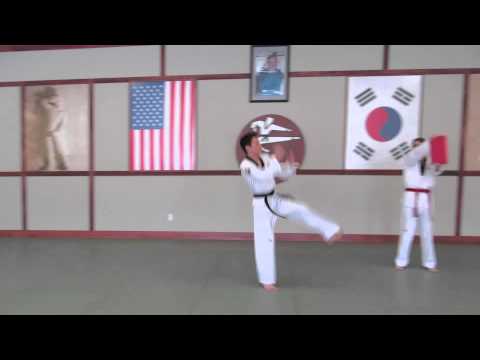
video 3 Flying Back kick Comp
0
Flying Back Kick·US Taekwondo Center - World Headquarters
Translation: flying back kick
The Flying Back Kick (Twimyo Dwit Chagi) is a back kick executed with a jumping/flying motion, delivering a powerful heel thrust while airborne. [1] The principle is the same as a standard back pushing kick except the fighter becomes airborne before impact, adding the body's dropping weight to the kick's force. [1] The technique requires the fighter to jump, rotate to sight the target over the shoulder, and drive the heel backward — all while in the air. It is one of the most powerful but highest-risk kicking techniques in the TKD arsenal. [1]
The Flying Back Kick (Twimyo Dwit Chagi) is documented in General Choi's Taekwon-Do encyclopedia as one of the flying kick category techniques. [1] The principle is the same as a standard back pushing kick with the addition of airborne execution. It is also practiced in karate and kickboxing as an advanced technique. [1]
One of the most powerful kicks when it lands — the airborne body weight combined with the heel thrust creates devastating impact. [1] However, the airborne state means the kicker is committed and vulnerable if the kick misses. High risk, high reward. Used primarily as a finishing technique against hurt or retreating opponents.
Practiced across Taekwondo, karate, and wushu. TKD lineage: General Choi Hong Hi → ITF/WT systems. Karate lineage: Okinawan te → Japanese karate. [1]
Primarily a training, demonstration, and point-fighting technique. Rarely seen in full-contact MMA or kickboxing due to acrobatic risk and telegraphing. Appears occasionally in TKD and point-fighting karate tournaments. [1]
No images yet for this technique.
Sign in to suggest an image.
No instructional courses yet for this technique.
Sign in to suggest a course.
Risk of injury to the person this technique is applied to
Airborne heel thrust generates enormous force. Landing risk if technique misses.
Skill level needed to execute this technique reliably
Whether this technique is allowed under major competition rule sets
Choi, H.H. (1999). Condensed Encyclopedia of Taekwon-Do. International Taekwon-Do Federation.
[1] Choi, Condensed Encyclopedia of Taekwon-Do (1999), Flying Kicks section
[1] Choi, Condensed Encyclopedia of Taekwon-Do (1999), Flying Kicks section
explosive leg power for the jump, flexibility, spatial awareness while airborne
calves + quadriceps (jump), gluteus maximus (thrust), core (stability in air)
Documented in De Bremaeker & Faige, Section 4.7. Combines a jumping entry with the back kick — closes distance while generating the most powerful kick in the martial arts arsenal. The flying version adds height and momentum to the already devastating back kick force. (De Bremaeker & Faige, Essential Book of Martial Arts Kicks, 2010)
The flying back kick consists of three parts: the run, the jump, and the kick. According to US Taekwondo Center - World Headquarters, mastering each phase in sequence is essential for executing the technique properly.
Keep your hips straight and recoil your arms in the opposite direction of the kick to maintain balance. US Taekwondo Center - World Headquarters emphasizes looking at your target while executing this arm movement, then returning with a snap before landing.
Allowing your hips to open during the technique will result in a side kick instead. US Taekwondo Center - World Headquarters recommends keeping both hands flat on the ground during practice to prevent your hips from opening.
The Flying Back Kick (Twimyo Dwit Chagi) is a back kick executed with a jumping/flying motion, delivering a powerful heel thrust while airborne. The principle is the same as a standard back pushing kick except the fighter becomes airborne before impact, adding the body's dropping weight to the kick's force.
The Flying Back Kick (Twimyo Dwit Chagi) is documented in General Choi's Taekwon-Do encyclopedia as one of the flying kick category techniques. The principle is the same as a standard back pushing kick with the addition of airborne execution.
Unified MMA: Legal: legal — standard striking technique; WKF Karate: Legal: legal — controlled contact required; WT Taekwondo: Legal: legal — kicks are primary scoring technique; WAKO Kickboxing: Legal: legal — full contact permitted; IFMA Muay Thai: Legal: legal — all strikes permitted
Danger rating 7/10. High — airborne heel thrust generates enormous force. Landing risk if technique misses.
The standard setup chain: Hurt opponent retreating → close distance with flying back kick → Jab-cross stuns opponent → flying back kick to finish → Off the cage/ropes.
Standard counters include: Step to the side — the kick is committed to one line / Push forward — disrupt the jump before the kick launches / Duck and level change — the airborne kicker can't adjust height.
Common variants: Straight jump (minimal rotation, maximum thrust); With spin (180° rotation adds power); Step-through (forward step then jump and kick backward).
Primarily a training, demonstration, and point-fighting technique. Rarely seen in full-contact MMA or kickboxing due to acrobatic risk and telegraphing.
Top errors to watch for: Jumping backward instead of upward — reduces kick height and power / Not sighting the target — kicking blind dramatically reduces accuracy / Landing on the kicking foot too hard — knee injury risk / Telegraphing the jump with excessive preparation.
The Flying Back Kick is also known as Tobi Ushiro Geri, Twimyo Dwit Chagi, Flying Back Thrust Kick, Jumping Back Kick, Airborne Back Kick.