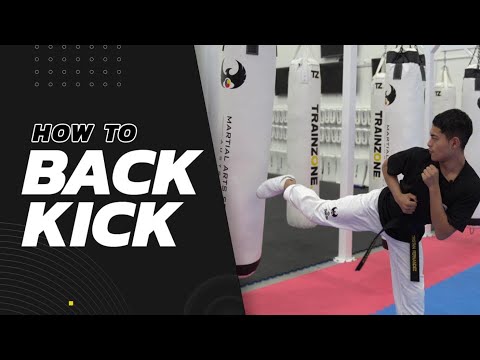
How to Back Kick | Martial Arts Spirit Tutorials
0
Downward Back Kick·Martial Arts Spirit
How to Back Kick | Martial Arts Spirit Tutorials In this tutorial we go through the steps to execute a Back Kick. Ple…
Translation: Downward back kick — a back kick directed downward and behind, targeting the opponent's knee, shin, or foot from above, driving the heel as a stomp
The Downward Back Kick drives the heel downward and backward at approximately 30-45° below horizontal, targeting the opponent's knee joint, shin, or instep (top of the foot) from behind — a stomping back kick that attacks the structural integrity of the opponent's legs rather than their body. [1] The technique combines the backward direction of the standard back kick with the downward stomping trajectory of the oblique kick, creating a hybrid that targets the most structurally vulnerable part of the human body — the knee — from the direction the knee is least able to resist force (from above-behind). [1] The human knee is a hinge joint designed to flex and extend along a single axis; forces applied from above and behind force the joint to buckle forward (hyperflexion), which can tear the ACL, PCL, and popliteal ligaments that stabilise the joint. [1] De Bremaeker and Faige document the Downward Back Kick as one of the back kick variants, noting its tactical application when the opponent is standing close behind the practitioner — the downward trajectory targets the lead leg's knee, which is the opponent's primary weight-bearing structure in that position. [1] The technique is sometimes called the 'Donkey Kick' because it resembles the kicking motion of a donkey — a powerful downward-backward stamp that drives the heel into whatever is behind and below the animal. [1] In MMA, the oblique kick to the knee (a related front-facing technique popularised by Jon Jones) has demonstrated the devastating effectiveness of stomping kicks to the knee joint — the Downward Back Kick applies the same principle from a rearward direction. [2] In self-defence, the Downward Back Kick is one of the most effective responses to being grabbed from behind: the heel stomps down onto the attacker's shin, knee, or instep without requiring the defender to turn around. [1]
The downward back kick or rear stomp has existed in martial arts for as long as humans have fought in close quarters — stomping backward onto an attacker's leg is an instinctive defensive response that appears across every culture's fighting tradition. [1] In Krav Maga, the rear stomp to the knee, shin, and instep is taught as a foundational self-defence response to rear attacks, reflecting Imi Lichtenfeld's principle that the simplest techniques are the most effective under stress. [1] In traditional karate and taekwondo, downward back kicks appear as bunkai (applications) of kata movements involving rear-stamping motions. [1] De Bremaeker and Faige documented the Downward Back Kick as Section 4.9 in their 2010 compilation, noting its cross-cultural universality and its particular value in self-defence scenarios involving rear attacks. [1] The Jon Jones-popularised oblique kick to the knee (a front-facing variant of the same downward-stomping principle) demonstrated in the UFC that knee-targeting stomps are devastatingly effective even against world-class athletes. [2]
The Downward Back Kick is one of the most effective self-defence techniques available because it targets the knee — a joint that cannot be conditioned or strengthened to resist stomping forces from above. [1] Unlike body targets (which can be hardened through conditioning) or the head (which can be protected by a guard), the knee is always vulnerable to axial loading from above, and damage to the knee immediately eliminates the attacker's ability to stand, chase, or mount further offence. [1] The technique requires no skill, flexibility, or conditioning to execute at a basic level — stomping backward onto a leg is a gross motor movement that works under extreme adrenal stress. [1] In MMA, the related oblique kick to the knee has altered the strategic landscape of the sport, with fighters now having to defend their knees as a primary concern. [2]
Universal martial arts technique (stomping backward onto an attacker's leg is instinctive) → codified in Krav Maga as a foundational rear-defence response → documented across karate, TKD, and self-defence systems → De Bremaeker & Faige (2010) cross-style compilation. Related front-facing variant (oblique kick) popularised in MMA by Jon Jones (2011+). [1],[2]
The Downward Back Kick is primarily a self-defence technique. In MMA, the related oblique kick (front-facing knee stomp) has been used by Jon Jones, Anderson Silva, and others to damage opponents' knees during UFC title fights. The backward-directed variant is used in cage-clinch situations where the opponent is behind the fighter.
No images yet for this technique.
Sign in to suggest an image.
How to Back Kick | Martial Arts Spirit Tutorials In this tutorial we go through the steps to execute a Back Kick. Ple…
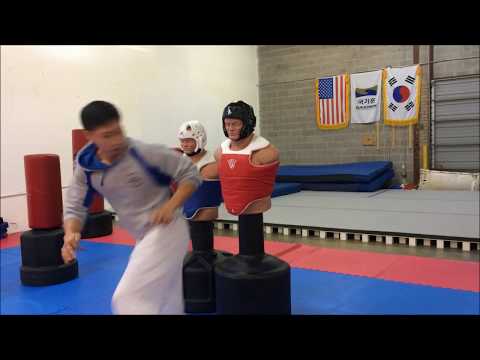
Not a tutorial this time guys. JUST 3 TIPS. This one is kinda..random
The downward back kick is executed as a direct, efficient strike characterized by minimal movement and compact chamber mechanics. Both Martial Arts Spirit and HwarangSam emphasize the importance of turning to face away from the target while maintaining a closed body position, though they diverge on execution style. Martial Arts Spirit prescribes a methodical six-step breakdown: turn, look over the shoulder, chamber the leg vertically upward, keep the foot pointing downward rather than to the side, extend powerfully, and drop the leg. The instructor stresses that the chamber should travel in a straight line toward the target, differentiating this "tuck" variation from side-arc approaches used in other martial arts traditions. HwarangSam critiques improper technique distinctions, clarifying that a true back kick differs from a spinning side kick through hip orientation and knee positioning—the hips rotate downward and backward rather than outward, producing power comparable to an uppercut in boxing. HwarangSam also addresses common errors: spinning rather than turning, foot landing past the centerline, and loss of the compact motion. Both instructors stress progression from slow, controlled practice to faster, more powerful execution, with emphasis on maintaining balance and avoiding telegraphing the technique to prevent counter-attacks.
Synthesized from 2 instructors
No instructional courses yet for this technique.
Sign in to suggest a course.
Risk of injury to the person this technique is applied to
The Downward Back Kick targeting the knee is one of the most injurious legal techniques available. The knee joint is structurally vulnerable to axial loading from above — a full-force Downward Back Kick can cause: ACL tears, PCL tears, MCL sprains, meniscus damage, patellar dislocation, and complete knee hyperflexion. The shin and instep targets are less dangerous but still produce significant pain and potential fractures (tibial stress fracture, metatarsal fracture). [1] In self-defence, the technique is considered a 'fight-ender' because knee damage immediately eliminates the attacker's ability to stand and pursue. [1]
Skill level needed to execute this technique reliably
Whether this technique is allowed under major competition rule sets
Essential Book of Martial Arts Kicks (De Bremaeker & Faige, 2010)
description: [1] De Bremaeker 2010 pp.161-162
Standard katakana transliteration of Western martial arts terminology (外来語) — used in Japanese MMA, boxing, and BJJ communities
description: [1] De Bremaeker 2010 pp.161-162
Minimal physical requirements — stomping backward is a gross motor movement accessible to ALL body types, ages, and fitness levels
No flexibility required
No special conditioning needed
Strong enough legs to stomp (legs used in walking are sufficient)
This is one of the most accessible techniques in all of martial arts
With a side kick, your hip bone rotates outward during extension. With a back kick, your hip should turn more downward so the extension goes behind you, toward your back—matching the name of the technique.
Over-rotating is the main issue—when you kick, your foot ends up past the center line and your body opens up, creating an opportunity for a counter attack. According to HwarangSam, avoiding this mistake is essential.
Every action should be as small and minimal as possible to stay efficient toward your target. Martial Arts Spirit emphasizes keeping your leg as close as you can to your supporting leg during the chamber and extension phases.
When your foot goes to the side, you open up your body. Keeping your foot facing down during the chamber keeps your shoulders closed off and facing backward, protecting your torso.
The Downward Back Kick drives the heel downward and backward at approximately 30-45° below horizontal, targeting the opponent's knee joint, shin, or instep (top of the foot) from behind — a stomping back kick that attacks the structural integrity of the opponent's legs rather than their body. The technique combines the backward direction of the standard back kick with the downward stomping trajectory of the oblique kick, creating a hybrid that targets the most structurally vulnerable part of the human body — the knee — from the direction the knee is least able to resist force (from above-behind).
The downward back kick or rear stomp has existed in martial arts for as long as humans have fought in close quarters — stomping backward onto an attacker's leg is an instinctive defensive response that appears across every culture's fighting tradition. In Krav Maga, the rear stomp to the knee, shin, and instep is taught as a foundational self-defence response to rear attacks, reflecting Imi Lichtenfeld's principle that the simplest techniques are the most effective under stress.
Unified MMA: legal — Legal striking technique; WBC/Boxing: banned — All kicks prohibited in boxing; WKF: legal — Legal, chudan (body) kick scores 2 points, jodan (head) kick scores 3 points; Kyokushin: legal — Legal at full power to body and head; WT: legal — Legal, body kick 2 points, head kick 3 points, spinning body 4 points, spinni…; WAKO: legal — Legal in Full Contact and Low Kick formats; K: legal — 1/GLORY — Legal; IFMA: legal — Legal — kicks are a core Muay Thai technique
Danger rating 8/10. The Downward Back Kick targeting the knee is one of the most injurious legal techniques available. The knee joint is structurally vulnerable to axial loading from above — a full-force Downward Back Kick can cause: ACL tears, PCL tears, MCL sprains, meniscus damage, patellar dislocation, and complete knee hyperflexion. The shin and instep targets are less dangerous but still produce significant pain and potential fractures (tibial stress fracture, metatarsal fracture). In self-defence, the technique is considered a 'fight-ender' because knee damage immediately eliminates the attacker's ability to stand and pursue.
The standard setup chain: Threat from behind detected (grab, clinch, approach) → WITHOUT turning: drive the heel downward and backward at 30-45° below horizontal → Target: opponent's lead knee (primary), shin, or instep → Heel impacts the target from above → Knee hyperflexes, shin bruises, or instep fractures → Attacker's base is damaged, grip loosens → Turn to face the threat → Continue with forward-facing techniques → In self-defence: rear bear hug → downward back kick to shin/knee → attacker loosens grip → hip escape or turn → counter-attack → disengage.
Standard counters include: Maintain distance from behind — the stomp has very short range (12-18 inches); standing beyond this distance negates it / Angle the lead leg — turning the knee outward reduces the knee's vulnerability to the downward axial force / Step to the side — lateral positioning avoids the straight-backward stomp trajectory / Release the grip — if grabbing the opponent from behind, releasing the grip before the stomp lands avoids the knee da….
Common variants: Knee stomp back kick (targeting the back of the opponent's knee (popliteal foss…); Shin stomp back kick (targeting the opponent's shin for pain and potential tibi…); Instep stomp (targeting the top of the opponent's foot for metatarsal f…); Sweeping downward back kick (adding a slight lateral component to the stomp, sweeping …); Heavy stomp (a committed, full-weight stomp where the kicker drives th…).
The Downward Back Kick is primarily a self-defence technique. In MMA, the related oblique kick (front-facing knee stomp) has been used by Jon Jones, Anderson Silva, and others to damage opponents' knees during UFC title fights.
Top errors to watch for: Kicking backward instead of downward — the most critical error: if the kick travels straight backward (horizontal), i… / Not dorsiflexing the ankle — the HEEL must be the contact surface for maximum damage to the knee; kicking with the so… / Stomping too high — targeting above the knee (thigh) produces a bruise but no structural damage; the kick must target… / Missing the leg entirely — without visual tracking (the kick fires behind), accuracy depends on spatial awareness; pr….
The Downward Back Kick is also known as Daunwādo Bakku Kikku, Donkey Kick, Stomping Back Kick, Rear Stomp Kick, Downward Heel Back Kick.