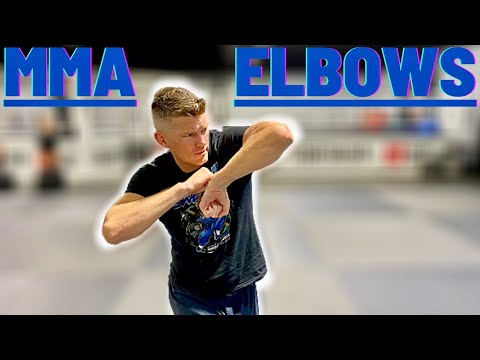
Why Elbows are So Effective In MMA & How To Throw Them!
0
Standard Rising Elbow·Stephen Wonderboy Thompson·Added by Admin
Elbows are so effective in MMA not only because of the power they can generate but also because of their slicing abiliti…
Translation: standard rising elbow
The Standard Rising Elbow is the fundamental upward elbow strike where the fighter drops the elbow to hip or waist level and then explosively drives it upward into the opponent's chin or jaw. [1] The arm remains bent at a tight angle, and the force is generated primarily by hip extension and leg drive pushing the body upward while the shoulder guides the elbow to the target. [1],[2] The standard rising elbow is most effective in the clinch or at very close punching range, particularly when the opponent's posture is upright and the chin is exposed. [2],[3]
The standard rising elbow. [1]
From Muay Thai. [1]
Used in MMA. [1]
No images yet for this technique.
Sign in to suggest an image.
Elbows are so effective in MMA not only because of the power they can generate but also because of their slicing abiliti…
No instructional courses yet for this technique.
Sign in to suggest a course.
Risk of injury to the person this technique is applied to
Rising elbow; targets chin from below
Skill level needed to execute this technique reliably
Whether this technique is allowed under major competition rule sets
Muay Thai: The Art of Fighting (Yod Ruerngsa, Khun Kao Charuad & James Cartmell, 2002)
Alias sources — [1] Muay Thai Unleashed (Delp, 2006) [2] Muay Thai: The Art of Fighting (Kraitus & Kraitus, 1988) [3] WBC Muay Thai Rules (2014)
Effectiveness sources — [1] Muay Thai Unleashed (Delp, 2006)
Mixed Japanese-Western terminology — combines traditional Japanese terms with katakana loanwords
Alias sources — [1] Muay Thai Unleashed (Delp, 2006) [2] Muay Thai: The Art of Fighting (Kraitus & Kraitus, 1988) [3] WBC Muay Thai Rules (2014)
Effectiveness sources — [1] Muay Thai Unleashed (Delp, 2006)
hand speed, hip rotation, wrist alignment on impact
proportional reach, strong wrists, fast-twitch shoulder muscles
deltoids, pectorals, triceps, core rotators, forearms
The Standard Rising Elbow is the fundamental upward elbow strike where the fighter drops the elbow to hip or waist level and then explosively drives it upward into the opponent's chin or jaw. The arm remains bent at a tight angle, and the force is generated primarily by hip extension and leg drive pushing the body upward while the shoulder guides the elbow to the target.
The standard rising elbow is one of the primary elbow techniques taught in Muay Thai, forming part of the fundamental elbow curriculum alongside horizontal and downward variations. It is regularly seen in Thai stadium fights when fighters break from the clinch.
Unified MMA: legal — Legal — all elbow strikes permitted; WBC/Boxing: banned — All elbow strikes prohibited in boxing; WKF: banned — Elbow strikes not a legal technique in sport karate; Kyokushin: banned — Elbow strikes prohibited; WT: banned — Prohibited; ITF: banned — Prohibited; WAKO: banned — Prohibited in all kickboxing formats; K: banned — 1/GLORY — Prohibited — key difference from Muay Thai; IFMA: legal — Legal — elbows are a core Muay Thai weapon (art of eight limbs)
Danger rating 7/10. Very High — rising elbow; targets chin from below
The standard setup chain: Close Distance → Hip Rotation → Strike with Elbow Point.
Standard counters include: Lean Back — pull the head out of elbow range to avoid the short-range strike / Clinch Tie-Up — close to body-to-body range to smother elbow strikes / Push Kick (Teep) — maintain distance to prevent elbow range from being established.
Common variants: Horizontal elbow (swinging the elbow horizontally at head level); Uppercut elbow (rising elbow from below targeting the chin); Downward elbow (chopping the elbow straight down (Muay Thai sok tat)); Spinning elbow (full rotation before driving the elbow into the target).
Used in MMA.
Top errors to watch for: Not loading the dip before driving upward — without the depth change, the elbow has no explosive pop / Lifting the arm without hip and leg engagement / Hitting the opponent's chest guard instead of targeting under the chin / Over-extending upward and losing base.
The Standard Rising Elbow is also known as Sutandādo Age Hiji, Standard Uppercut Elbow, Sok Ngat, Vertical Rising Elbow.