Strike & defenceLocksClose rangeFighting multiple people
Distance
CloseMiddleLong
Limb angle
Zero180–135°135–90°90–45°45–0°
Body target
Upper bodyMiddle bodyLower body
Overview
The Standard Horizontal Elbow Strike is the textbook execution of the horizontal elbow, where the fighter pivots on the lead foot, rotates the hips and shoulders, and drives the point of the elbow laterally into the opponent's temple or jaw. [1] Contact is made with the tip of the olecranon process, and the arm remains tightly bent at approximately 90 degrees throughout the strike to maintain structural rigidity. [1],[2] This strike is most effective at very close range, often delivered from the clinch or as a counter when an opponent steps into punching range. [2],[3]
Also known as
Sok TatTH[1]Cross ElbowBoxing[2]Horizontal Elbow[3]
The standard horizontal elbow strike is the most fundamental elbow technique in Muay Thai, taught universally in Thai training camps as the first elbow a student learns. [1] It has been a competition staple for over a century of formal Muay Thai ring fighting. [2],[3]
Country of origin· shown in random order
🇹🇭ThailandMuay Thai
🇧🇷BrazilMMA
🇺🇸USAMMA
🇲🇲MyanmarLethwei
🇮🇱IsraelKrav Maga
Effectiveness
The horizontal elbow is the most commonly used elbow strike in Muay Thai competition, valued for its ability to cut opponents and produce stoppages due to lacerations. [1] The sharp olecranon bone concentrates force into a small area, making cuts more likely than with any punch. [1]
Lineage
Horizontal elbows are a core component of Muay Thai's 'eight weapons' system and have been fundamental to the art since before the modern ring era. [1]
Competition Record
In Muay Thai competition at Lumpinee and Rajadamnern stadiums, elbow cuts are one of the most common causes of stoppages. [1] In MMA, Jon Jones has been one of the most effective users of the horizontal elbow, using spinning and clinch elbows to cut opponents in multiple UFC title fights. [2]
Images
No images yet for this technique.
Sign in to suggest an image.
Biomechanical Mechanism
Primary Action — Ballistic extension of the arm — kinetic chain transfers force from the ground through the hips to the fist
Standard Horizontal Elbow Strike·Sean "Muay Thai Guy" Fagan
Ready to unlock your full potential and get daily Muay Thai insights? 💥 Click the link below to join my EXCLUSIVE Nak M…
1 / 2
3 videos
What Instructors Say
The standard horizontal elbow strike is a close-range weapon fundamental to Muay Thai, delivered by rotating the hips and shoulders to drive the elbow across the target at jaw or temple height. EvermoreMuayThai emphasizes initiating the strike by twisting on the rear foot with the thumb pointing downward, then bringing the elbow straight across; this instructor distinguishes the horizontal elbow (sokta) from the diagonal elbow slash (sokti), noting that proper guard placement determines which variant will penetrate an opponent's defense. Sean Fagan and MMA ATLAS both stress that elbows are short-range weapons requiring footwork to close distance and that simultaneous hand positioning is critical for defense—the non-striking hand should protect the head and temples to prevent counter-elbows when in close range. EvermoreMuayThai and MMA ATLAS agree that the motion resembles a hook, using hip and shoulder rotation to generate power, while maintaining a tight guard. All three instructors highlight that accurate target selection and defensive positioning are essential, as throwing an elbow places the striker within elbow range of the opponent. The strike's effectiveness depends on timing, footwork, and understanding that even modest power delivery causes significant damage due to the elbow's point of contact.
Synthesized from 3 instructors
EvermoreMuayThai — Basic Attack - Rear-Hand Horizontal Elbow (Sok Tat / Sok Ti) * | Muay Thai Tips | Thai Boxing World: Detailed mechanical breakdown of rear-hand horizontal elbow, emphasizing foot twist to generate power, hand placement for defense (glove on head), thumb-down positioning, and distinction between sokta (straight horizontal) and sokti (diagonal slash variant). Explained how opponent guard placement determines strike success.
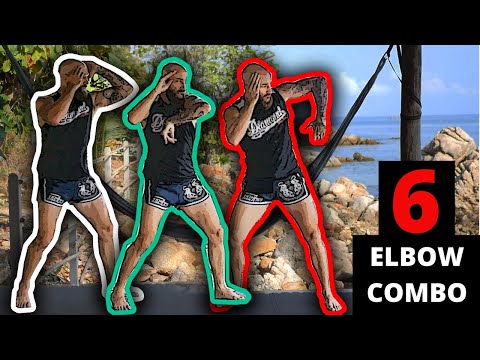
Sean Fagan (Muay Thai Guy) — KILLER Elbow Combo - 6 Badass Muay Thai Elbow Strikes: Established that elbows are short-range weapons requiring footwork and distance coverage; emphasized defensive fundamentals (hands up, chin tucked) since landing an elbow means opponent is in elbow range. Noted that power need not be maximum—even light elbow contact causes significant damage.
MMA ATLAS — Muay Thai Basics: 5 Beginner Elbow Strikes: Described the side/horizontal elbow as moving in horizontal motion with power generation from hip and shoulder leverage (motion similar to a hook). Emphasized keeping the arm tight to the body, maintaining shoulder protection of the jaw, and using proper footwork to close distance.
Learn This Technique
No instructional courses yet for this technique.
Sign in to suggest a course.
Ratings
Danger Rating
Risk of injury to the person this technique is applied to
7
Very High7/10
Slashing elbow; primary laceration-causing strike in Muay Thai
Difficulty
Skill level needed to execute this technique reliably
Intermediate
Competition Legality
Whether this technique is allowed under major competition rule sets
Illegal
WBC/Boxing — All elbow strikes prohibited in boxing {src— WBC Rules of Boxing}
— WKF — Elbow strikes not a legal technique in sport karate
How do I generate power in a horizontal elbow strike?
According to MMA ATLAS, you should use leverage and churn your hips and shoulders when throwing the strike. Professional fighter Sean Fagan emphasizes that when throwing a spear elbow, your feet need to move forward with the strike and you should pop your shoulder slightly to maximize range and power.
What's the difference between a straight horizontal elbow and an elbow slash?
According to Evermore Muay Thai, with a straight sokti (horizontal elbow), you come straight across, but with an elbow slash, your thumb points down at the floor and you draw an upside-down arc that comes down at about a 25-30 degree angle across the eyebrow and back.
Why does my horizontal elbow miss even when I'm at the right distance?
Evermore Muay Thai explains that if your opponent has their gloves at punch range, a straight horizontal elbow thrown from your current position may land on their glove instead of the target; you need to account for their guard placement when timing the strike.
How close do I need to be to land a horizontal elbow strike?
Sean Fagan emphasizes that elbows are short-range weapons, so you need to cover distance and use good footwork by stepping forward to get into proper elbow range before executing the technique.
How does the Standard Horizontal Elbow Strike work?
The Standard Horizontal Elbow Strike is the textbook execution of the horizontal elbow, where the fighter pivots on the lead foot, rotates the hips and shoulders, and drives the point of the elbow laterally into the opponent's temple or jaw. Contact is made with the tip of the olecranon process, and the arm remains tightly bent at approximately 90 degrees throughout the strike to maintain structural rigidity.
Where does the Standard Horizontal Elbow Strike come from?
The standard horizontal elbow strike is the most fundamental elbow technique in Muay Thai, taught universally in Thai training camps as the first elbow a student learns. It has been a competition staple for over a century of formal Muay Thai ring fighting.
Is the Standard Horizontal Elbow Strike legal in competition?
Unified MMA: legal — Legal — all elbow strikes permitted; WBC/Boxing: banned — All elbow strikes prohibited in boxing; WKF: banned — Elbow strikes not a legal technique in sport karate; Kyokushin: banned — Elbow strikes prohibited; WT: banned — Prohibited; ITF: banned — Prohibited; WAKO: banned — Prohibited in all kickboxing formats; K: banned — 1/GLORY — Prohibited — key difference from Muay Thai; IFMA: legal — Legal — elbows are a core Muay Thai weapon (art of eight limbs)
How dangerous is the Standard Horizontal Elbow Strike?
Danger rating 7/10. Very High — slashing elbow; primary laceration-causing strike in Muay Thai
How do I set up the Standard Horizontal Elbow Strike?
The standard setup chain: Close Distance → Hip Rotation → Strike with Elbow Point.
How do I defend against the Standard Horizontal Elbow Strike?
Standard counters include: Lean Back — pull the head out of elbow range to avoid the short-range strike / Clinch Tie-Up — close to body-to-body range to smother elbow strikes / Push Kick (Teep) — maintain distance to prevent elbow range from being established.
What are the variants of the Standard Horizontal Elbow Strike?
Common variants: Horizontal elbow (swinging the elbow horizontally at head level); Uppercut elbow (rising elbow from below targeting the chin); Downward elbow (chopping the elbow straight down (Muay Thai sok tat)); Spinning elbow (full rotation before driving the elbow into the target).
How effective is the Standard Horizontal Elbow Strike in competition?
In Muay Thai competition at Lumpinee and Rajadamnern stadiums, elbow cuts are one of the most common causes of stoppages. In MMA, Jon Jones has been one of the most effective users of the horizontal elbow, using spinning and clinch elbows to cut opponents in multiple UFC title fights.
What are common mistakes when doing the Standard Horizontal Elbow Strike?
Top errors to watch for: Trying to reach too far and opening the arm — if you need to reach, use a hook punch instead / Rotating only the shoulders without the hips, which halves the rotational force / Hitting with the back of the arm or tricep area instead of the olecranon / Not entering close enough — the horizontal elbow requires clinch-to-close range.
What are other names for the Standard Horizontal Elbow Strike?
The Standard Horizontal Elbow Strike is also known as Suihei Hiji-uchi (Kihon-gata), Sok Tat, Cross Elbow, Horizontal Elbow.