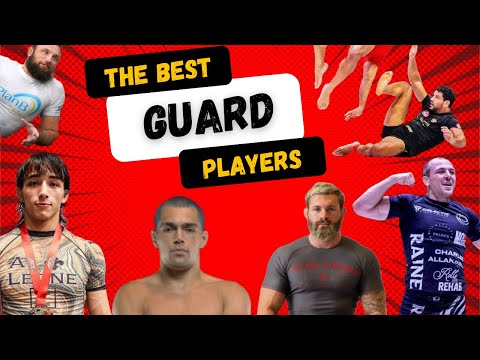
Top 3 Guard Players to Study in Jiu Jitsu (2024)
0
Guard Top·Nate Markham
https://www.youtube.com/channel/UC4W_U64tjAAM8BJypFwobNQ 0:00 Intro 0:24 #3 1:26 #2 2:46 #3 4:31 Closing Note - Other G…
Translation: Guard top
The Guard Top family within the Guard Group covers the techniques and strategies for the top player when trapped inside an opponent's guard — maintaining posture, controlling grips, and working to break the guard open for passing. [1] This family addresses the fundamental challenge of being inside closed guard: the guard player has broken your posture, controls your collar and sleeves, and threatens with armbars, triangles, and sweeps. [1],[2] The top player's survival and advancement depend on maintaining an upright posture, fighting grips, and systematically working to open the guard through standing or kneeling guard breaks. [2],[3]
No images yet for this technique.
Sign in to suggest an image.
https://www.youtube.com/channel/UC4W_U64tjAAM8BJypFwobNQ 0:00 Intro 0:24 #3 1:26 #2 2:46 #3 4:31 Closing Note - Other G…
No instructional courses yet for this technique.
Sign in to suggest a course.
Risk of injury to the person this technique is applied to
Inside guard exposes the top player to triangles, armbars, guillotines, sweeps; poor posture is very dangerous
Skill level needed to execute this technique reliably
Whether this technique is allowed under major competition rule sets
Jiu-Jitsu University (Saulo Ribeiro, 2008)
Description sources — [1] Jiu-Jitsu University (Ribeiro, 2008) [2] Mastering Jujitsu (Gracie & Danaher, 2003)
Description sources — [1] Jiu-Jitsu University (Ribeiro, 2008) [2] Mastering Jujitsu (Gracie & Danaher, 2003)
postural strength, grip strength, base stability
heavy bodyweight, long arms, strong core
erector spinae, forearms, quadriceps, core
Every move, in any martial art, shares a few universal traits. Mix and match below to pinpoint the right tool — or compare equivalents across styles.
Guard top — the position of the fighter inside the opponent's guard — requires passing to advance. In MMA, guard top allows ground-and-pound strikes but in pure grappling, the guard top player must pass or risk being swept or submitted. (Ribeiro, Jiu-Jitsu University; MMA training manuals)
One effective defensive option is to immediately spin to the K guard on the side of the leg being attacked. This transition helps you escape the grip before your opponent can establish control.
Shallow K guard variations are effective setups for defending legs, and pairing them with guard retention fundamentals gives you reliable options to stay safe while your opponent is actively hunting for leg locks.
The Guard Top family within the Guard Group covers the techniques and strategies for the top player when trapped inside an opponent's guard — maintaining posture, controlling grips, and working to break the guard open for passing. This family addresses the fundamental challenge of being inside closed guard: the guard player has broken your posture, controls your collar and sleeves, and threatens with armbars, triangles, and sweeps.
Guard top strategy developed as a response to the Gracie family's guard innovations — once the guard became offensively viable, top players needed systematic approaches to survive and advance.
IBJJF: legal — Legal — guard is fundamental to BJJ, sweeps from guard score 2 points; IJF: restricted — Guard pulling penalized as non-combativity — groundwork from guard permitted …; ADCC: legal — Legal, guard pull penalized -1 point in points portion; Unified MMA: legal — Legal — no penalty for playing guard; FIAS Sport Sambo: legal — Legal
Danger rating 4/10. Moderate — inside guard exposes the top player to triangles, armbars, guillotines, sweeps; poor posture is very dangerous
The standard setup chain: Establish Posture → Grip Fight → Break Guard → Initiate Pass → Consolidate.
Standard counters include: Posture Break — pulling head down to set up attacks / Sweep — reversing position from guard / Submission — triangles, armbars, guillotines / Guard Retention — re-establishing guard when nearly passed.
Common variants: Closed guard top (posture management) (maintaining upright posture inside locked guard [1]); Open guard top (standing) (standing in front of open guard to initiate passes); Open guard top (kneeling) (kneeling position for pressure-based passing); Half guard top (top position with one leg trapped in half guard).
Guard top work is scored indirectly through guard passes (3 points). In MMA, ground control time from guard top is a major judging metric.
Top errors to watch for: Broken posture inside closed guard — leaning forward with head down enables all of the guard player's attacks / Hands on the mat — gives guard player wrist control; keep hands on their body / Trying to pass from inside closed guard — the guard must be opened first / Ignoring grips — allowing deep collar grips enables the guard player's entire offence.
The Guard Top is also known as Gādo Toppu, Guard Top Position, Top of Guard, Inside Guard.