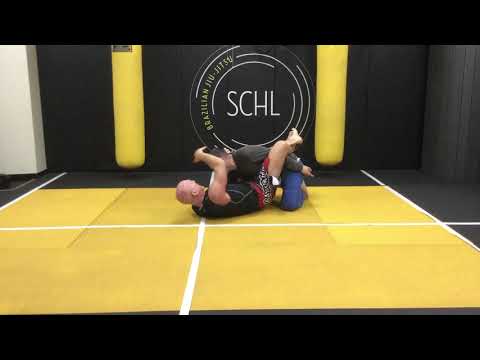
BJJ over 60 years old. Rat Guard Basic
0
Rat Guard·BJJ For Over 60 Years Old·Added by Admin
Having had a few back surgeries, double knee replacements ,and being 64 years old, I am always searching for ways to ada…
Translation: rat guard
The rat guard is a closed guard system where the guard player breaks the opponent's posture, secures a necktie and tricep grip, then swings an arm to threaten a guillotine, causing the opponent to press tighter — at which point the guard player grabs the inside of their own hamstring, creating a locked frame that traps the opponent's head under the armpit with legs locked. [1] Created by Rene Dreifuss of Radical MMA NYC, originally designed for MMA and Combat Jiu-Jitsu based on an old judo position Dreifuss learned while training in Japan. [2] Specifically designed to nullify ground-and-pound while maintaining offensive options.
Effective guard system for MMA where ground-and-pound must be neutralized. Accessible to all body types. [1]
Created by Rene Dreifuss at Radical MMA NYC. Based on judo position learned in Japan.
Used primarily in MMA and Combat Jiu-Jitsu contexts rather than traditional sport BJJ competition.
No images yet for this technique.
Sign in to suggest an image.
Having had a few back surgeries, double knee replacements ,and being 64 years old, I am always searching for ways to ada…
No instructional courses yet for this technique.
Sign in to suggest a course.
Risk of injury to the person this technique is applied to
Positional control system designed to be safe for the guard player
Skill level needed to execute this technique reliably
Whether this technique is allowed under major competition rule sets
The Rat Guard (Dreifuss, Radical MMA NYC)
[1] Radical MMA NYC — original rat guard system by Dreifuss
The Rat Guard (Dreifuss, Radical MMA NYC) || BJJ Fanatics — Rat Guard BJJ (bjjfanatics.com) || BJJ World — The Basics of the Sneaky BJJ Rat Guard (bjj-world.com) || BJJEE — How Legit Is The Rat Guard? (bjjee.com)
Standard katakana transliteration of Western martial arts terminology (外来語) — used in Japanese MMA, boxing, and BJJ communities
[1] Radical MMA NYC — original rat guard system by Dreifuss
[2] BJJ World and BJJEE — technique analysis and legitimacy assessment
no special athletic ability or flexibility — accessible to all body types
grip strength, biceps, core
Never put your hands flat on the mat—this exposes you to Kimura attacks. Keep your elbows positioned close to your waist rather than high up, as high elbows make you vulnerable to arm bar submissions.
Drive their head down by taking their shoulder and keeping continuous pressure to break their posture. This positioning keeps them broken and unable to see you, which prevents them from punching effectively.
The primary option is a triangle choke—if that fails, you can transition to an arm bar by hipping up. If the arm bar doesn't work, make a fist and place it under the elbow to continue applying pressure.
Avoid allowing your opponent to get one leg over your shoulder and one under your arm, as this setup leads directly into triangle submissions.
The rat guard is a closed guard system where the guard player breaks the opponent's posture, secures a necktie and tricep grip, then swings an arm to threaten a guillotine, causing the opponent to press tighter — at which point the guard player grabs the inside of their own hamstring, creating a locked frame that traps the opponent's head under the armpit with legs locked. Created by Rene Dreifuss of Radical MMA NYC, originally designed for MMA and Combat Jiu-Jitsu based on an old judo position Dreifuss learned while training in Japan.
Created by Rene Dreifuss of Radical MMA NYC. Based on an old judo position learned in Japan, adapted for MMA and Combat Jiu-Jitsu.
IBJJF: legal — Legal — guard is fundamental to BJJ, sweeps from guard score 2 points; IJF: restricted — Guard pulling penalized as non-combativity — groundwork from guard permitted …; ADCC: legal — Legal, guard pull penalized -1 point in points portion; Unified MMA: legal — Legal — no penalty for playing guard; FIAS Sport Sambo: legal — Legal
Danger rating 2/10. Low — positional control system designed to be safe for the guard player
The standard setup chain: Establish closed guard → Secure necktie and tricep grip → Fake guillotine threat → Opponent drives in → Grab inside of own hamstring → Lock the frame with head trapped → Attack: sit-up sweep, triangle, guillotine, or back take.
Standard counters include: Posture up forcefully before the grips are established / Strip the necktie grip early / Stand up in guard to break the control / Stack and create distance.
Common variants: Standard rat guard (basic posture break with necktie to hamstring grip); MMA rat guard (emphasizes ground-and-pound neutralization); Rat guard to sit-up sweep (primary sweep from the position); Rat guard to triangle (transition to triangle choke); Rat guard to back take (transition when opponent attempts to escape).
Used primarily in MMA and Combat Jiu-Jitsu contexts rather than traditional sport BJJ competition.
Top errors to watch for: Not breaking posture before establishing the grips — the necktie must be tight / Releasing the hamstring grip — breaks the locked frame / Not threatening the guillotine — the fake guillotine is what causes the opponent to drive in / Staying passive — the rat guard must lead to attacks.
The Rat Guard is also known as Ratto Gādo, Rat Guard, Rat Guard System, Dreifuss Guard.