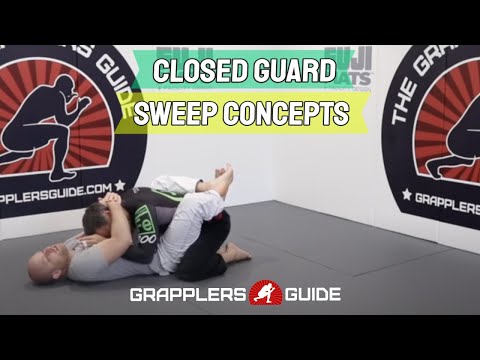
Closed Guard Sweep Concepts by Jason Scully
0
Standard Technical Standup·The Grapplers Guide by Jason Scully
The Grapplers Guide is the longest running and most recommended premium BJJ and grappling learning site ever created. L…
Translation: standard technical standup
The Standard Technical Standup From Turtle executes the escape by transitioning from turtle to a seated posting position (hand behind on the mat), then performing the technical standup by stepping up with one leg and rising to standing while keeping the posting hand on the mat for balance. [1] The turtled fighter sits through to one hip, posts the hand behind, steps the far leg up, and rises to standing, using the posting hand and the stepping leg as the base points. [1],[2] Throughout the standup, the fighter maintains a defensive frame with the free hand to prevent the opponent from closing distance or re-establishing ground control. [2],[3]
The standard technical standup is the baseline version of this fundamental standing escape. [1]
A fundamental BJJ and MMA technique. [1]
Used in MMA and BJJ competition. [1]
No images yet for this technique.
Sign in to suggest an image.
The Grapplers Guide is the longest running and most recommended premium BJJ and grappling learning site ever created. L…
When you first start Jiu Jitsu, you're gonna be getting stuck in the bottom of mount. A lot. Even by people who aren't v…
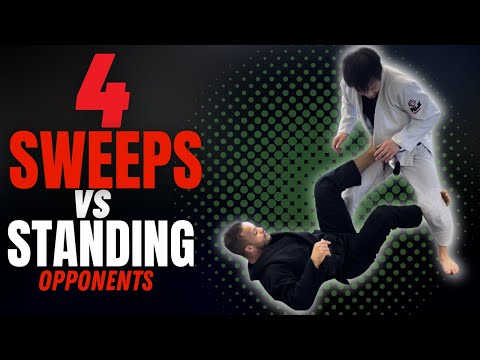
IF HAVE HARD TIME SWEEP SOMEONE WHEN THEY STANDING FORM YOUR GUARD THIS VIDEO IS FOR YOU. . . On This video i show 4 way…
The standard technical standup from turtle position represents a fundamental escape method taught across multiple instructional contexts. While the provided transcripts primarily address mount escapes and closed-guard sweeps rather than turtle-specific standup mechanics, Jason Scully's concept-based approach offers foundational principles applicable to the technical standup. The core mechanics involve controlling opponent limbs—what Scully terms 'taking out a table leg'—to neutralize their defensive positioning and create space for the standup. BIG OSS Jiu-Jitsu emphasizes the critical transition moment when an opponent rises, instructing practitioners to immediately shift grips from positional control to the limbs being used for base. Brandon Mccaghren's description of the bridge-and-roll escape demonstrates the importance of fluid, singular movement rather than segmented actions. Key common principles across instructors include: maintaining tight control on one side of the opponent's body, using hip positioning to create leverage and separation, and avoiding static holds in favor of momentum-generating movement. Scully's emphasis on getting underneath the opponent or bringing their weight over the defender's center applies conceptually to technical standup mechanics, where base control and weight distribution determine success. The instructors collectively stress that transitions must be immediate and that practitioners should not remain stationary once escape movements begin.
Synthesized from 3 instructors
No instructional courses yet for this technique.
Sign in to suggest a course.
Risk of injury to the person this technique is applied to
Turtle escapes involve rolling and granby movements; neck strain risk
Skill level needed to execute this technique reliably
Whether this technique is allowed under major competition rule sets
Mastering Jujitsu (Renzo Gracie & John Danaher, 2003)
Alias sources — [1] Jiu-Jitsu University (Saulo Ribeiro, 2008) [2] Gracie Jiu-Jitsu (Gracie & Gracie, 2001)
Effectiveness sources — [1] Mastering Jujitsu (Gracie & Danaher, 2003)
Standard katakana transliteration of Western martial arts terminology (外来語) — used in Japanese MMA, boxing, and BJJ communities
Alias sources — [1] Jiu-Jitsu University (Saulo Ribeiro, 2008) [2] Gracie Jiu-Jitsu (Gracie & Gracie, 2001)
Effectiveness sources — [1] Mastering Jujitsu (Gracie & Danaher, 2003)
hip mobility, explosive bridge/shrimp power, timing
flexible hips and strong glutes for escape movements
glutes, hip flexors, core, triceps (framing)
According to BIG OSS Jiu-Jitsu, when your opponent stands up, you must transition your grips immediately—don't try to keep holding the same grips or you risk them passing your guard. The key is to shift to controls like ankle grips, underhooks, or sleeve grips depending on what they give you.
Jason Scully emphasizes that if you don't control your opponent's arms during a sweep, they can post their hands out to stop you—either by doing a cartwheel or turning their body out to escape the sweep.
The core principle, according to Jason Scully, is to bring your opponent's base and center of gravity over you first, which destroys their posture and balance, making the actual sweep much easier to complete.
BIG OSS Jiu-Jitsu recommends grabbing the ankles as your primary transition—if you have both sleeves, drop your hips to force them back, then hook both ankles and sweep. You can also use an underhook for a muscle sweep or grab a single ankle depending on timing.
The Standard Technical Standup From Turtle executes the escape by transitioning from turtle to a seated posting position (hand behind on the mat), then performing the technical standup by stepping up with one leg and rising to standing while keeping the posting hand on the mat for balance. The turtled fighter sits through to one hip, posts the hand behind, steps the far leg up, and rises to standing, using the posting hand and the stepping leg as the base points.
The standard technical standup from turtle is a hybrid technique combining wrestling bottom escapes with the BJJ technical standup methodology. It is widely taught in MMA as one of the primary methods for returning to the feet from a turtled position.
Unified MMA: legal — Legal defensive/transitional technique; IBJJF: legal — Legal; IJF: legal — Legal; ADCC: legal — Legal; UWW: legal — Legal, escape scores 1 point (freestyle), reversal scores 1 point; FIAS Sport Sambo: legal — Legal; NCAA Folkstyle: legal — Legal, escape scores 1 point, reversal scores 2 points
Danger rating 3/10. Moderate — turtle escapes involve rolling and granby movements; neck strain risk
The standard setup chain: Create Space → Disrupt Control → Execute Escape → Recover Position.
Standard counters include: Maintain Pressure — keep consistent weight distribution to limit escape space / Anticipate Direction — read escape attempt direction and block early / Transition — flow to a new position when the current one is threatened.
Common variants: Standard escape (primary escape mechanic using frames, bridges, or hip mov…); Combination escape (chaining two escape directions or methods); Counter escape (using the opponent's attack attempt to create the escape …); Competition variation (modified for rule-set optimisation).
Used in MMA and BJJ competition.
Top errors to watch for: Standing up without the posting hand — the post provides essential stability / Stepping the same-side foot as the posting hand — step the opposite-side foot for proper body mechanics / Rising with the back turned to the opponent — maintain awareness and keep them in front / Standing up too slowly — explosive speed is necessary to beat the opponent's re-attack.
The Standard Technical Standup is also known as Sutandādo Tekunikaru Sutando Appu, Basic Turtle Standup, Standard Technical Stand From Turtle.