Strike & defenceLocksClose rangeFighting multiple people
Distance
CloseMiddleLong
Overview
The Technical Standup From Turtle subfamily covers the escape where the turtled fighter performs a technical standup — posting one hand behind, stepping up with one leg, and rising to a standing position while maintaining a defensive frame against the opponent. [1] The technical standup from turtle is adapted from the standard technical standup but begins from the hands-and-knees turtle position rather than from sitting. [1],[2] This standup is important in MMA where returning to the feet is often the primary defensive objective from turtle. [2],[3]
Also known as
Turtle Tech Standup[1]Technical Stand From All Fours[2]
The technical standup from turtle combines the wrestling turtle escape with the BJJ/MMA technical standup, creating an efficient pathway from the turtle to standing. [1] It became particularly important in MMA where the turtle is vulnerable to ground-and-pound and back takes. [2],[3]
Country of origin· shown in random order
🇬🇷GreeceWrestling
🇺🇸USAWrestling, MMA
🇧🇷BrazilBrazilian Jiu-Jitsu, MMA
🇯🇵Japan亀からのテクニカルスタンドアップ(Kame kara no Tekunikaru Sutando Appu)Brazilian Jiu-Jitsu
Effectiveness
Technical standup from turtle uses the technical standup method to return to standing from the turtle position. [1]
Lineage
Combines the BJJ technical standup with turtle escape methodology. [1]
✓The technical standup from turtle transitions from all-fours to standing by posting a hand, stepping a foot forward, and rising to a fighting stance (Couture, Wrestling for Fighting, 2007)
✓Step 1: from turtle, post one hand on the mat
✓Step 2: step the opposite-side foot forward next to the posted hand
✓Step 3: rise by pushing off the posted hand and driving upward with the forward leg
✓Step 4: establish a fighting stance and create distance from the opponent
✓The technical standup from turtle is the standard method for returning to the feet in MMA
✓Combine with frames on the opponent to prevent them from following as you rise
✓The posted hand and forward foot create a triangle base — this is structurally stable for rising
✓After standing, immediately create distance with footwork or establish a clinch on your terms
Common Mistakes
!Not posting the hand — the post provides stability during the rise
!Standing with the feet too close together — the forward foot must be sufficiently ahead for balance
!Rising with the back curved — maintain an upright posture as you stand
!Not creating distance immediately after standing — the opponent will re-clinch or re-shoot
!Standing with both hands on the mat (losing defensive coverage) — one hand posts, one hand guards
!Using the standup when the opponent has body control — address their grips before standing
!Not training the technical standup under realistic conditions — drill with a partner on your back
What's the difference between a closed turtle and an open turtle when defending?
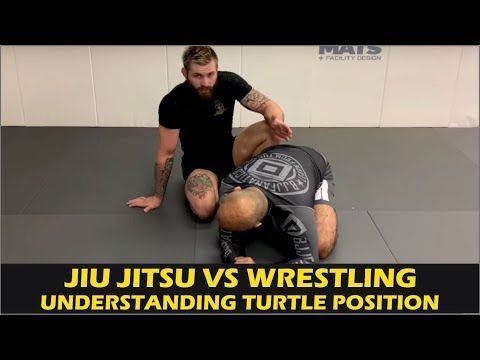
In a closed turtle, your opponent will fall down every time. If they open their turtle in any way, you can get in and begin inserting hooks or hands. Gordon Ryan emphasizes playing the dilemma of closed versus open turtle to control your options for attack.
How do you escape the technical standup against a much larger opponent?
When working with someone significantly larger, you need to understand the mechanics of how to properly knock them over rather than relying on strength alone. The key is recognizing when your opponent opens their turtle position, which creates the opportunity to execute your escape.
How much can I open my turtle before my opponent gets an advantage?
The more you open your turtle in any way, the easier it is for your opponent to insert their hands and sometimes even their legs to establish hooks and control. Minimizing how much you open your turtle position is critical to defense.
How does the Technical Standup From Turtle work?
The Technical Standup From Turtle subfamily covers the escape where the turtled fighter performs a technical standup — posting one hand behind, stepping up with one leg, and rising to a standing position while maintaining a defensive frame against the opponent. The technical standup from turtle is adapted from the standard technical standup but begins from the hands-and-knees turtle position rather than from sitting.
Where does the Technical Standup From Turtle come from?
The technical standup from turtle combines the wrestling turtle escape with the BJJ/MMA technical standup, creating an efficient pathway from the turtle to standing. It became particularly important in MMA where the turtle is vulnerable to ground-and-pound and back takes.
Is the Technical Standup From Turtle legal in competition?
How dangerous is the Technical Standup From Turtle?
Danger rating 3/10. Moderate — turtle escapes involve rolling and granby movements; neck strain risk
How do I set up the Technical Standup From Turtle?
The standard setup chain: Create Space → Disrupt Control → Execute Escape → Recover Position.
How do I defend against the Technical Standup From Turtle?
Standard counters include: Maintain Pressure — keep consistent weight distribution to limit escape space / Anticipate Direction — read escape attempt direction and block early / Transition — flow to a new position when the current one is threatened.
What are the variants of the Technical Standup From Turtle?
Common variants: Standard escape (primary escape mechanic using frames, bridges, or hip mov…); Combination escape (chaining two escape directions or methods); Counter escape (using the opponent's attack attempt to create the escape …); Competition variation (modified for rule-set optimisation).
How effective is the Technical Standup From Turtle in competition?
Used in MMA and BJJ competition.
What are common mistakes when doing the Technical Standup From Turtle?
Top errors to watch for: Not posting the hand — the post provides stability during the rise / Standing with the feet too close together — the forward foot must be sufficiently ahead for balance / Rising with the back curved — maintain an upright posture as you stand / Not creating distance immediately after standing — the opponent will re-clinch or re-shoot.
What are other names for the Technical Standup From Turtle?
The Technical Standup From Turtle is also known as Kame kara no Tekunikaru Sutando Appu, Turtle Tech Standup, Technical Stand From All Fours.