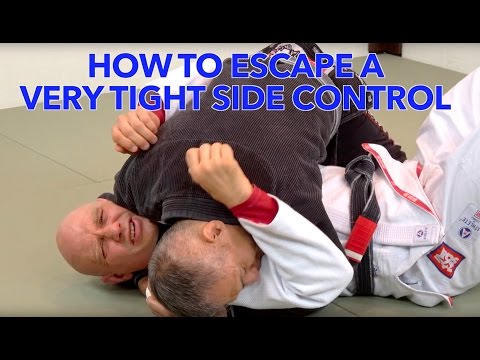
How to Escape a Really Tight Side Control
0
Side Control Escape·Stephan Kesting
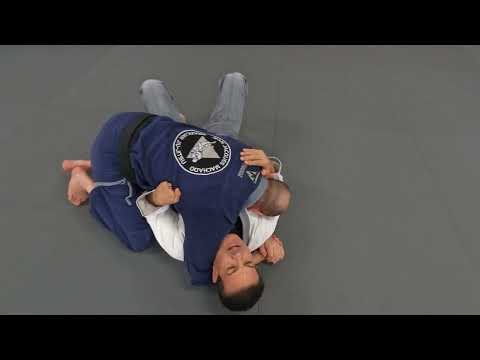
Stephan Kesting and Ritchie Yip take you through escaping a really tight side control! Download Stephan's guide to lear…
Translation: Side control escape
The Side Control Escape family within the Submission Escape group covers techniques for escaping submission attempts that are initiated from the side control position — combining submission defence with positional escape to simultaneously neutralise the submission threat and improve position. [1] When an opponent attacks with americanas, kimuras, arm triangles, or baseball bat chokes from side control, the defender must address both the immediate submission danger and the underlying positional disadvantage. [1],[2] These escapes are distinct from pure positional side control escapes because they must neutralise a specific submission grip or angle before positional escape mechanics can be applied — for example, escaping an americana requires first defeating the figure-four grip before hip escaping to guard. [2],[3] Understanding these combined submission-and-position escapes is critical because skilled grapplers chain submission attempts with positional control, making it impossible to address one without the other. [3]
Combined submission-position escape concepts developed as side control attacking systems became more sophisticated in BJJ competition. [1] As grapplers developed elaborate submission chains from side control (americana → kimura → arm triangle → baseball bat choke), the need for integrated defence-and-escape techniques grew. [1],[2]
These escapes are regularly seen at the highest levels of BJJ and MMA competition, where side control submissions are common attack sequences. [1]
No images yet for this technique.
Sign in to suggest an image.
Stephan Kesting and Ritchie Yip take you through escaping a really tight side control! Download Stephan's guide to lear…
#escapes #jeanjacquesmachado #bjj ----- One of the pioneers of the art of Brazilian Jiu-Jitsu and one of its greatest…
No instructional courses yet for this technique.
Sign in to suggest a course.
Risk of injury to the person this technique is applied to
High — these escapes occur while a submission is actively being applied; the risk of being submitted during the escape attempt is significant; the bottom player must manage both the submission threat and the positional disadvantage simultaneously
Skill level needed to execute this technique reliably
Whether this technique is allowed under major competition rule sets
Jiu-Jitsu University (Saulo Ribeiro, 2008)
Description sources — [1] Jiu-Jitsu University (Ribeiro, 2008) on escape hierarchy [2] Competition analysis of side control submission chains [3] Training methodology for combined escapes
Description sources — [1] Jiu-Jitsu University (Ribeiro, 2008) on escape hierarchy [2] Competition analysis of side control submission chains [3] Training methodology for combined escapes
grip strength (defeating submission grips), hip mobility (escaping after the submission is neutralised), mental composure (remaining calm while being submitted)
strong hands (grip fighting), flexible shoulders (surviving joint lock attacks), cardio endurance
forearms (grip defence), hip flexors (shrimping), shoulders (frame creation), core (bridging and turning)
Every move, in any martial art, shares a few universal traits. Mix and match below to pinpoint the right tool — or compare equivalents across styles.
Side control escapes rely on creating frames (forearms against the opponent's neck and hip) to create space for hip movement. The shrimp-to-guard recovery is the primary escape method. (Ribeiro, Jiu-Jitsu University)
According to Stephan Kesting, your first priority isn't the escape itself—it's getting your arms back into position. Proper arm positioning is what enables the escape, so spend your effort there before attempting the final escape movement.
Stephan Kesting addresses this common question by emphasizing that you can use techniques like bridging and hip escaping after getting your arms into proper position, or turning onto your leg. The key is working incrementally to gain inches of space rather than expecting a quick escape.
Jean Jacques Machado explains that the further your arms move away from your body, the better it is for your opponent and the harder it becomes for you to defend and escape. Keeping your elbows lined up with your body and close to your hips prevents your opponent from trapping your arm or setting up submissions.
Stephan Kesting emphasizes that when on the bottom, you want to create movement and momentum—using forward and back action plus side to side action. Your opponent on top wants stability and to kill your momentum, so continuous movement is your advantage.
The Side Control Escape family within the Submission Escape group covers techniques for escaping submission attempts that are initiated from the side control position — combining submission defence with positional escape to simultaneously neutralise the submission threat and improve position. When an opponent attacks with americanas, kimuras, arm triangles, or baseball bat chokes from side control, the defender must address both the immediate submission danger and the underlying positional disadvantage.
Combined submission-position escape concepts developed as side control attacking systems became more sophisticated in BJJ competition. As grapplers developed elaborate submission chains from side control (americana → kimura → arm triangle → baseball bat choke), the need for integrated defence-and-escape techniques grew.
Unified MMA: legal — Legal defensive/transitional technique; IBJJF: legal — Legal; IJF: legal — Legal; ADCC: legal — Legal; UWW: legal — Legal; FIAS Sport Sambo: legal — Legal
Danger rating 6/10. Moderate-high — these escapes occur while a submission is actively being applied; the risk of being submitted during the escape attempt is significant; the bottom player must manage both the submission threat and the positional disadvantage simultaneously
The standard setup chain: Recognise Submission Threat → Defend the Grip → Create Space → Recover Guard → Consolidate.
Standard counters include: When attacking from side control: chain submissions — when one submission is defended, immediately transition to the … / Use the escape attempt to advance position — if the bottom player hip escapes during kimura defence, use the movement… / Maintain heavy pressure between submission attempts to prevent the escape portion of the defence.
Common variants: Americana defence to hip escape (defeating the figure-four grip and immediately shrimping …); Kimura defence to reversal (using the kimura defence grip to hip escape or come to th…); Arm triangle escape (walking the hips toward the opponent to relieve choking p…); Baseball bat choke defence (hand fighting to strip the collar grips before the choke …); North-south choke escape (turning to face the opponent and creating space before th…); Paper cutter choke defence (stripping the collar grip and turning to recover guard).
These escapes are regularly seen at the highest levels of BJJ and MMA competition, where side control submissions are common attack sequences.
Top errors to watch for: Trying to hip escape while a submission is locked on — the submission must be addressed before positional escape; hip… / Not recognising the submission setup — allowing the opponent to fully establish an americana or kimura grip before re… / Walking hips AWAY from an arm triangle — this is the most common arm triangle escape error; walking away tightens the… / Panicking and using strength alone — submission escapes require technique; explosive strength without proper mechanic….
The Side Control Escape is also known as Saido Kontorōru Esukēpu, Submission Escape From Side Control, Side Control Submission Defence.