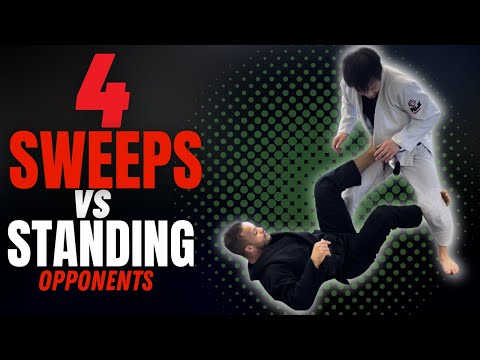
4 Ways to Sweep Anyone Vs Standing Opponents( Beginners Must Know it)
0
Standard Leg Over·BIG OSS Jiu-Jitsu Channel
IF HAVE HARD TIME SWEEP SOMEONE WHEN THEY STANDING FORM YOUR GUARD THIS VIDEO IS FOR YOU. . . On This video i show 4 way…
Translation: standard leg over
The Standard Leg Over threads the far leg over the opponent's head from behind, hooks the ankle or calf around the opponent's neck, and pulls backward to break the kesa gatame control and force the opponent into a defensive position. [1] The defender must create enough hip space through bridging to swing the leg over, then uses the leg's pulling force to drag the opponent backward off their base. [1],[2] The technique can finish as an armbar if the defender controls the arm, or as a positional reversal if the opponent releases the headlock. [2],[3]
The standard leg over is the baseline version of this kesa gatame escape. [1]
A fundamental judo pin escape. [1]
Used in judo competition. [1]
No images yet for this technique.
Sign in to suggest an image.
IF HAVE HARD TIME SWEEP SOMEONE WHEN THEY STANDING FORM YOUR GUARD THIS VIDEO IS FOR YOU. . . On This video i show 4 way…
Instructionals and seminars can be found through http://lachlangiles.net
When you first start Jiu Jitsu, you're gonna be getting stuck in the bottom of mount. A lot. Even by people who aren't v…
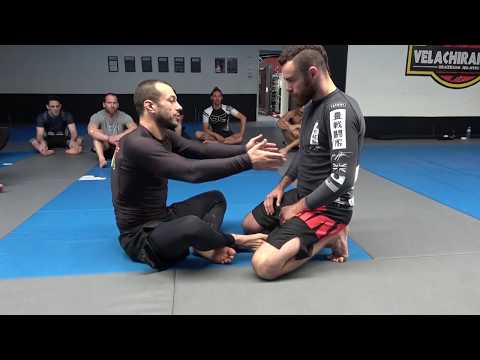
The Standard Leg Over escape from kesa gatame involves trapping the opponent's leg to create momentum for a reversal. Brandon McCaghren (BJJ365) emphasizes the foundational bridge-and-roll mechanic, instructing practitioners to trap the foot by shifting the hip and turning the knees inward rather than attempting containment from the center—a positioning that prevents the top player from hiding the trapped leg. McCaghren stresses avoiding prolonged holds and instead using trapping duration only to initiate forward momentum, executing the roll as a single fluid motion by looking backward over the shoulder and bridging in that direction rather than rolling sideways. BIG OSS Jiu-Jitsu Channel (Marcio Lofomarcello) focuses on grip transitions when an opponent stands, demonstrating ankle and leg control sweeps that require immediate repositioning rather than maintaining original grips—principles aligned with the dynamic weight distribution needed for effective leg entanglement. Absolute MMA St Kilda's Lachlan Giles approaches butterfly positioning differently, emphasizing underhook placement and shoulder positioning to prevent the opponent from posting and escaping, though his focus addresses kneeling positions rather than the kesa gatame scenario. All three instructors agree that leg control requires precise hip and shoulder alignment to deny counter-posts, and that timing the initiation of momentum before full commitment to the reversal significantly improves success rates.
Synthesized from 3 instructors
No instructional courses yet for this technique.
Sign in to suggest a course.
Risk of injury to the person this technique is applied to
Bottom escapes from mount/side control; bridge and hip escape mechanics (Ribeiro 2008)
Skill level needed to execute this technique reliably
Whether this technique is allowed under major competition rule sets
Jiu-Jitsu University (Saulo Ribeiro, 2008)
Alias sources — [1] Kodokan Judo (Jigoro Kano, 1986) [2] Jiu-Jitsu University (Saulo Ribeiro, 2008)
Effectiveness sources — [1] Kodokan Judo (Kano, 1986)
Mixed Japanese-Western terminology — combines traditional Japanese terms with katakana loanwords
Alias sources — [1] Kodokan Judo (Jigoro Kano, 1986) [2] Jiu-Jitsu University (Saulo Ribeiro, 2008)
Effectiveness sources — [1] Kodokan Judo (Kano, 1986)
hip escape (shrimping) speed, framing strength, timing
flexible hips and quick lateral movement
hip flexors, obliques, triceps (framing), core
According to Brandon McCaghren, you should make the bridge and roll one fluid movement rather than two separate movements—looking back over your shoulder and bridging in that direction. Making it one continuous motion significantly increases your success rate.
Brandon McCaghren advises shifting your hip over and turning your knees toward the trapped leg, then pulling your heel to your butt. Avoid trapping from the center, as your opponent can stay low and hide the foot trap from you—a shift with your hip over creates a much more effective trap.
Brandon McCaghren describes the knee elbow escape as the mount escape that 'makes the most sense as you move up the food chain,' used when your opponent's weight is on top and they're attacking your hand. It involves framing on the opposite hip, flattening your leg between theirs, and pulling your knee and elbow back together to drop them into half guard.
The Standard Leg Over threads the far leg over the opponent's head from behind, hooks the ankle or calf around the opponent's neck, and pulls backward to break the kesa gatame control and force the opponent into a defensive position. The defender must create enough hip space through bridging to swing the leg over, then uses the leg's pulling force to drag the opponent backward off their base.
The standard leg over is a classical judo escape technique that has been adapted into BJJ's ground fighting curriculum, valued for its dual function as both an escape and a submission setup. It represents an advanced kesa gatame escape option.
Unified MMA: legal — Legal defensive/transitional technique; IBJJF: legal — Legal; IJF: legal — Legal; ADCC: legal — Legal; UWW: legal — Legal; FIAS Sport Sambo: legal — Legal
Danger rating 3/10. Moderate — bottom escapes from mount/side control; bridge and hip escape mechanics (Ribeiro 2008)
The standard setup chain: Create Space → Disrupt Control → Execute Escape → Recover Position.
Standard counters include: Maintain Pressure — keep consistent weight distribution to limit escape space / Anticipate Direction — read escape attempt direction and block early / Transition — flow to a new position when the current one is threatened.
Common variants: Shrimp to guard (framing and hip-escaping to recover full guard or half guard); Underhook escape (winning the underhook and coming to knees or reversing); Bridge to knees (bridging into the opponent and transitioning to turtle or…); Ghost escape (inverting under the opponent to re-guard from the opposit…).
Used in judo competition.
Top errors to watch for: Swinging the leg without sufficient hip walking — the hip walk creates the range; skipping it makes the leg fall short / Hooking too shallow (across the face only) — the hook must go behind the shoulder for proper leverage / Not applying downward pressure with the leg — a passive leg over doesn't create escape force / Losing the trapped arm during the transition — coordinate arm extraction with the leg-over movement.
The Standard Leg Over is also known as Sutandādo Ashi-goe, Basic Leg Over Escape, Kesa Leg Hook Reversal.