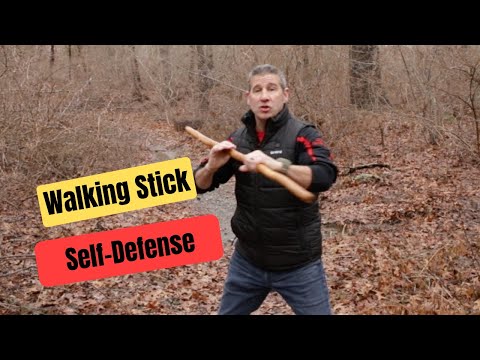
How To Use a Walking Stick for Self-Defense
0
Standard Stick Defence Technique·The Modern Defender·Added by Admin
Please Hit The LIKE and SUBSCRIBE BUTTONS as well as the NOTIFICATION BELL. Thanks For Watching. Have you ever been out…
Translation: standard stick defence technique
The Standard Stick Defence Technique executes the fundamental impact weapon defence by stepping inside the arc of the swing, blocking the weapon arm at the wrist or forearm with both hands, and immediately controlling the weapon hand while closing to clinch range where the stick cannot be used effectively. [1] The defence targets the weapon arm — not the weapon — because controlling the hand controls the threat. [1],[2] Once the weapon arm is controlled, the defender applies a wrist lock, arm bar, or strip technique to disarm the attacker while maintaining close body contact that prevents the attacker from creating swinging distance. [2],[3]
A standard stick defence technique. [1]
From Filipino martial arts. [1]
Used in stick fighting competition. [1]
No images yet for this technique.
Sign in to suggest an image.
Please Hit The LIKE and SUBSCRIBE BUTTONS as well as the NOTIFICATION BELL. Thanks For Watching. Have you ever been out…
No instructional courses yet for this technique.
Sign in to suggest a course.
Risk of injury to the person this technique is applied to
Weapon defence scenarios involve lethal threats; failure risk is catastrophic
Skill level needed to execute this technique reliably
Whether this technique is allowed under major competition rule sets
Karate-Do Kyohan: The Master Text (Gichin Funakoshi, 1935)
Alias sources — [1] The S.P.E.A.R. System (Blauer, 2003) [2] Complete Guide to Krav Maga (Killebrew, 2007) [3] The Filipino Martial Arts (Inosanto, 1980)
Effectiveness sources — [1] Filipino Martial Arts (Wiley, 1997)
Mixed Japanese-Western terminology — combines traditional Japanese terms with katakana loanwords
Alias sources — [1] The S.P.E.A.R. System (Blauer, 2003) [2] Complete Guide to Krav Maga (Killebrew, 2007) [3] The Filipino Martial Arts (Inosanto, 1980)
Effectiveness sources — [1] Filipino Martial Arts (Wiley, 1997)
forearm conditioning, reaction speed, structural stability
dense bone structure, strong forearms
forearm flexors/extensors, deltoids, biceps, core (absorbing impact)
Bring your hands down with your non-dominant hand on the bottom of the stick. For example, if you're right-handed, your left hand goes on the bottom.
Bringing the stick over your head, under your arm, and turning your body out is one of the more powerful strikes available in stick defence.
You don't want an attacker too close because your stick skills become ineffective; maintaining distance allows you to use the weapon properly and control the engagement.
The Standard Stick Defence Technique executes the fundamental impact weapon defence by stepping inside the arc of the swing, blocking the weapon arm at the wrist or forearm with both hands, and immediately controlling the weapon hand while closing to clinch range where the stick cannot be used effectively. The defence targets the weapon arm — not the weapon — because controlling the hand controls the threat.
The standard stick defence technique is a fundamental self-defence skill taught in Filipino martial arts, Krav Maga, and military combatives. The principle of closing distance against impact weapons is a universal tactical concept taught across all weapon defence systems.
Unified MMA: legal — Legal defensive technique; IBJJF: legal — Legal; IJF: legal — Legal defensive action; WBC/Boxing: legal — Legal; WKF: legal — Legal; WT: legal — Legal
Danger rating 9/10. Extreme — weapon defence scenarios involve lethal threats; failure risk is catastrophic
The standard setup chain: Anticipate the Attack → Execute Defence → Recover Stance → Counter or Disengage.
Standard counters include: Timing — attack when the defence is recovering or between movements / Feint — use deception to create openings in the defensive structure / Angle Change — attack from an unexpected angle that the defence does not cover.
Common variants: High block (forearm raised above the head to protect against overhead…); Low block (forearm driven downward to deflect kicks or body strikes); Cross block (forearm crosses the body to protect the opposite side); Double forearm block (both forearms together for maximum coverage).
Used in stick fighting competition.
Top errors to watch for: Stepping backward instead of to the outside — backward movement keeps you in the weapon's path / Intercepting the weapon instead of the arm — arm control is reliable; weapon interception is not / Using one hand for the interception — two hands provide the control needed against a swinging weapon / Not closing to clinch distance after intercepting — staying at arm's length lets the attacker re-swing.
The Standard Stick Defence Technique is also known as Sutandādo Bō Bōgyo-waza, Basic Stick Block, Standard Baton Defence, Impact Weapon Deflection.