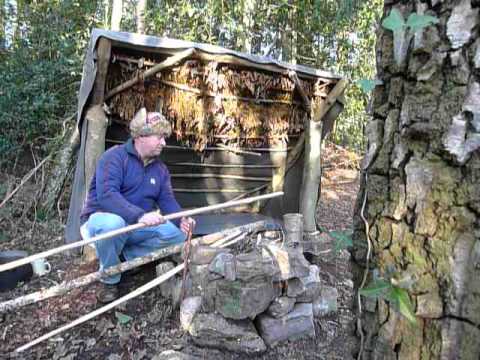
Walking stick defence, what materials?
0
Standard Stick Defence·macrolithic
Out for a walk and get attacked for instance by a savage dog or bear. A bushcraft knife isn't going to help you much. Wh…
Translation: standard stick defence
The Standard Stick Defence subfamily covers fundamental techniques for defending against attacks with sticks, batons, and similar impact weapons, using a combination of blocking, evasion, and closing distance. [1] The defensive approach varies by range: at long range, evasion and distance management are primary; at medium range, blocking and deflecting with the forearms is used; at close range, trapping the weapon arm and clinching neutralises the stick's effectiveness. [1],[2] Standard stick defence emphasises that the weapon hand is the target — controlling the hand controls the weapon. [2],[3]
Standard stick defence techniques are drawn from Filipino martial arts and traditional self-defence systems, where defending against stick attacks is a core component of the training curriculum. [1] The principles of stick defence — attack the hand, close the distance, control the weapon — are universal across all impact weapon defence systems. [2],[3]
Standard stick defence techniques. [1]
From Filipino martial arts curricula. [1]
Used in Arnis competition. [1]
No images yet for this technique.
Sign in to suggest an image.
Out for a walk and get attacked for instance by a savage dog or bear. A bushcraft knife isn't going to help you much. Wh…
No instructional courses yet for this technique.
Sign in to suggest a course.
Risk of injury to the person this technique is applied to
Weapon defence scenarios involve lethal threats; failure risk is catastrophic
Skill level needed to execute this technique reliably
Whether this technique is allowed under major competition rule sets
Karate-Do Kyohan: The Master Text (Gichin Funakoshi, 1935)
Alias sources — [1] The S.P.E.A.R. System (Blauer, 2003) [2] Complete Guide to Krav Maga (Killebrew, 2007) [3] The Filipino Martial Arts (Inosanto, 1980)
Effectiveness sources — [1] Filipino Martial Arts (Wiley, 1997)
Mixed Japanese-Western terminology — combines traditional Japanese terms with katakana loanwords
Alias sources — [1] The S.P.E.A.R. System (Blauer, 2003) [2] Complete Guide to Krav Maga (Killebrew, 2007) [3] The Filipino Martial Arts (Inosanto, 1980)
Effectiveness sources — [1] Filipino Martial Arts (Wiley, 1997)
forearm conditioning, reaction speed, structural stability
dense bone structure, strong forearms
forearm flexors/extensors, deltoids, biceps, core (absorbing impact)
Every move, in any martial art, shares a few universal traits. Mix and match below to pinpoint the right tool — or compare equivalents across styles.
Cornus (also called Cornelia or Cherry) is an excellent choice—it's a hard, strong wood that grows in southern Europe and the Mediterranean region and was historically used to make bows. According to the instructor, if you can source it from central France, you'll have a superior walking stick material.
Spindle wood should be avoided for defence purposes, as it is too light and lacks the density needed for effective stick defence, though it may be suitable for other applications.
The Standard Stick Defence subfamily covers fundamental techniques for defending against attacks with sticks, batons, and similar impact weapons, using a combination of blocking, evasion, and closing distance. The defensive approach varies by range: at long range, evasion and distance management are primary; at medium range, blocking and deflecting with the forearms is used; at close range, trapping the weapon arm and clinching neutralises the stick's effectiveness.
Standard stick defence techniques are drawn from Filipino martial arts and traditional self-defence systems, where defending against stick attacks is a core component of the training curriculum. The principles of stick defence — attack the hand, close the distance, control the weapon — are universal across all impact weapon defence systems.
Unified MMA: legal — Legal defensive technique; IBJJF: legal — Legal; IJF: legal — Legal defensive action; WBC/Boxing: legal — Legal; WKF: legal — Legal; WT: legal — Legal
Danger rating 9/10. Extreme — weapon defence scenarios involve lethal threats; failure risk is catastrophic
The standard setup chain: Anticipate the Attack → Execute Defence → Recover Stance → Counter or Disengage.
Standard counters include: Timing — attack when the defence is recovering or between movements / Feint — use deception to create openings in the defensive structure / Angle Change — attack from an unexpected angle that the defence does not cover.
Common variants: High block (forearm raised above the head to protect against overhead…); Low block (forearm driven downward to deflect kicks or body strikes); Cross block (forearm crosses the body to protect the opposite side); Double forearm block (both forearms together for maximum coverage).
Used in Arnis competition.
Top errors to watch for: Defending without identifying the angle of attack — each angle requires a different defensive response / Intercepting too close to the weapon head — intercept at the wrist or forearm where the lever arm is shortest / Staying at mid-range after intercepting — close to clinch immediately; mid-range allows the attacker to re-swing / Not using the environment for defence — chairs, tables, doors, and vehicles are more reliable than empty-hand techniques.
The Standard Stick Defence is also known as Sutandādo Bō Bōgyo, Baton Defence, Impact Weapon Defence, Stick Block.