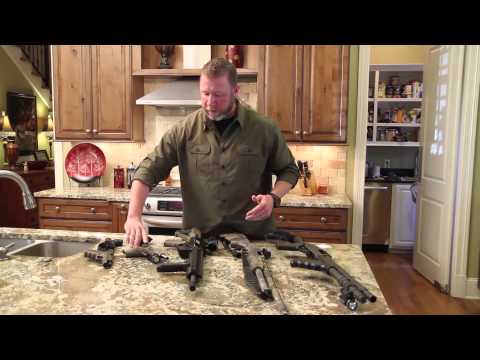
The "Best" Home Defense Gun
0
Standard Gun Defence·legallyconcealed
http://www.LegallyConcealed.org/ Click here http://www.legallyconcealed.org for a FREE report, "The Gear I Bet My Life O…
Translation: standard gun defence
The Standard Gun Defence subfamily covers the fundamental techniques for defending against a handgun presented at close range, including muzzle redirection, weapon control, and disarm sequences. [1] The standard gun defence follows a principle-based approach: redirect the muzzle away from the body, control the weapon and weapon hand, counterattack to disrupt the attacker, and disarm the weapon. [1],[2] All gun defence techniques require the firearm to be within arm's reach and rely on explosive speed and commitment to redirect the muzzle before the attacker can react. [2],[3]
Standard gun defence techniques were developed through military close-quarters combat training and adapted for civilian self-defence by systems including Krav Maga, Systema, and various reality-based self-defence programmes. [1] The techniques are continuously refined through force-on-force training with simulation weapons. [2],[3]
Standard gun defence redirects and controls a firearm threat. [1]
From Krav Maga weapon defence curriculum. [1]
A self-defence discipline. [1]
No images yet for this technique.
Sign in to suggest an image.
http://www.LegallyConcealed.org/ Click here http://www.legallyconcealed.org for a FREE report, "The Gear I Bet My Life O…
No instructional courses yet for this technique.
Sign in to suggest a course.
Risk of injury to the person this technique is applied to
Weapon defence scenarios involve lethal threats; failure risk is catastrophic
Skill level needed to execute this technique reliably
Whether this technique is allowed under major competition rule sets
Boxing (Edwin Haislet, 1940)
Alias sources — [1] The S.P.E.A.R. System (Blauer, 2003) [2] Complete Guide to Krav Maga (Killebrew, 2007) [3] Complete Guide to Krav Maga (Killebrew, 2007)
Effectiveness sources — [1] Krav Maga: How to Defend Yourself Against Armed Assault (Lichtenfeld & Yanilov, 2001)
Mixed Japanese-Western terminology — combines traditional Japanese terms with katakana loanwords
Alias sources — [1] The S.P.E.A.R. System (Blauer, 2003) [2] Complete Guide to Krav Maga (Killebrew, 2007) [3] Complete Guide to Krav Maga (Killebrew, 2007)
Effectiveness sources — [1] Krav Maga: How to Defend Yourself Against Armed Assault (Lichtenfeld & Yanilov, 2001)
reaction speed, structural body mechanics, defensive awareness
quick reflexes and conditioned defensive surfaces
varies — forearms (blocking), legs (movement), core (stability)
Every move, in any martial art, shares a few universal traits. Mix and match below to pinpoint the right tool — or compare equivalents across styles.
According to legallyconcealed, you should choose a gun you can handle effectively and manipulate if a malfunction occurs, rather than buying based on what looks cool. The instructor emphasizes selecting a reliable weapon suited to your actual capability, not just expensive gear.
legallyconcealed explains that modern threats often involve multiple attackers working in pairs, trios, or groups of four or more, so having more bullets gives you better odds and more time to defend yourself compared to limited-capacity options like a 5-round revolver.
legallyconcealed notes that revolvers have slow reload times—even experienced competition shooters take longer to dump shells and reload with a speed loader—and limited capacity of only 5 rounds, making them less practical than semi-automatic pistols in prolonged defense situations.
legallyconcealed recommends considering electronic hearing protection with batteries that allows you to hear the outside world normally but automatically dampens the sound when shots are fired, protecting your hearing during a defensive encounter.
The Standard Gun Defence subfamily covers the fundamental techniques for defending against a handgun presented at close range, including muzzle redirection, weapon control, and disarm sequences. The standard gun defence follows a principle-based approach: redirect the muzzle away from the body, control the weapon and weapon hand, counterattack to disrupt the attacker, and disarm the weapon.
Standard gun defence techniques were developed through military close-quarters combat training and adapted for civilian self-defence by systems including Krav Maga, Systema, and various reality-based self-defence programmes. The techniques are continuously refined through force-on-force training with simulation weapons.
Unified MMA: legal — Legal defensive technique; IBJJF: legal — Legal; IJF: legal — Legal defensive action; WBC/Boxing: legal — Legal; WKF: legal — Legal; WT: legal — Legal
Danger rating 9/10. Extreme — weapon defence scenarios involve lethal threats; failure risk is catastrophic
The standard setup chain: Anticipate the Attack → Execute Defence → Recover Stance → Counter or Disengage.
Standard counters include: Timing — attack when the defence is recovering or between movements / Feint — use deception to create openings in the defensive structure / Angle Change — attack from an unexpected angle that the defence does not cover.
Common variants: Standard defence (primary defensive technique from the most common position); Reactive defence (triggered by the opponent's attack, minimal movement for …); Proactive defence (anticipating the attack and positioning to neutralise it …); Counter defence (using the defensive movement to create an immediate count…).
A self-defence discipline.
Top errors to watch for: Attempting the defence when compliance is an option — if they want your wallet, give it to them / Looking at the gun instead of the attacker's body language — the attacker's intent determines your decision, not the … / Practicing with poor trigger discipline on training weapons — even in training, maintain firearms safety habits / Attempting the defence when the gun is more than arm's length away — contact distance only.
The Standard Gun Defence is also known as Sutandādo Jū Bōgyo, Pistol Defence, Handgun Disarm, Firearm Defence.