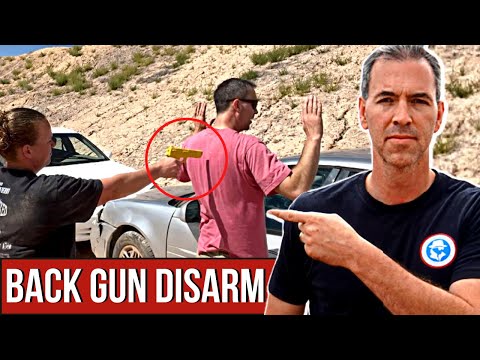
How to Disarm a Gun From Behind
0
Gun Defence·Jason Hanson
How to Disarm a Gun From Behind! 00:00 Intro 01:03 How to Disarm a Gun From Behind Thank you for watching!! Watch ne…
Translation: gun defence
The Gun Defence family covers defensive techniques against firearm threats, including disarms and redirections at close range. [1] Gun defence is the most extreme self-defence scenario and should only be attempted when escape is impossible and the threat of harm is imminent — compliance is generally the safest response when avoidance is not possible. [1],[2] Gun defence techniques focus on redirecting the muzzle away from the body, controlling the weapon hand, and executing a disarm before the attacker can fire or recover control. [2],[3]
Modern gun defence techniques were developed primarily through military and law enforcement training programmes, with Krav Maga's firearm defence curriculum being among the most widely taught civilian systems. [1] These techniques are regularly debated in the self-defence community due to the extreme risk involved, with most experts emphasising that gun defences should only be attempted as an absolute last resort. [2],[3]
Gun defences redirect the weapon away from the body and control the attacker's weapon hand. [1]
Gun defence techniques are primarily associated with Krav Maga, developed by Imi Lichtenfeld for the Israeli Defence Forces. [1]
Gun defence is a self-defence discipline, not a competitive sport. [1]
No images yet for this technique.
Sign in to suggest an image.
How to Disarm a Gun From Behind! 00:00 Intro 01:03 How to Disarm a Gun From Behind Thank you for watching!! Watch ne…
No instructional courses yet for this technique.
Sign in to suggest a course.
Risk of injury to the person this technique is applied to
Weapon defence scenarios involve lethal threats; failure risk is catastrophic
Skill level needed to execute this technique reliably
Whether this technique is allowed under major competition rule sets
Boxing (Edwin Haislet, 1940)
Alias sources — [1] MMA Instruction Manual (UFC, 2008) [2] MMA Instruction Manual (UFC, 2008) [3] MMA Instruction Manual (UFC, 2008)
Effectiveness sources — [1] Krav Maga: How to Defend Yourself Against Armed Assault (Lichtenfeld & Yanilov, 2001)
Official karate technique names (和語/漢語)
Established Japanese martial arts naming convention — native Japanese term (和語/漢語)
Alias sources — [1] MMA Instruction Manual (UFC, 2008) [2] MMA Instruction Manual (UFC, 2008) [3] MMA Instruction Manual (UFC, 2008)
Effectiveness sources — [1] Krav Maga: How to Defend Yourself Against Armed Assault (Lichtenfeld & Yanilov, 2001)
reaction speed, structural body mechanics, defensive awareness
quick reflexes and conditioned defensive surfaces
varies — forearms (blocking), legs (movement), core (stability)
Every move, in any martial art, shares a few universal traits. Mix and match below to pinpoint the right tool — or compare equivalents across styles.
Gun defenses are taught in Krav Maga and military combatives — the fundamental principle is redirecting the muzzle line while simultaneously controlling the weapon hand. These techniques are extremely high-risk and practiced only in controlled training environments. (Krav Maga manuals; military combatives; Lichtenfeld system)
According to Jason Hanson, the most important step is to get out of the barrel of the gun immediately, because if the attacker pulls the trigger while you're in line with it, you will be shot.
Jason Hanson recommends always spinning to your right, since most people are right-handed and the odds will be in your favor when you spin that direction.
If you spin into the attacker's armed side, you will end up trapping the gun rather than creating distance, but you can then control their arm and immobilize their elbow.
The Gun Defence family covers defensive techniques against firearm threats, including disarms and redirections at close range. Gun defence is the most extreme self-defence scenario and should only be attempted when escape is impossible and the threat of harm is imminent — compliance is generally the safest response when avoidance is not possible.
Modern gun defence techniques were developed primarily through military and law enforcement training programmes, with Krav Maga's firearm defence curriculum being among the most widely taught civilian systems. These techniques are regularly debated in the self-defence community due to the extreme risk involved, with most experts emphasising that gun defences should only be attempted as an absolute last resort.
Unified MMA: legal — Legal defensive technique; IBJJF: legal — Legal; IJF: legal — Legal defensive action; WBC/Boxing: legal — Legal; WKF: legal — Legal; WT: legal — Legal
Danger rating 9/10. Extreme — weapon defence scenarios involve lethal threats; failure risk is catastrophic
The standard setup chain: Anticipate the Attack → Execute Defence → Recover Stance → Counter or Disengage.
Standard counters include: Timing — attack when the defence is recovering or between movements / Feint — use deception to create openings in the defensive structure / Angle Change — attack from an unexpected angle that the defence does not cover.
Common variants: Standard defence (primary defensive technique from the most common position); Reactive defence (triggered by the opponent's attack, minimal movement for …); Proactive defence (anticipating the attack and positioning to neutralise it …); Counter defence (using the defensive movement to create an immediate count…).
Gun defence is a self-defence discipline, not a competitive sport.
Top errors to watch for: Attempting gun defence at distance — at any distance beyond contact range, compliance or escape is safer than a disar… / Hesitating or telegraphing the defence — gun defence must be explosive and immediate; any pause is lethal / Redirecting the muzzle toward bystanders — redirect away from yourself AND away from others / Trying to grab the gun barrel from the front — redirect the slide/barrel from the side.
The Gun Defence is also known as Jū Bōgyo, Firearm Defence, Pistol Defence, Gun Disarm.