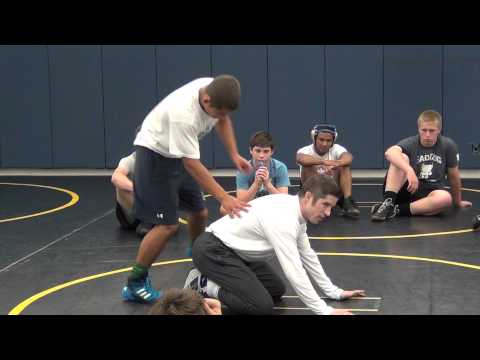
09 Ankle Breakdown - Quick Sit to Hip Heist
0
Hip Sit Defence·SJJ Wrestling
Translation: hip sit defence
The Hip Sit Defence subfamily covers the defensive technique of dropping the hips and sitting back when an opponent attempts a takedown, lowering the centre of gravity and making it difficult for the attacker to lift or drive the defender. [1] The hip sit creates heavy defensive weight by lowering the hips below the attacker's grip level, forcing them to lift against the defender's full bodyweight plus gravity. [1],[2] The hip sit is particularly effective against body lock takedowns and clinch-based takedowns where the attacker needs to elevate the defender's hips. [2],[3]
Hip sit defence drops the hips to prevent the opponent from completing a takedown. [1]
A wrestling takedown defence technique. [1]
Used in wrestling and MMA. [1]
No images yet for this technique.
Sign in to suggest an image.
No instructional courses yet for this technique.
Sign in to suggest a course.
Risk of injury to the person this technique is applied to
Sprawls and stuffs involve sudden body weight displacement; knee/hip strain risk
Skill level needed to execute this technique reliably
Whether this technique is allowed under major competition rule sets
Boxing (Edwin Haislet, 1940)
Alias sources — [1] Wrestling Coaching Manual (USA Wrestling, 2015) [2] MMA Instruction Manual (Ryan & Snowden, 2010) [3] MMA Instruction Manual (Ryan & Snowden, 2010)
Effectiveness sources — [1] Wrestling Physical Conditioning Encyclopedia (Petrov, 1977)
Standard katakana transliteration of Western martial arts terminology (外来語) — used in Japanese MMA, boxing, and BJJ communities
Alias sources — [1] Wrestling Coaching Manual (USA Wrestling, 2015) [2] MMA Instruction Manual (Ryan & Snowden, 2010) [3] MMA Instruction Manual (Ryan & Snowden, 2010)
Effectiveness sources — [1] Wrestling Physical Conditioning Encyclopedia (Petrov, 1977)
grip fighting technique, forearm endurance, timing
strong hands and forearms, quick stripping motions
forearm flexors/extensors, wrist rotators, biceps
Every move, in any martial art, shares a few universal traits. Mix and match below to pinpoint the right tool — or compare equivalents across styles.
You want to immobilize their foot so they can't move it; once you achieve that position, you've successfully controlled them and can work from there.
In college wrestling you can use aggressive finishing techniques like face smashing, but in high school competition these moves are not allowed, so you need to adjust your approach based on the ruleset.
The Hip Sit Defence subfamily covers the defensive technique of dropping the hips and sitting back when an opponent attempts a takedown, lowering the centre of gravity and making it difficult for the attacker to lift or drive the defender. The hip sit creates heavy defensive weight by lowering the hips below the attacker's grip level, forcing them to lift against the defender's full bodyweight plus gravity.
Hip sitting as takedown defence has been a fundamental wrestling technique since the sport's earliest forms, representing one of the most intuitive defensive responses to lifting takedown attempts. It is a basic defensive skill taught in all wrestling programmes.
Unified MMA: legal — Legal defensive technique; IBJJF: legal — Legal — defensive techniques are fundamental to grappling; IJF: legal — Legal defensive action; ADCC: legal — Legal; UWW: legal — Legal defensive technique; FIAS Sport Sambo: legal — Legal
Danger rating 3/10. Moderate — sprawls and stuffs involve sudden body weight displacement; knee/hip strain risk
The standard setup chain: Anticipate the Attack → Execute Defence → Recover Stance → Counter or Disengage.
Standard counters include: Timing — attack when the defence is recovering or between movements / Feint — use deception to create openings in the defensive structure / Angle Change — attack from an unexpected angle that the defence does not cover.
Common variants: Standard defence (primary defensive technique from the most common position); Reactive defence (triggered by the opponent's attack, minimal movement for …); Proactive defence (anticipating the attack and positioning to neutralise it …); Counter defence (using the defensive movement to create an immediate count…).
Used in wrestling and MMA.
Top errors to watch for: Sitting the hips back but not down — the hips must drop vertically, not horizontally; back movement doesn't prevent l… / Sitting too low and ending up on the ground — the hip sit is low but still a standing (or near-standing) position / Not fighting grips during the hip sit — the sit buys time, but you must break the opponent's control / Using the hip sit against leg attacks — the hip sit doesn't address single or double legs; use the sprawl instead.
The Hip Sit Defence is also known as Hippu Shitto Difensu, Hip Sit, Sit Back Defence, Heavy Hips.