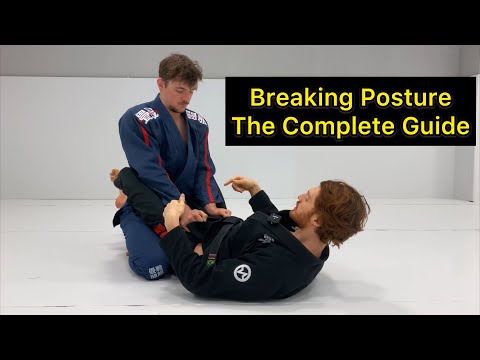
Breaking Posture in Closed Guard ( The Complete Guide )
0
Standard Posture Break·JonThomasBJJ·Added by Admin
Closed guard is one of the most powerful guards in all of jiu jitsu. When controlled well it is very difficult to escape…
Translation: standard posture break
The Standard Posture Break strips the opponent's grips by extending the spine upright, pushing the hips forward, and driving the chest up, using the entire body's postural strength to overcome the opponent's grip. [1] The defender grabs the opponent's gripping hand with both hands, then postures up explosively, using the standing or kneeling position's mechanical advantage to peel the grip off. [1],[2] The standard posture break is the most reliable grip breaking technique because it uses large muscle groups against the opponent's comparatively weaker grip muscles. [2],[3]
The standard posture break. [1]
A fundamental BJJ technique. [1]
Used in BJJ competition. [1]
No images yet for this technique.
Sign in to suggest an image.
Closed guard is one of the most powerful guards in all of jiu jitsu. When controlled well it is very difficult to escape…
No instructional courses yet for this technique.
Sign in to suggest a course.
Risk of injury to the person this technique is applied to
Submission defence involves resisting joint locks/chokes; risk of injury if defence fails or is delayed
Skill level needed to execute this technique reliably
Whether this technique is allowed under major competition rule sets
Kodokan Judo (Jigoro Kano, 1986)
Effectiveness sources — [1] Jiu-Jitsu University (Ribeiro, 2008)
Alias sources — [1] Jiu-Jitsu University (Ribeiro, 2008) [2] Fundamentals of Brazilian Jiu-Jitsu (Danaher, 2012) [3] Kodokan Judo (Kano, 1986)
Standard katakana transliteration of Western martial arts terminology (外来語) — used in Japanese MMA, boxing, and BJJ communities
Alias sources — [1] Jiu-Jitsu University (Ribeiro, 2008) [2] Fundamentals of Brazilian Jiu-Jitsu (Danaher, 2012) [3] Kodokan Judo (Kano, 1986)
Effectiveness sources — [1] Jiu-Jitsu University (Ribeiro, 2008)
grip fighting technique, forearm endurance, timing
strong hands and forearms, quick stripping motions
forearm flexors/extensors, wrist rotators, biceps
Once you break posture, you have multiple attacking options depending on how your opponent responds. Jon Thomas BJJ recommends going for an overhook and scooting to the side, or using a cross collar grip followed by a crunch to pin your elbow to his chest, which prevents him from generating counter pressure.
After getting the cross collar grip, crunch forward and bring your elbow to his sternum rather than keeping your arm extended. Jon Thomas BJJ emphasizes that keeping your arm extended allows counter pressure, so closing the distance by pinning your elbow to his chest eliminates this defense.
Jon Thomas BJJ suggests using an overhook combined with a belt grip, then shrimping to the side to set up a triangle choke by controlling the wrist and using your leg. Alternatively, you can bridge your hips to pop his elbow over and unlock your legs to transition to another submission.
Understanding how to break posture and attack against all different control sets allows you to keep the offense flowing regardless of which attack you ultimately want to execute, preventing your opponent from settling into a defensive position.
The Standard Posture Break strips the opponent's grips by extending the spine upright, pushing the hips forward, and driving the chest up, using the entire body's postural strength to overcome the opponent's grip. The defender grabs the opponent's gripping hand with both hands, then postures up explosively, using the standing or kneeling position's mechanical advantage to peel the grip off.
The standard posture break is one of the most fundamental defensive techniques in BJJ, taught as the first step of guard top defence — break the grips, establish posture, then work to pass. It has been a basic teaching point in grappling instruction for decades.
Unified MMA: legal — Legal defensive technique; IBJJF: legal — Legal — defensive techniques are fundamental to grappling; IJF: legal — Legal defensive action; ADCC: legal — Legal; UWW: legal — Legal defensive technique; FIAS Sport Sambo: legal — Legal
Danger rating 3/10. Moderate — submission defence involves resisting joint locks/chokes; risk of injury if defence fails or is delayed
The standard setup chain: Anticipate the Attack → Execute Defence → Recover Stance → Counter or Disengage.
Standard counters include: Timing — attack when the defence is recovering or between movements / Feint — use deception to create openings in the defensive structure / Angle Change — attack from an unexpected angle that the defence does not cover.
Common variants: Standard defence (primary defensive technique from the most common position); Reactive defence (triggered by the opponent's attack, minimal movement for …); Proactive defence (anticipating the attack and positioning to neutralise it …); Counter defence (using the defensive movement to create an immediate count…).
Used in BJJ competition.
Top errors to watch for: Hands on the chest instead of the hips — chest placement allows the opponent to control your arms and re-break posture / Elbows flared wide — flared elbows invite arm drags and underhooks that immediately break posture / Extending from the lower back — this causes back fatigue and doesn't generate enough force; drive from the hips / Recovering posture slowly — slow recovery gives the opponent time to transition to submissions during the recovery.
The Standard Posture Break is also known as Sutandādo Posuchā Bureiku, Basic Posture Break, Standard Kuzushi, Posture Collapse.