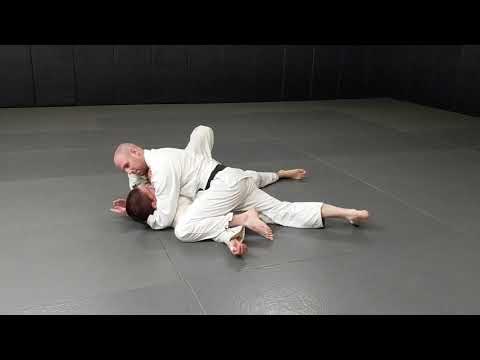
Episode #108: High percentage Bicep Slicer:Crush options
0
Standard Bicep Slicer Defence·Rochester Judo·Added by Admin
Translation: standard bicep slicer defence
The Standard Bicep Slicer Defence addresses the bicep crush by immediately working to extend the arm or reposition the fulcrum point before compressive pressure damages the muscle tissue. [1] The defender focuses on straightening the elbow to eliminate the fold that creates compression, using the free hand to push against the attacker's leg or arm that is serving as the fulcrum. [1],[2] If extension is not possible, the defender turns into the attacker to reduce the angle of compression while working to extract the arm from the locked position. [2],[3]
The standard bicep slicer defence maintains arm extension to prevent the compression. [1]
A BJJ defence technique. [1]
Used in BJJ competition. [1]
No images yet for this technique.
Sign in to suggest an image.
No instructional courses yet for this technique.
Sign in to suggest a course.
Risk of injury to the person this technique is applied to
Submission defence involves resisting joint locks/chokes; risk of injury if defence fails or is delayed
Skill level needed to execute this technique reliably
Whether this technique is allowed under major competition rule sets
Jiu-Jitsu University (Saulo Ribeiro, 2008)
Alias sources — [1] Jiu-Jitsu University (Ribeiro, 2008) [2] Fundamentals of Brazilian Jiu-Jitsu (Danaher, 2012) [3] Brazilian Jiu-Jitsu: Theory and Technique (Gracie, 2001)
Effectiveness sources — [1] Jiu-Jitsu University (Ribeiro, 2008)
Standard katakana transliteration of Western martial arts terminology (外来語) — used in Japanese MMA, boxing, and BJJ communities
Alias sources — [1] Jiu-Jitsu University (Ribeiro, 2008) [2] Fundamentals of Brazilian Jiu-Jitsu (Danaher, 2012) [3] Brazilian Jiu-Jitsu: Theory and Technique (Gracie, 2001)
Effectiveness sources — [1] Jiu-Jitsu University (Ribeiro, 2008)
reaction speed, structural body mechanics, defensive awareness
quick reflexes and conditioned defensive surfaces
varies — forearms (blocking), legs (movement), core (stability)
Rochester Judo recommends starting from spider web position (jujigatami position with your opponent on their back) as an effective setup for bicep slicer variations.
If your opponent rolls, roll up with them and transition into the arm-sit position to maintain control and continue your attack.
The Standard Bicep Slicer Defence addresses the bicep crush by immediately working to extend the arm or reposition the fulcrum point before compressive pressure damages the muscle tissue. The defender focuses on straightening the elbow to eliminate the fold that creates compression, using the free hand to push against the attacker's leg or arm that is serving as the fulcrum.
The standard bicep slicer defence became a necessary part of the grappling curriculum as bicep slicers gained prevalence in competition, particularly in no-gi and MMA contexts. It is now taught as part of comprehensive submission defence programmes.
Unified MMA: legal — Legal defensive technique; IBJJF: legal — Legal — defensive techniques are fundamental to grappling; IJF: legal — Legal defensive action; ADCC: legal — Legal; UWW: legal — Legal defensive technique; FIAS Sport Sambo: legal — Legal
Danger rating 3/10. Moderate — submission defence involves resisting joint locks/chokes; risk of injury if defence fails or is delayed
The standard setup chain: Anticipate the Attack → Execute Defence → Recover Stance → Counter or Disengage.
Standard counters include: Timing — attack when the defence is recovering or between movements / Feint — use deception to create openings in the defensive structure / Angle Change — attack from an unexpected angle that the defence does not cover.
Common variants: Standard defence (primary defensive technique from the most common position); Reactive defence (triggered by the opponent's attack, minimal movement for …); Proactive defence (anticipating the attack and positioning to neutralise it …); Counter defence (using the defensive movement to create an immediate count…).
Used in BJJ competition.
Top errors to watch for: Straightening the arm without controlling the lever forearm — both must happen simultaneously / Trying to rotate the arm instead of straightening — rotation doesn't address the compression angle / Panicking from the pain and pulling wildly — controlled, technical defence is more effective than frantic movement / Not addressing the position after escaping the submission — the opponent will simply re-attack if you stay in the sam….
The Standard Bicep Slicer Defence is also known as Sutandādo Baiseppu Suraisā Difensu, Basic Bicep Slicer Defence, Standard Arm Crush Escape, Bicep Crush Defence.