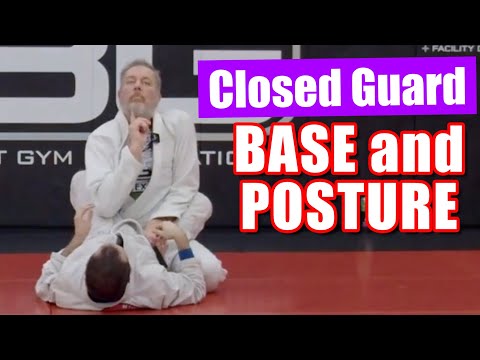
Invisible Structure That Makes a Good Posture
0
Posture Defence·SBG PDX & Vancouver BJJ and MMA Videos
Try out SBG University for a month for free. Use the code: YOUTUBEFREE https://sbgu.samcart.com/referral/OD1DNOAi/vUiYFZ…
Translation: posture defence
The Posture Defence subfamily covers choke defensive techniques that use body positioning and postural alignment to prevent the opponent from applying choking pressure. [1] Posture defence addresses the root cause of many chokes — broken posture — by maintaining or recovering an upright, aligned body position that makes choke application difficult. [1],[2] In closed guard, maintaining an upright posture with the head high and spine straight prevents most cross-collar and guillotine attacks. [2],[3]
Posture defence has been a core concept in grappling since the earliest systems recognised that broken posture creates submission vulnerability. [1] BJJ's emphasis on posture in the guard and during back defence has made postural awareness one of the most important defensive concepts in modern grappling. [2],[3]
Posture defence maintains upright posture to prevent the opponent from breaking you down for submissions. [1]
Posture management is fundamental in BJJ and MMA. [1]
Essential in guard passing and submission defence. [1]
No images yet for this technique.
Sign in to suggest an image.
Try out SBG University for a month for free. Use the code: YOUTUBEFREE https://sbgu.samcart.com/referral/OD1DNOAi/vUiYFZ…
No instructional courses yet for this technique.
Sign in to suggest a course.
Risk of injury to the person this technique is applied to
Submission defence involves resisting joint locks/chokes; risk of injury if defence fails or is delayed
Skill level needed to execute this technique reliably
Whether this technique is allowed under major competition rule sets
Boxing (Edwin Haislet, 1940)
Alias sources — [1] Jiu-Jitsu University (Ribeiro, 2008) [2] Fundamentals of Brazilian Jiu-Jitsu (Danaher, 2012) [3] Kodokan Judo (Kano, 1986)
Effectiveness sources — [1] Jiu-Jitsu University (Ribeiro, 2008)
Standard katakana transliteration of Western martial arts terminology (外来語) — used in Japanese MMA, boxing, and BJJ communities
Alias sources — [1] Jiu-Jitsu University (Ribeiro, 2008) [2] Fundamentals of Brazilian Jiu-Jitsu (Danaher, 2012) [3] Kodokan Judo (Kano, 1986)
Effectiveness sources — [1] Jiu-Jitsu University (Ribeiro, 2008)
reaction speed, structural body mechanics, defensive awareness
quick reflexes and conditioned defensive surfaces
varies — forearms (blocking), legs (movement), core (stability)
Every move, in any martial art, shares a few universal traits. Mix and match below to pinpoint the right tool — or compare equivalents across styles.
Focus on stability by sitting on your heels and getting as low as possible. Keep your head and shoulders in front of your hips—never lean back to compensate, as this allows your opponent to sit up and sweep you. According to SBG PDX & Vancouver BJJ, your head and shoulders must stay forward of your hips at all times.
Tuck your tailbone rather than flaring it out. When you tuck your tailbone while pinching your knees together and keeping your shoulders slightly in front of your hips, your opponent cannot pull you forward even without using your hands—the structure of your skeleton becomes your defense.
Keep your elbows always inside, not flared out where your opponent can climb up. Position your hand so if they try to push it between their legs for a triangle, they cannot get it through. Your inside hand holds them down while preventing submissions.
No—SBG PDX & Vancouver BJJ emphasizes you should be either all the way down (when necessary) or all the way up in an upright posture preparing to stand or open their legs. Never stay in between, as this is where your opponent can do the most damage with sweeps and submissions.
The Posture Defence subfamily covers choke defensive techniques that use body positioning and postural alignment to prevent the opponent from applying choking pressure. Posture defence addresses the root cause of many chokes — broken posture — by maintaining or recovering an upright, aligned body position that makes choke application difficult.
Posture defence has been a core concept in grappling since the earliest systems recognised that broken posture creates submission vulnerability. BJJ's emphasis on posture in the guard and during back defence has made postural awareness one of the most important defensive concepts in modern grappling.
Unified MMA: legal — Legal defensive technique; IBJJF: legal — Legal — defensive techniques are fundamental to grappling; IJF: legal — Legal defensive action; ADCC: legal — Legal; UWW: legal — Legal defensive technique; FIAS Sport Sambo: legal — Legal
Danger rating 3/10. Moderate — submission defence involves resisting joint locks/chokes; risk of injury if defence fails or is delayed
The standard setup chain: Anticipate the Attack → Execute Defence → Recover Stance → Counter or Disengage.
Standard counters include: Timing — attack when the defence is recovering or between movements / Feint — use deception to create openings in the defensive structure / Angle Change — attack from an unexpected angle that the defence does not cover.
Common variants: Standard defence (primary defensive technique from the most common position); Reactive defence (triggered by the opponent's attack, minimal movement for …); Proactive defence (anticipating the attack and positioning to neutralise it …); Counter defence (using the defensive movement to create an immediate count…).
Essential in guard passing and submission defence.
Top errors to watch for: Posturing with a rounded back — a curved spine actually helps the opponent break you down; keep the back straight / Posturing too high and becoming off-balance — maintain a stable base while extending upward / Posturing up but leaving the elbows wide — flared elbows invite collar ties and arm drags that break posture / Using only upper body to posture — drive from the hips and legs; the lower body provides the power.
The Posture Defence is also known as Posuchā Difensu, Posture Control, Posture Up, Kuzushi Defence.