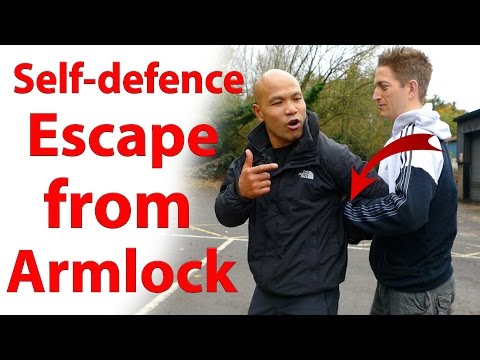
Self defence How to escape from armlock
0
Armlock Defence·Master Wong
Self defence How to escape from armlock Subscribe for more videos, click here: https://www.youtube.com/user/138mws Ge…
Translation: armlock defence
The Armlock Defence family covers all defensive techniques used to prevent or escape from arm-based joint locks including armbars, kimuras, americanas, and wrist locks. [1] Armlock defence operates on the principle of preventing the opponent from isolating the arm and extending or rotating it past its anatomical limit. [1],[2] The primary defensive strategies are grip fighting (preventing the opponent from controlling the arm), stacking (driving weight forward to relieve extension pressure), and the hitchhiker escape (rotating out of the armbar's fulcrum). [2],[3]
Armlock defences have been taught alongside armlock attacks since the earliest jujutsu and judo systems. [1] BJJ's competitive evolution drove the development of increasingly sophisticated armlock escapes, with the hitchhiker escape becoming one of the most important defensive innovations in modern grappling. [2],[3]
Armlock defence was developed alongside arm attack systems in judo and BJJ. [1]
Armlock defence is essential in BJJ and MMA competition. [1]
No images yet for this technique.
Sign in to suggest an image.
Self defence How to escape from armlock Subscribe for more videos, click here: https://www.youtube.com/user/138mws Ge…
No instructional courses yet for this technique.
Sign in to suggest a course.
Risk of injury to the person this technique is applied to
Submission defence involves resisting joint locks/chokes; risk of injury if defence fails or is delayed
Skill level needed to execute this technique reliably
Whether this technique is allowed under major competition rule sets
Boxing (Edwin Haislet, 1940)
Alias sources — [1] Jiu-Jitsu University (Ribeiro, 2008) [2] Mastering Jujitsu (Gracie & Danaher, 2003) [3] Enter the System (Danaher, 2018)
Effectiveness sources — [1] Mastering Jujitsu (Gracie & Danaher, 2003) [2] Jiu-Jitsu University (Ribeiro, 2008)
Mixed Japanese-Western terminology — combines traditional Japanese terms with katakana loanwords
Alias sources — [1] Jiu-Jitsu University (Ribeiro, 2008) [2] Mastering Jujitsu (Gracie & Danaher, 2003) [3] Enter the System (Danaher, 2018)
Effectiveness sources — [1] Mastering Jujitsu (Gracie & Danaher, 2003) [2] Jiu-Jitsu University (Ribeiro, 2008)
grip fighting technique, forearm endurance, timing
strong hands and forearms, quick stripping motions
forearm flexors/extensors, wrist rotators, biceps
Every move, in any martial art, shares a few universal traits. Mix and match below to pinpoint the right tool — or compare equivalents across styles.
The Grip Fighting Defence subfamily covers armlock defence techniques where the defender prevents the submission by maintaining grip connections that stop the opponent from isolating and extending the arm. [1] The most common grip defence is clasping the hands together — Gable grip, S-grip, or interlocking fingers — preventing the opponent from straightening the arm for an armbar. [1,2] Grip fighting defence is the first line of armlock defence, buying time while the defender works for a positional escape. [2,3]
The Hitchhiker Defence subfamily covers the armbar escape technique where the defender rotates in the direction of the thumb (like a hitchhiking motion), turning the body to relieve the hyperextension pressure on the elbow joint. [1] The hitchhiker escape works by changing the angle of the arm relative to the attacker's fulcrum — by rotating toward the thumb side, the defender turns the arm so the elbow is no longer aligned with the attacker's hips, removing the leverage needed for the armbar. [1,2] The escape is completed by rolling through the rotation and either recovering guard or establishing top position. [2,3]
The Stacking Defence subfamily covers armlock defence techniques where the defender drives their weight forward and upward, compressing the attacker beneath them to relieve the extension pressure on the arm and create conditions for escape. [1] Stacking works by collapsing the space the attacker needs to apply leverage — when the defender's weight is stacked on top of the attacker, the attacker cannot fully extend the arm because their body is compressed. [1,2] The stacking defence transitions to guard pass attempts as the defender uses the forward pressure to work past the attacker's legs. [2,3]
Armlock defense prioritizes prevention over escape — keeping the arm bent and close to the body prevents the attacker from isolating and extending it. Once the arm is fully extended, escape is nearly impossible. The Gable grip (clasping both hands together) is the primary last-resort defense. (Ribeiro, Jiu-Jitsu University)
According to Master Wong, escaping an armlock is basic and simple if you know what you're doing. The most important thing is to support your arm with your other hand to prevent it from being broken.
Master Wong emphasizes pushing their arm down to prevent them from securing the lock position, which stops them from being able to apply pressure upward.
Master Wong stresses that saving your arm should be your first priority before attempting any other defensive or counter actions.
The Armlock Defence family covers all defensive techniques used to prevent or escape from arm-based joint locks including armbars, kimuras, americanas, and wrist locks. Armlock defence operates on the principle of preventing the opponent from isolating the arm and extending or rotating it past its anatomical limit.
Armlock defences have been taught alongside armlock attacks since the earliest jujutsu and judo systems. BJJ's competitive evolution drove the development of increasingly sophisticated armlock escapes, with the hitchhiker escape becoming one of the most important defensive innovations in modern grappling.
Unified MMA: legal — Legal defensive technique; IBJJF: legal — Legal — defensive techniques are fundamental to grappling; IJF: legal — Legal defensive action; ADCC: legal — Legal; UWW: legal — Legal defensive technique; FIAS Sport Sambo: legal — Legal
Danger rating 3/10. Moderate — submission defence involves resisting joint locks/chokes; risk of injury if defence fails or is delayed
The standard setup chain: Anticipate the Attack → Execute Defence → Recover Stance → Counter or Disengage.
Standard counters include: Timing — attack when the defence is recovering or between movements / Feint — use deception to create openings in the defensive structure / Angle Change — attack from an unexpected angle that the defence does not cover.
Common variants: Standard defence (primary defensive technique from the most common position); Reactive defence (triggered by the opponent's attack, minimal movement for …); Proactive defence (anticipating the attack and positioning to neutralise it …); Counter defence (using the defensive movement to create an immediate count…).
Armlock defence is essential in BJJ and MMA competition.
Top errors to watch for: Waiting until the arm is fully extended to begin defending — fight the grip and positioning early, before isolation / Relying on strength to resist the extension — technical defence (stacking, hitchhiker, grip fighting) is sustainable;… / Reaching with the free hand across your body — this exposes the second arm to attacks / Pulling the arm straight back against the hips — the opponent's hip bridge is stronger than your pull; use angles ins….
The Armlock Defence is also known as Ude Kansetsu-waza Difensu, Arm Lock Escape, Joint Lock Defence, Anti-Armbar.