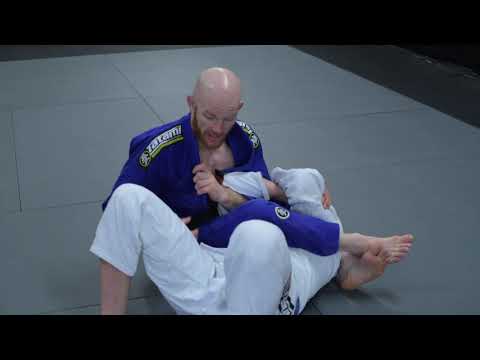
Closed Guard - Armbar vs Stacking Defence
0
Stacking Defence·Darragh O Conaill BJJ
Translation: stacking defence
The Stacking Defence subfamily covers armlock defence techniques where the defender drives their weight forward and upward, compressing the attacker beneath them to relieve the extension pressure on the arm and create conditions for escape. [1] Stacking works by collapsing the space the attacker needs to apply leverage — when the defender's weight is stacked on top of the attacker, the attacker cannot fully extend the arm because their body is compressed. [1],[2] The stacking defence transitions to guard pass attempts as the defender uses the forward pressure to work past the attacker's legs. [2],[3]
Stacking defence drives forward to stack the opponent, relieving submission pressure. [1]
Stacking is a fundamental submission defence in BJJ. [1]
Used in BJJ and MMA competition. [1]
No images yet for this technique.
Sign in to suggest an image.
No instructional courses yet for this technique.
Sign in to suggest a course.
Risk of injury to the person this technique is applied to
Submission defence involves resisting joint locks/chokes; risk of injury if defence fails or is delayed
Skill level needed to execute this technique reliably
Whether this technique is allowed under major competition rule sets
Boxing (Edwin Haislet, 1940)
Alias sources — [1] Jiu-Jitsu University (Ribeiro, 2008) [2] Fundamentals of Brazilian Jiu-Jitsu (Danaher, 2012) [3] Brazilian Jiu-Jitsu: Theory and Technique (Gracie, 2001)
Effectiveness sources — [1] Mastering Jujitsu (Gracie & Danaher, 2003)
Standard katakana transliteration of Western martial arts terminology (外来語) — used in Japanese MMA, boxing, and BJJ communities
Alias sources — [1] Jiu-Jitsu University (Ribeiro, 2008) [2] Fundamentals of Brazilian Jiu-Jitsu (Danaher, 2012) [3] Brazilian Jiu-Jitsu: Theory and Technique (Gracie, 2001)
Effectiveness sources — [1] Mastering Jujitsu (Gracie & Danaher, 2003)
reaction speed, structural body mechanics, defensive awareness
quick reflexes and conditioned defensive surfaces
varies — forearms (blocking), legs (movement), core (stability)
Every move, in any martial art, shares a few universal traits. Mix and match below to pinpoint the right tool — or compare equivalents across styles.
Use the arm that is closest to your opponent's head to hook deep on their arm. Darragh O Conaill BJJ emphasizes that this deep hook is the first important element of a proper armbar setup.
You want your hand as deep as possible on the arm. Darragh O Conaill BJJ explains that if your grip is shallow and loose, the transition will be weaker—as you spin to finish, a bad grip will only get looser, making the submission fail.
Keep your legs strong and use them to generate momentum to help toss your opponent through. Darragh O Conaill BJJ notes that your leg position is crucial to stop the stack—even if your opponent does come up, you need that arm to reach through while maintaining leg pressure to land smoothly into the armbar.
The Stacking Defence subfamily covers armlock defence techniques where the defender drives their weight forward and upward, compressing the attacker beneath them to relieve the extension pressure on the arm and create conditions for escape. Stacking works by collapsing the space the attacker needs to apply leverage — when the defender's weight is stacked on top of the attacker, the attacker cannot fully extend the arm because their body is compressed.
Stacking as armlock defence has been a fundamental grappling technique since the earliest development of armbar attacks, representing one of the most intuitive defensive responses to being caught in an armbar. It is widely taught across BJJ, judo, and MMA as a primary armbar defence.
Unified MMA: legal — Legal defensive technique; IBJJF: legal — Legal — defensive techniques are fundamental to grappling; IJF: legal — Legal defensive action; ADCC: legal — Legal; UWW: legal — Legal defensive technique; FIAS Sport Sambo: legal — Legal
Danger rating 3/10. Moderate — submission defence involves resisting joint locks/chokes; risk of injury if defence fails or is delayed
The standard setup chain: Anticipate the Attack → Execute Defence → Recover Stance → Counter or Disengage.
Standard counters include: Timing — attack when the defence is recovering or between movements / Feint — use deception to create openings in the defensive structure / Angle Change — attack from an unexpected angle that the defence does not cover.
Common variants: Standard defence (primary defensive technique from the most common position); Reactive defence (triggered by the opponent's attack, minimal movement for …); Proactive defence (anticipating the attack and positioning to neutralise it …); Counter defence (using the defensive movement to create an immediate count…).
Used in BJJ and MMA competition.
Top errors to watch for: Stacking without walking the feet forward — the power comes from driving with the legs, not leaning with the upper body / Stacking with a rounded back — maintain a straight back and drive from the hips for maximum pressure / Allowing the opponent to maintain hip angle while you stack — you must drive them flat to neutralize the armbar / Stacking but not fighting the grip simultaneously — the stack creates the window to strip grips; use it.
The Stacking Defence is also known as Sutakkingu Difensu, Stack Pass, Stacking Escape, Pressure Stack.