Basic Guard Recovery | Fundamental Jiu Jitsu | Performance Martial Arts Academy
0
Standard Full Guard Recovery·Performance Martial Arts Academy·Added by Admin
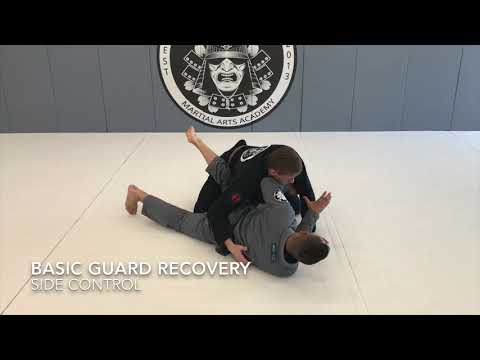
Don’t let them hug your head, and get that guard back!
Translation: standard full guard recovery
The Standard Full Guard Recovery executes the fundamental technique of re-closing the guard around the opponent's torso, typically by using frames and hip movement to create space, then bringing both legs around the opponent's waist and locking the ankles behind their back. [1] The recovery sequence involves framing against the opponent's shoulders or hips, shrimping to create hip space, swinging the outside leg around the opponent's back, and closing the ankles to secure closed guard. [1],[2] Timing is critical — the recovery must be executed when the opponent is transitioning between passing positions and their weight is momentarily uncommitted. [2],[3]
Full guard recovery is the most fundamental guard recovery skill in BJJ, as the closed guard is the most secure bottom position and offers the widest range of offensive options. [1] The ability to recover full guard from inferior positions is considered a hallmark of high-level defensive grappling. [2]
Full guard recovery is a core component of the Gracie Jiu-Jitsu self-defence curriculum, as the closed guard was the primary bottom position from which the Gracie family taught all ground fighting. [1]
Full guard recovery is a standard BJJ defensive technique. [1]
No images yet for this technique.
Sign in to suggest an image.
Don’t let them hug your head, and get that guard back!
No instructional courses yet for this technique.
Sign in to suggest a course.
Risk of injury to the person this technique is applied to
Guard retention uses frames and hip movement; minimal direct injury risk
Skill level needed to execute this technique reliably
Whether this technique is allowed under major competition rule sets
Boxing (Edwin Haislet, 1940)
Alias sources — [1] Jiu-Jitsu University (Ribeiro, 2008) [2] Fundamentals of Brazilian Jiu-Jitsu (Danaher, 2012) [3] Brazilian Jiu-Jitsu: Theory and Technique (Gracie, 2001)
Effectiveness sources — [1] Jiu-Jitsu University (Ribeiro, 2008) [2] Brazilian Jiu-Jitsu: Theory and Technique (Gracie, 2001)
Standard katakana transliteration of Western martial arts terminology (外来語) — used in Japanese MMA, boxing, and BJJ communities
Alias sources — [1] Jiu-Jitsu University (Ribeiro, 2008) [2] Fundamentals of Brazilian Jiu-Jitsu (Danaher, 2012) [3] Brazilian Jiu-Jitsu: Theory and Technique (Gracie, 2001)
Effectiveness sources — [1] Jiu-Jitsu University (Ribeiro, 2008) [2] Brazilian Jiu-Jitsu: Theory and Technique (Gracie, 2001)
structural arm strength, forearm density, timing
strong arms and elbows for load-bearing frames
triceps, deltoids, forearms, core
Keeping your head free allows you to have much more mobility in your escape, which is why you should avoid letting your opponent hug your head when being put into side control. Performance Martial Arts Academy emphasizes that the ability to maintain this head position is crucial for successful guard recovery.
Place your arm underneath your knee rather than on top of it—when your arm is underneath, your opponent cannot simply crush your knee down because it's attached to your hand and shoulder. Performance Martial Arts Academy stresses this distinction because the opposite position puts you in a vulnerable spot.
Keep good sensitivity in your outside foot rather than letting it dangle, because if your opponent tries to circle it toward your back, that sensitivity actually helps re-square the guard for you automatically. Performance Martial Arts Academy notes this footwork is an important detail for maintaining control during the recovery.
Get your knee, hip, and rear shoulder into alignment to create space, and use your whole core and lats to pull your shoulders down and away from your ears rather than just pushing with your arms. Performance Martial Arts Academy emphasizes using your shoulder and core strength for this fundamental positioning.
The Standard Full Guard Recovery executes the fundamental technique of re-closing the guard around the opponent's torso, typically by using frames and hip movement to create space, then bringing both legs around the opponent's waist and locking the ankles behind their back. The recovery sequence involves framing against the opponent's shoulders or hips, shrimping to create hip space, swinging the outside leg around the opponent's back, and closing the ankles to secure closed guard.
The standard full guard recovery is one of the foundational defensive techniques in BJJ, practised since the art's earliest days as the primary method of maintaining the guard-based fighting position. It remains one of the most important defensive skills in competitive grappling.
Unified MMA: legal — Legal defensive technique; IBJJF: legal — Legal; IJF: legal — Legal defensive action; WBC/Boxing: legal — Legal; WKF: legal — Legal; WT: legal — Legal
Danger rating 2/10. Low — guard retention uses frames and hip movement; minimal direct injury risk
The standard setup chain: Anticipate the Attack → Execute Defence → Recover Stance → Counter or Disengage.
Standard counters include: Timing — attack when the defence is recovering or between movements / Feint — use deception to create openings in the defensive structure / Angle Change — attack from an unexpected angle that the defence does not cover.
Common variants: Standard defence (primary defensive technique from the most common position); Reactive defence (triggered by the opponent's attack, minimal movement for …); Proactive defence (anticipating the attack and positioning to neutralise it …); Counter defence (using the defensive movement to create an immediate count…).
Full guard recovery is a standard BJJ defensive technique.
Top errors to watch for: Trying to swing both legs around at once — insert one leg first, then the other / Not framing before attempting leg insertion — without space, the legs can't get around / Leaving the guard unlocked (ankles not crossed) — an unlocked guard is easily opened / Recovering guard without controlling posture — the opponent immediately postures up and rains ground-and-pound.
The Standard Full Guard Recovery is also known as Sutandādo Furu Gādo Rikabarī, Basic Closed Guard Recovery, Standard Guard Re-Close, Knee-In Guard Recovery.