Guard Recovery and Inverting (Lachlan Giles)
0
Full Guard Recovery·Absolute MMA St Kilda - Melbourne
Follow the links below for detailed instructional series by Lachlan Giles The Guard Passing Anthology: Half Guard can b…
Translation: full guard recovery
The Full Guard Recovery subfamily covers techniques for re-establishing closed (full) guard — legs wrapped around the opponent's torso with ankles crossed — after the guard has been opened or partially passed. [1] Full guard recovery typically involves creating enough hip space through shrimping or framing to bring both legs around the opponent's body and close the ankles behind their back. [1],[2] Recovering full guard is often the defensive priority because closed guard is the most controlling bottom position, eliminating the opponent's ability to stand, posture, or pass without first opening the guard. [2],[3]
Full guard recovery has been a fundamental BJJ defensive skill since the art's foundation, as the closed guard was the primary bottom position in early BJJ competition. [1] The ability to recover full guard after an opponent's passing attempt remains a critical defensive skill at all levels. [2],[3]
Full guard recovery re-establishes closed guard from an inferior position. [1]
A fundamental BJJ defensive technique. [1]
Used in BJJ competition. [1]
No images yet for this technique.
Sign in to suggest an image.
Follow the links below for detailed instructional series by Lachlan Giles The Guard Passing Anthology: Half Guard can b…
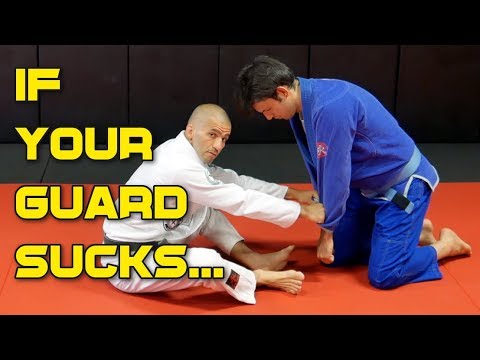
Guard Recovery Fundamentals Online Course: https://guardrecoveryfundamentals.com/ If your guard sucks and keeps getting…
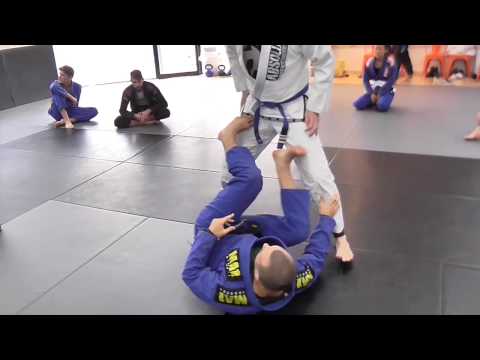
Full Guard Recovery encompasses a family of inversion and repositioning techniques used when an opponent begins passing the guard, ranging from early-stage passes (foot-line distance) to advanced scenarios where the passer has already crossed the knee line or established an underhook. The unifying principle is that the defender maintains or re-establishes contact with the passer while rotating their hips off the mat and spinning back into guard position, rather than attempting to chase with the legs alone—a strategy that would lose the race to a standing opponent. Lachlan Giles (Absolute MMA St Kilda) emphasizes that inversion has become a fundamental skill necessary for modern guard retention, distinguishing recovery by distance and pressure conditions: at far range, the defender lifts hips and spins through while maintaining shin contact; at closer range, pressure assists the motion; and once the knee line is passed, the inversion becomes a tighter, sit-up-like movement using an underhook and foot-post. Critical technical details include keeping shoulders flat on the mat to avoid neck strain, freeing the far leg to enable hip lift, preventing the passer from establishing head control, and using momentum from the passer's movement rather than fighting against pressure. MMA Leech frames guard recovery differently, prioritizing double-sleeve grip control before the pass develops, arguing that maintaining grip on both the passer's wrists forces them to expend energy and grants the defender time to escape—a preventative rather than reactive approach. Both instructors agree that guard recovery is a layered problem: stopping the pass at the feet is easiest, at the knees is intermediate, and at the hips is most difficult, making early contact maintenance essential.
Synthesized from 2 instructors
No instructional courses yet for this technique.
Sign in to suggest a course.
Risk of injury to the person this technique is applied to
Guard retention uses frames and hip movement; minimal direct injury risk
Skill level needed to execute this technique reliably
Whether this technique is allowed under major competition rule sets
Boxing (Edwin Haislet, 1940)
Alias sources — [1] Jiu-Jitsu University (Ribeiro, 2008) [2] Fundamentals of Brazilian Jiu-Jitsu (Danaher, 2012) [3] Brazilian Jiu-Jitsu: Theory and Technique (Gracie, 2001)
Effectiveness sources — [1] Jiu-Jitsu University (Ribeiro, 2008)
Standard katakana transliteration of Western martial arts terminology (外来語) — used in Japanese MMA, boxing, and BJJ communities
Alias sources — [1] Jiu-Jitsu University (Ribeiro, 2008) [2] Fundamentals of Brazilian Jiu-Jitsu (Danaher, 2012) [3] Brazilian Jiu-Jitsu: Theory and Technique (Gracie, 2001)
Effectiveness sources — [1] Jiu-Jitsu University (Ribeiro, 2008)
reaction speed, structural body mechanics, defensive awareness
quick reflexes and conditioned defensive surfaces
varies — forearms (blocking), legs (movement), core (stability)
Every move, in any martial art, shares a few universal traits. Mix and match below to pinpoint the right tool — or compare equivalents across styles.
Establishing control and grips makes it harder for your opponent to pass your guard, allowing you to play your guard effectively once recovered. MMA Leech emphasizes keeping your arm locked on your elbows and maintaining strong grips to prevent your opponent from breaking your control.
Yes—Lachlan Giles notes that inverting is now so common in modern jiu-jitsu that it should be considered a fundamental technique if you want to have a good guard.
Lift your hips off the ground and roll through rather than trying to force your bottom leg through. Lachlan Giles emphasizes that your hips must come up to generate the momentum needed for the invert.
Keep contact with your opponent throughout the inversion and avoid pushing them away so far that you lose connection. Lachlan Giles stresses maintaining leg contact so when your opponent moves, you have the chance to lift your hips and spin through.
The Full Guard Recovery subfamily covers techniques for re-establishing closed (full) guard — legs wrapped around the opponent's torso with ankles crossed — after the guard has been opened or partially passed. Full guard recovery typically involves creating enough hip space through shrimping or framing to bring both legs around the opponent's body and close the ankles behind their back.
Full guard recovery has been a fundamental BJJ defensive skill since the art's foundation, as the closed guard was the primary bottom position in early BJJ competition. The ability to recover full guard after an opponent's passing attempt remains a critical defensive skill at all levels.
Unified MMA: legal — Legal defensive technique; IBJJF: legal — Legal; IJF: legal — Legal defensive action; WBC/Boxing: legal — Legal; WKF: legal — Legal; WT: legal — Legal
Danger rating 2/10. Low — guard retention uses frames and hip movement; minimal direct injury risk
The standard setup chain: Anticipate the Attack → Execute Defence → Recover Stance → Counter or Disengage.
Standard counters include: Timing — attack when the defence is recovering or between movements / Feint — use deception to create openings in the defensive structure / Angle Change — attack from an unexpected angle that the defence does not cover.
Common variants: Standard defence (primary defensive technique from the most common position); Reactive defence (triggered by the opponent's attack, minimal movement for …); Proactive defence (anticipating the attack and positioning to neutralise it …); Counter defence (using the defensive movement to create an immediate count…).
Used in BJJ competition.
Top errors to watch for: Trying to close guard without first creating space — you must frame and shrimp to make room for the legs / Pulling the opponent into guard with your arms instead of using your legs — the legs do the work / Not locking the ankles immediately — an unlocked guard is easily opened / Recovering full guard when half guard or open guard would be more effective — read the situation.
The Full Guard Recovery is also known as Furu Gādo Rikabarī, Closed Guard Recovery, Full Guard Replacement, Guard Re-Close.