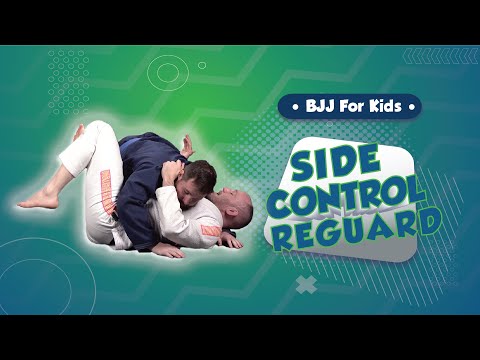
Shrimp Reguard from Side Control - Brazilian Jiu-Jitsu for Kids
0
Reguard·Utopia Martial Arts
A challenging movement to learn for both adults and kids, but critical to regaining control from your opponent getting a…
Translation: reguard
The Reguard family covers defensive techniques specifically focused on recovering a full or half guard position after it has been compromised or partially passed by the opponent. [1] Reguarding is the final stage of guard retention — when frames and hip movement have created enough space, the defender must reinsert the legs between themselves and the opponent to establish a recognised guard position. [1],[2] This family includes full guard recovery (re-closing the legs around the opponent's torso) and half guard recovery (catching the opponent's leg with the legs to establish half guard). [2],[3]
Reguarding techniques developed alongside the guard retention system in Brazilian Jiu-Jitsu, where the ability to recover guard from nearly passed positions became a critical competitive skill. [1] Modern BJJ competition has driven the development of increasingly sophisticated reguarding methods. [2],[3]
Reguarding recovers a guard position after it has been partially or fully passed. [1]
Reguarding is a fundamental BJJ defensive skill. [1]
Essential in BJJ competition. [1]
No images yet for this technique.
Sign in to suggest an image.
A challenging movement to learn for both adults and kids, but critical to regaining control from your opponent getting a…
No instructional courses yet for this technique.
Sign in to suggest a course.
Risk of injury to the person this technique is applied to
Guard retention uses frames and hip movement; minimal direct injury risk
Skill level needed to execute this technique reliably
Whether this technique is allowed under major competition rule sets
Boxing (Edwin Haislet, 1940)
Alias sources — [1] Jiu-Jitsu University (Ribeiro, 2008) [2] Jiu-Jitsu University (Ribeiro, 2008) [3] Mastering Jujitsu (Gracie & Danaher, 2003)
Effectiveness sources — [1] Jiu-Jitsu University (Ribeiro, 2008)
Standard katakana transliteration of Western martial arts terminology (外来語) — used in Japanese MMA, boxing, and BJJ communities
Alias sources — [1] Jiu-Jitsu University (Ribeiro, 2008) [2] Jiu-Jitsu University (Ribeiro, 2008) [3] Mastering Jujitsu (Gracie & Danaher, 2003)
Effectiveness sources — [1] Jiu-Jitsu University (Ribeiro, 2008)
structural arm strength, forearm density, timing
strong arms and elbows for load-bearing frames
triceps, deltoids, forearms, core
Every move, in any martial art, shares a few universal traits. Mix and match below to pinpoint the right tool — or compare equivalents across styles.
The Full Guard Recovery subfamily covers techniques for re-establishing closed (full) guard — legs wrapped around the opponent's torso with ankles crossed — after the guard has been opened or partially passed. [1] Full guard recovery typically involves creating enough hip space through shrimping or framing to bring both legs around the opponent's body and close the ankles behind their back. [1,2] Recovering full guard is often the defensive priority because closed guard is the most controlling bottom position, eliminating the opponent's ability to stand, posture, or pass without first opening the guard. [2,3]
The Half Guard Recovery subfamily covers techniques for establishing half guard — trapping one of the opponent's legs between the defender's legs — when full guard recovery is not possible. [1] Half guard recovery is often the more realistic defensive option when the guard is being passed, as catching one leg requires less space and movement than recovering full guard. [1,2] The half guard position, once considered a last-resort defensive position, has evolved into a sophisticated offensive platform in modern BJJ with numerous sweeps and submissions available. [2,3]
Re-guarding (recovering guard from a disadvantaged position) is the fundamental recovery skill in BJJ. Combines framing and hip movement to insert the knee/leg between the attacker and defender. The goal of every bottom escape is ultimately to re-guard. (Ribeiro, Jiu-Jitsu University; BJJ fundamentals)
Reguard means regaining guard position after being trapped in side control—essentially getting back to a position where you have your opponent controlled between your legs. According to Utopia Martial Arts, it's a fundamental escape technique taught to beginners and children.
Keep your foot on the ground throughout the escape, as this stops your opponent from pushing back into you and allows your foot to create leverage to move your hips away and create space for your knee to come inside.
Get on your side, protect yourself with your arms facing your opponent's hips, then connect your elbow to your knee underneath while pushing away to establish the reguard position.
The Reguard family covers defensive techniques specifically focused on recovering a full or half guard position after it has been compromised or partially passed by the opponent. Reguarding is the final stage of guard retention — when frames and hip movement have created enough space, the defender must reinsert the legs between themselves and the opponent to establish a recognised guard position.
Reguarding techniques developed alongside the guard retention system in Brazilian Jiu-Jitsu, where the ability to recover guard from nearly passed positions became a critical competitive skill. Modern BJJ competition has driven the development of increasingly sophisticated reguarding methods.
Unified MMA: legal — Legal defensive technique; IBJJF: legal — Legal; IJF: legal — Legal defensive action; WBC/Boxing: legal — Legal; WKF: legal — Legal; WT: legal — Legal
Danger rating 2/10. Low — guard retention uses frames and hip movement; minimal direct injury risk
The standard setup chain: Anticipate the Attack → Execute Defence → Recover Stance → Counter or Disengage.
Standard counters include: Timing — attack when the defence is recovering or between movements / Feint — use deception to create openings in the defensive structure / Angle Change — attack from an unexpected angle that the defence does not cover.
Common variants: Standard defence (primary defensive technique from the most common position); Reactive defence (triggered by the opponent's attack, minimal movement for …); Proactive defence (anticipating the attack and positioning to neutralise it …); Counter defence (using the defensive movement to create an immediate count…).
Essential in BJJ competition.
Top errors to watch for: Waiting until the guard is fully passed to attempt reguarding — start the reguard at the first sign of the pass / Reguarding without frames — frames create the space needed for leg re-insertion / Using only one method of reguarding (e.g., only shrimping) — develop multiple methods for different pass types / Flat-backing during reguard attempts — turn to your side and use hip movement.
The Reguard is also known as Rigādo, Guard Recovery, Re-Guard, Guard Re-Establishment.