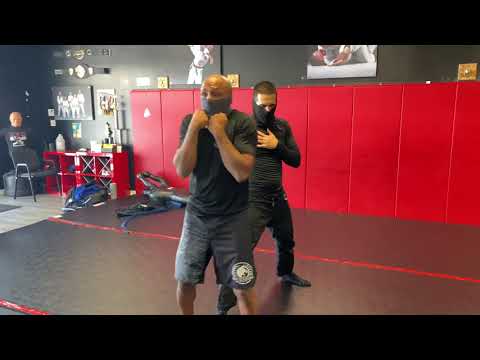
Standing Pull Back Strangle Defense
0
Standard Pull Back·Trillo Jiujitsu Academy·Added by Admin
Trillo Jiujitsu Academy 18400 NW 75 Place #122 Miami, Florida 33015 786-294-0447 trilloacademy.com https://www.facebook.…
Translation: standard pull back
The Standard Pull Back executes the fundamental pull-back defence by shifting the weight to the rear foot while bending the upper body backward from the waist, pulling the chin and head just out of range of the incoming strike. [1] The movement must be minimal — just enough to make the strike miss — so the fighter can quickly shift the weight forward for a counter-attack. [1],[2] The standard pull back keeps the eyes on the opponent and the hands up, allowing the fighter to read the next attack and respond immediately. [2],[3]
The pull back creates distance from incoming strikes by leaning the upper body backward while keeping the feet planted, allowing for immediate counter-attacks as the attacker over-extends. [1] The technique is most effective at the end of the opponent's range, where a small backward lean is sufficient to make the punch miss. [2]
The standard pull-back is the fundamental lean-back defence. [1]
Roy Jones Jr. frequently employed the pull-back as a signature defensive technique during his career, using his extraordinary reflexes to lean away from punches and counter, contributing to his 49 wins across four weight divisions. [1]
No images yet for this technique.
Sign in to suggest an image.
Trillo Jiujitsu Academy 18400 NW 75 Place #122 Miami, Florida 33015 786-294-0447 trilloacademy.com https://www.facebook.…
No instructional courses yet for this technique.
Sign in to suggest a course.
Risk of injury to the person this technique is applied to
Evasion techniques avoid contact entirely; lowest injury risk of all techniques
Skill level needed to execute this technique reliably
Whether this technique is allowed under major competition rule sets
Boxing (Edwin Haislet, 1940)
Alias sources — [1] Championship Fighting (Dempsey, 1950) [2] Boxing Mastery (Hatmaker, 2004) [3] Fighter's Fact Book (Christensen, 2000)
Effectiveness sources — [1] Boxing Mastery (Hatmaker, 2004) [2] Championship Fighting (Dempsey, 1950)
Standard katakana transliteration of Western martial arts terminology (外来語) — used in Japanese MMA, boxing, and BJJ communities
Alias sources — [1] Championship Fighting (Dempsey, 1950) [2] Boxing Mastery (Hatmaker, 2004) [3] Fighter's Fact Book (Christensen, 2000)
Effectiveness sources — [1] Boxing Mastery (Hatmaker, 2004) [2] Championship Fighting (Dempsey, 1950)
neck flexibility, knee bend coordination, visual tracking
shorter stature for easier level changes, strong neck
neck muscles, quadriceps, obliques, calves
Instead of pulling your elbow down, cup your opponent's arm as you step over and drive your hips forward, which gives you better control and positioning for the escape. This hand position prevents them from completing the choke while you work to transition.
Slide your knee in to act as a frame between you and your opponent, which helps you create space and control as you work your escape from the strangle position.
Practice slowly without speed and consider using a blindfold during the drill so you can focus on remembering all the steps correctly, since how you train is how you'll respond in a real situation.
The Standard Pull Back executes the fundamental pull-back defence by shifting the weight to the rear foot while bending the upper body backward from the waist, pulling the chin and head just out of range of the incoming strike. The movement must be minimal — just enough to make the strike miss — so the fighter can quickly shift the weight forward for a counter-attack.
The standard pull back is a fundamental defensive technique in boxing, taught as part of the basic head movement curriculum in boxing gyms worldwide. Counter-punching specialists have relied on the pull back as a primary defensive tool throughout boxing history.
Unified MMA: legal — Legal defensive technique; WBC/Boxing: legal — Legal — blocking and evasion are core boxing skills; WKF: legal — Legal — blocking is a fundamental karate skill; Kyokushin: legal — Legal; WT: legal — Legal; WAKO: legal — Legal; K: legal — 1/GLORY — Legal; IFMA: legal — Legal
Danger rating 1/10. Low — evasion techniques avoid contact entirely; lowest injury risk of all techniques
The standard setup chain: Anticipate the Attack → Execute Defence → Recover Stance → Counter or Disengage.
Standard counters include: Timing — attack when the defence is recovering or between movements / Feint — use deception to create openings in the defensive structure / Angle Change — attack from an unexpected angle that the defence does not cover.
Common variants: Inside slip (moving the head to the inside of the incoming punch); Outside slip (moving the head to the outside of the incoming punch); Bob and weave (ducking under a hook and rising on the other side); Pull-back (leaning the head and torso backward to make the punch fal…).
Roy Jones Jr. frequently employed the pull-back as a signature defensive technique during his career, using his extraordinary reflexes to lean away from punches and counter, contributing to his 49 wins across four weight divisions.
Top errors to watch for: Leaning back from the waist instead of shifting weight to the rear foot — the weight shift is what creates the distance / Over-leaning and losing balance backward — stay within your base; if you can't counter immediately, you've leaned too… / Pulling back against every punch — it only works against straight punches at mid-range / Not returning forward — the pull-back without the counter is just retreating.
The Standard Pull Back is also known as Sutandādo Puru Bakku, Lean Away, Rear Shift, Weight Pull.