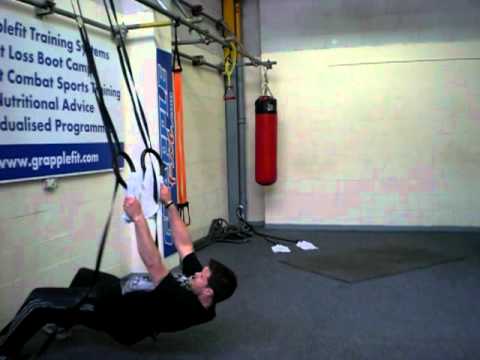
Judo power phase - the pull @ Grapplefit
0
Pull Back·Grapplefit
The pull power complex this time - featuring gi rows, predator band snapdowns, rowing planks with gi sleeve, and the fav…
Translation: pull back
The Pull Back subfamily covers the defensive technique where the fighter leans the upper body backward, pulling the head out of range of an incoming strike by shifting the weight to the rear foot. [1] The pull back is a range-based head movement defence that uses the distance created by leaning backward to make strikes fall short. [1],[2] While effective for avoiding individual strikes, the pull back temporarily compromises balance by shifting the weight rearward, making it important to recover quickly or transition to a counter. [2],[3]
The pull-back leans the upper body backward to let strikes fall short. [1]
The pull-back is a fundamental boxing head movement. [1]
Used in boxing and MMA competition. [1]
No images yet for this technique.
Sign in to suggest an image.
The pull power complex this time - featuring gi rows, predator band snapdowns, rowing planks with gi sleeve, and the fav…
No instructional courses yet for this technique.
Sign in to suggest a course.
Risk of injury to the person this technique is applied to
Evasion techniques avoid contact entirely; lowest injury risk of all techniques
Skill level needed to execute this technique reliably
Whether this technique is allowed under major competition rule sets
Boxing (Edwin Haislet, 1940)
Alias sources — [1] Championship Fighting (Dempsey, 1950) [2] Boxing Mastery (Hatmaker, 2004) [3] Fighter's Fact Book (Christensen, 2000)
Effectiveness sources — [1] Boxing: The Complete Guide to Training and Fitness (Hatmaker, 2004)
Standard katakana transliteration of Western martial arts terminology (外来語) — used in Japanese MMA, boxing, and BJJ communities
Alias sources — [1] Championship Fighting (Dempsey, 1950) [2] Boxing Mastery (Hatmaker, 2004) [3] Fighter's Fact Book (Christensen, 2000)
Effectiveness sources — [1] Boxing: The Complete Guide to Training and Fitness (Hatmaker, 2004)
neck flexibility, knee bend coordination, visual tracking
shorter stature for easier level changes, strong neck
neck muscles, quadriceps, obliques, calves
Every move, in any martial art, shares a few universal traits. Mix and match below to pinpoint the right tool — or compare equivalents across styles.
The Pull Back subfamily covers the defensive technique where the fighter leans the upper body backward, pulling the head out of range of an incoming strike by shifting the weight to the rear foot. The pull back is a range-based head movement defence that uses the distance created by leaning backward to make strikes fall short.
The pull back has been a fundamental boxing defence since the sport's early days, used by counter-punchers who lean back to make punches miss, then snap forward with counter-strikes. Muhammad Ali's leaning pull back became one of the most recognisable defensive moves in boxing history.
Unified MMA: legal — Legal defensive technique; WBC/Boxing: legal — Legal — blocking and evasion are core boxing skills; WKF: legal — Legal — blocking is a fundamental karate skill; Kyokushin: legal — Legal; WT: legal — Legal; WAKO: legal — Legal; K: legal — 1/GLORY — Legal; IFMA: legal — Legal
Danger rating 1/10. Low — evasion techniques avoid contact entirely; lowest injury risk of all techniques
The standard setup chain: Anticipate the Attack → Execute Defence → Recover Stance → Counter or Disengage.
Standard counters include: Timing — attack when the defence is recovering or between movements / Feint — use deception to create openings in the defensive structure / Angle Change — attack from an unexpected angle that the defence does not cover.
Common variants: Inside slip (moving the head to the inside of the incoming punch); Outside slip (moving the head to the outside of the incoming punch); Bob and weave (ducking under a hook and rising on the other side); Pull-back (leaning the head and torso backward to make the punch fal…).
Used in boxing and MMA competition.
Top errors to watch for: Leaning back too far — this compromises your balance and makes it hard to counter quickly / Pulling back with weight on the front foot — the weight must shift to the back foot for the lean to work / Using the pull-back against hooks — hooks curve around the pull-back; this defence is for straight punches / Staying leaned back — the pull-back is momentary; return to centre and counter immediately.
The Pull Back is also known as Puru Bakku, Lean Back, Fadeaway, Pull Counter Position.